
In 1959, physicist Richard Feynman reminded us that there was still “plenty more room at the bottom”, signalling that miniaturisation had a long way to go.
Within a decade, photolithography was producing micro-scale features leading to the first commercial microprocessor (Intel 4004) in 1971 with 10μm feature sizes. Towards the end of the 1970s, electron beam lithography arrived, enabling sub-micron sizes and micromachining for micro-electromechanical systems (MEMS) devices.
Over the next two decades, there were further developments: the Scanning Tunnelling Microscope (STM) arrived in 1981, and 1986 saw the Atomic Force Microscope (AFM) providing atomic-scale analyses. The development of carbon nanotubes came in 1991, followed by quantum dots and a plethora of bio-applications.
Meanwhile, in electronics, the new millennium brought semiconductor nodes down below 100nm, and progress has continued with transistor nodes currently sub-2nm. There has also been a mass of nano-scale sensors developed, with some of the most promising being optical and involving the manipulation of light on the nano-scale. The current trends are in integrating these chips into miniature devices for portability. This endeavour is by no means easy: incorporating many different aspects of science from photonics, materials science (what is it made from?), and packaging (how do you put it together?).
Smart Nano NI: an interdisciplinary ecosystem
These are the themes covered by Smart Nano NI, a Northern Ireland-based consortium of academic and industry partners specialising in the areas of photonics, nanotechnology and smart manufacturing, funded by UK Research and Innovation to the sum of £42.4m under the regional Strength-in-Places funding scheme[1].
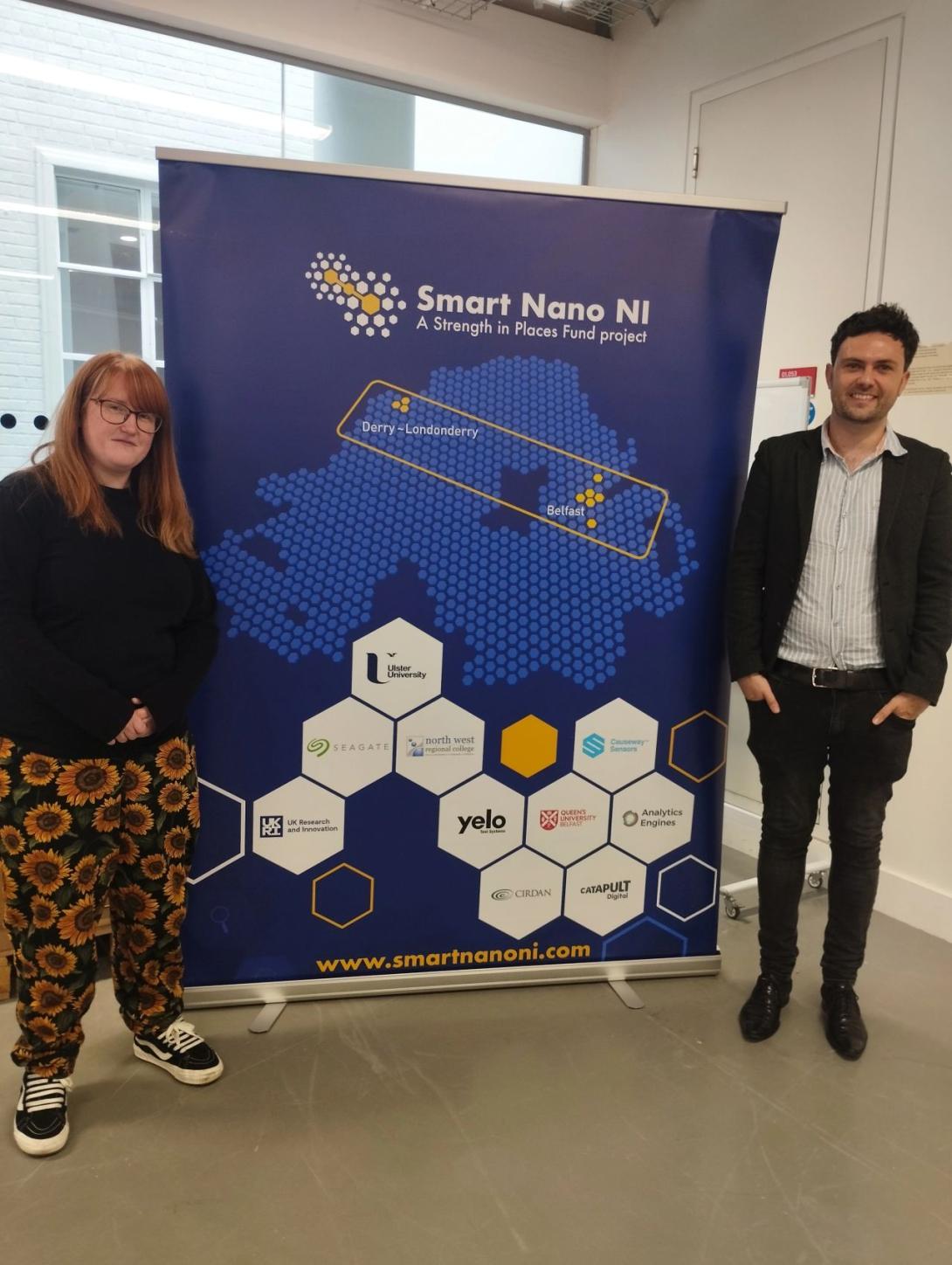
Dr Katie Cavanagh, from Yelo and Smart Nano NI (left) with Dr Mike Hardy (Image: courtesy of Mike Hardy)
The latter focus on the emerging area of smart technologies is increasingly important – incorporating concepts such as AI, machine learning, internet-of-things devices, big data and cyber security.
One of the interesting things about Smart Nano NI is the structure – it’s very flexible, without the rigidity of a typical research project. This enables the most innovative research possible and puts trust in project stakeholders to organise and manage their research endeavours.
We have seen interdisciplinary science innovation hubs in places such as the US, Korea and Japan for a while now, and Smart Nano NI is similar in many ways. The project operates at the mid-to-high Technology Readiness Level (TRL) scale, trying to push fundamental research into working products. These schemes have never been more necessary.
A bright outlook for multidisciplinary science
Despite some global contractions with Covid-19 and world events, sectors such as photonics, nanotechnology, data science and device packaging are still hot areas. We all know about smart technologies by now, and nanotechnology gets a fair amount of coverage, but photonics remains relatively under-appreciated. For instance, how likely is it that a random member of the UK public could tell you what photonics actually is or where light technology is used (or will be used) in everyday life?
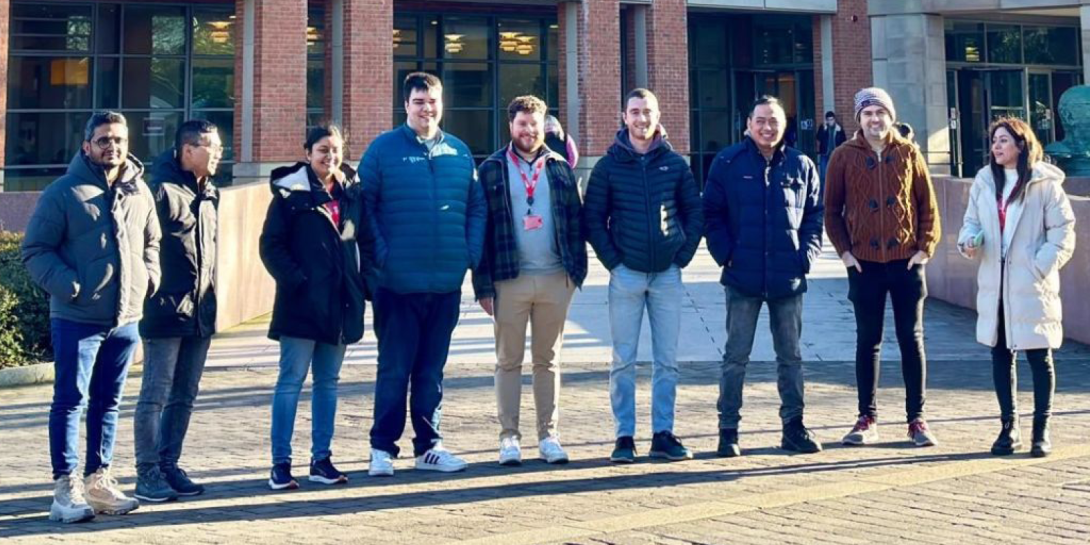
The Smart Nano NI research team at Queen’s University Belfast’s McClay Library
(Image: Dr Yessenia Jauregui-Sánchez)
Despite this, the recent UK Photonics Leadership Group report estimated photonics as underpinning 13% of global innovation[2] and the 2025 Northern Ireland (NI) market report on lasers and photonics suggests that photonics is a key ‘enabling technology’, meaning light tech supports a lot of other innovations (whether we realise it or not)[3].
The portable spectrometer device market has a compound annual growth rate (CAGR) projection of 9% across the current decade[4]. Spectroscopy is a notable photonics application space that we focus heavily on in NI and where the region has a clear advantage in existing expertise and capabilities[5].
This, then, provides useful strategic insight. NI is just a small place, and so doubling down on these areas where we have a head start may be critical for our competitiveness. Perhaps we will be able to broaden this with NI becoming a global hotspot for photonics research.
With projects such as the new Northern Ireland Photonics Innovation Cluster (NI-PIC), which is a group of photonics-interested companies in the region, that is exactly what we are trying to do[6].
This, of course, doesn’t mean NI won’t need to expand and strengthen existing relationships within the wider UK, Ireland and beyond.
One way such relationships can be fostered is through investment in further innovation centres along similar themes.
Following on from Smart Nano NI is another Queen’s University Belfast-led initiative: the Advanced Manufacturing Innovation Centre (AMIC), a smart factory just outside Belfast and part of the Belfast Region City Deal[7]. AMIC will have photonics as a cornerstone area – headed by former Causeway Sensors CEO Antony Murphy, who was listed in the Photonics100 last year.
Interdisciplinary teams and events
All of this means that multiskilled teams need to be assembled and harmonised towards specific goals – and that’s difficult; historically, disciplines such as those mentioned have been disparate. As we say, we actually need to work together more, finding complementary domestic and international partners.
There was a hint of this at the recent UK Semiconductor meeting at Queen’s University in Belfast, instigated by the launch of the UK’s new Semiconductor Centre in London. Whereas the UK is strong in semiconductor packaging and R&D, it was highlighted that other countries have strength in manufacturing and scalability.
Smart Nano NI was also involved in Microelectronics UK in London last year. The event, held at the London Excel Exhibition Centre, was a resounding success and underlined the importance of getting these adjacent groups interacting.
Meanwhile, back in NI, Seagate Technology, which leads the Smart Nano NI project, continues to go from strength to strength, having released its new heat-assisted magnetic recording (HAMR) hard-drives, which use miniature lasers to heat up the magnetic disk for a few nanoseconds to increase storage density.
With the rise of AI, and the storage space that is needed for it, this has never been more important and is a prime example of an application in photonics that the general public knows little about.
This needs to change, and spreading the message of photonics can do that. And so, with that, we’ll all be continuing to ‘look up’ as we store more and more data in the cloud… meaning while there might be less room at the bottom than there used to be, there’s still plenty more room at the top!
Mike Hardy is a Research Fellow on the Smart Nano NI project in the Centre for Quantum Materials and Technologies, School of Mathematics and Physics, Queen’s University Belfast. His background is in Raman spectroscopy and miniature sensing devices.
References
[1] Smart Nano NI [Online] smartnanoni.com
[2] Lincoln J, Lohmann A, & McLeod A. UK Photonics 2025: The hidden economic engine
(UK Photonics Leadership Group) June 2025 [Online] https://photonicsuk.org/
[3] Matrix NI Report: Photonics and Lasers Capability. October 2025 [Online] https://matrixni.org/documents/photonics-and-lasers-capability/
[4] Allied Market Research, Portable Spectrometer Market Size, Share, Competitive Landscape and Trend Analysis Report by Product Type, Distribution Channel and Application: Global Opportunity Analysis and Industry Forecast,
2021-2030 , 2021.
[5] NI-PIC [Online] niphotonics.com
[6] AMIC [Online] we-are-amic.com
[7] NIMSCC [Online] northernirelandmanufacturing.co.uk
This article appeared in UK Photonics Uncovered, which will launch on the Photonics UK stage of Microelectronics UK event on Tues, 29 Sept, 2026. Come say hello to the Electro Optics team at Stand B50.