
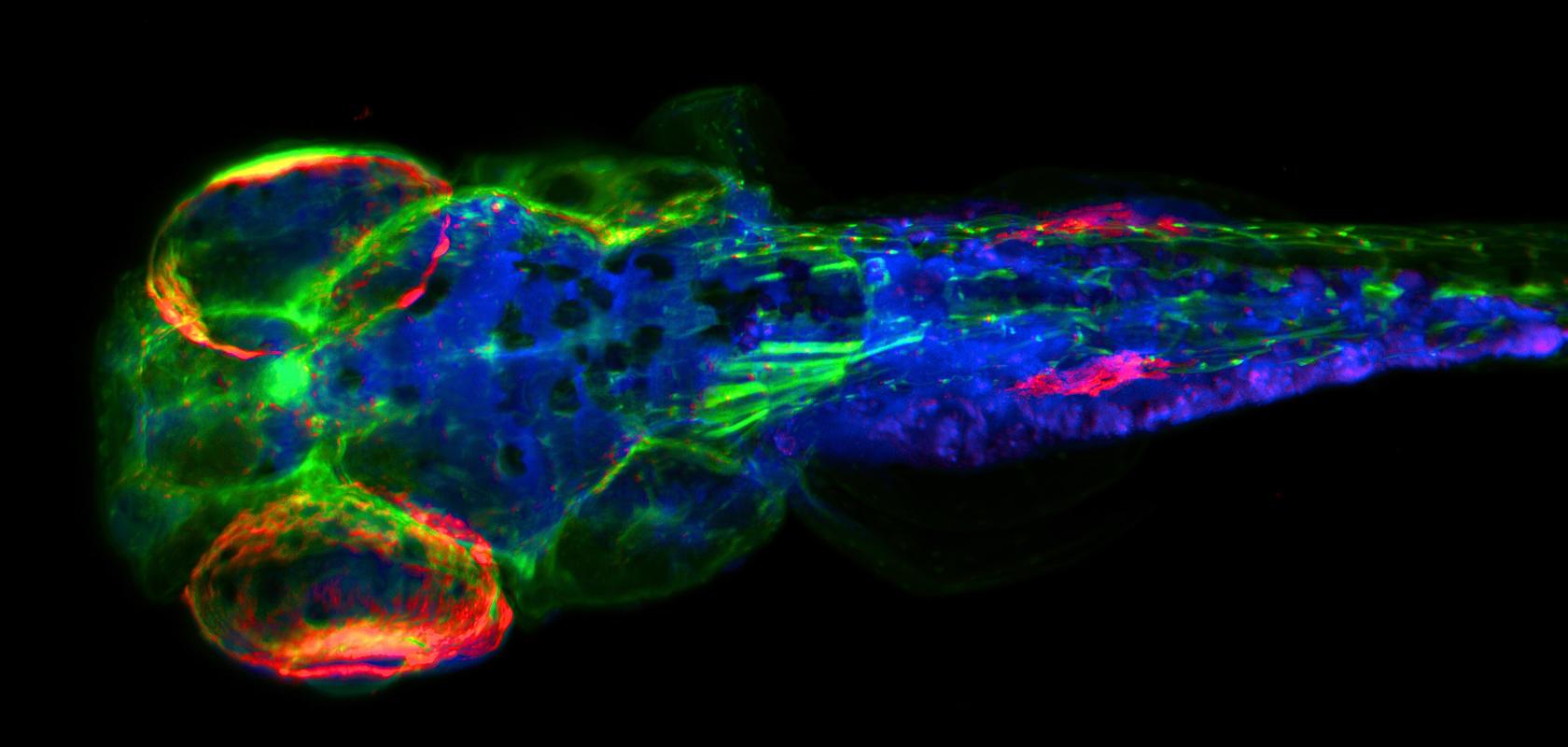
Life science instrumentation demands higher plex multi-colour imaging. Therefore, the technical challenges of crowding the visible spectrum are driving migration into the near-infrared window.
Multi-band optical filters are foundational components within modern imaging systems across the life sciences and analytical instrumentation markets. The biggest advantage of these multi-band systems is operational speed. Specifically, they enable researchers to acquire multiple colours to identify, track, and differentiate specific cellular components or proteins sequentially or simultaneously. However, as the demand for higher multiplexing grows, the industry faces a physical barrier. We are running out of room in the visible spectrum.
Historically, quad-band filter configurations have been the industry standard. In a typical quad-band system, the fourth band often stretches to the edge of the visible spectrum, utilising fluorophores like Cy5 or Alexa Fluor 647. Today, the market trend is moving decisively beyond four channels. Instrument developers and researchers are routinely calling for pentaband and hexaband systems to unlock fifth, sixth, or even seventh colours for deep biological insight.
Squeezing the optical spectrum
This drive for greater multiplicity introduces strict technical trade-offs for filter design. A multi-band filter system doesn’t just contain the nominal four or five channels. A quad-band filter actually requires eight distinct bands (four excitation and four emission bands) that must be strictly isolated from one another.
As more bands are packed into a single system, the spectral real estate available for each channel shrinks. The bands must become narrower, which makes it much more difficult to efficiently excite and detect the target fluorophores.
This crowded environment can exacerbate the issue of spectral overlap. By their chemical nature, the excitation and emission curves of organic dyes are bell-shaped.
While the peak transmission might be perfectly positioned, the wider tails of these curves can bleed into neighbouring channels. Filter manufacturers and researchers can’t alter the fundamental chemistry of these dyes to eliminate the tails. So, the logical solution to escape this bleed-through is to expand the spectral window out to the right, migrating directly into the near-infrared (NIR) region.
Engineering the infrared transition
Designing and manufacturing high-performance optical filters for high-plex NIR imaging can push the limits of thin-film coating technology. To achieve the extreme edge steepness and strict spectral isolation required to prevent crosstalk in dense systems, the dielectric coating layers on the substrate are usually thicker.
This increased coating thickness introduces physical manufacturing complexities. To maintain strict optical flatness tolerances across these thicker surfaces, filter designers must rely on robust substrate materials. Standard fused silica remains the substrate of choice for both dichroic beamsplitters and emission filters; it offers excellent transmission properties across both the visible and NIR ranges, ensuring that expanding into the infrared does not compromise performance in lower channels.
The limits of illumination and the SWIR horizon
As with visible fluorescence, NIR fluorescence requires the correct light source, optical filters, lenses, dyes, and detector. For NIR-I (700-900nm), some standard multi-LED light engines provide the necessary excitation wavelengths. Laser diodes (785nm, 808nm) are also options. The filters, lenses, and dyes are generally available. NIR imaging does require a silicon-based monochrome camera (sCMOS or CCD) because of its extended sensitivity range compared to visible, color cameras.
NIR-II (1000-1700nm, SWIR) has a small presence in the biological fluorescence market. Individual, single-wavelength lasers and LEDs can be integrated into bespoke systems with custom software sequencing when necessary. Standard multi-LED light engines do not yet routinely offer high-power output deep into the NIR. Specialized IR objective lenses and InGaAs cameras would also be required. Currently, SWIR technology remains the domain of non-fluorescent industrial applications, such as machine vision, sorting systems for precision agriculture, and remote sensing for autonomous vehicles.
The future of life science instrumentation
For life science instrumentation, the immediate future is firmly anchored in solving the NIR equation. The hardware capabilities are largely in place, meaning the mainstream adoption of 5-channel and 6-channel systems over the next five years will rely heavily on closer co-design between filter manufacturers and dye developers to ensure new, stable fluorophores match highly precise filter center-wavelengths. While the fact that NIR light is invisible to the human eye presents an adoption hurdle for labs accustomed to visual confirmation, the raw analytical power of adding extra channels makes the transition inevitable.
None of this requires reinventing the instrument. The detectors and substrates are already capable, which means the next few years of progress rest less on new hardware than on closer collaboration between filter and dye developers. As stable fluorophores arrive to match precise filter centre-wavelengths, five and six-channel imaging in the near-infrared will move from specialist setups into routine practice. The visible spectrum is full. The room to grow is just to the right of it.
Roy Kinoshita, Ph.D. is Account Manager for Microscopy at Chroma Technology