
The Importance of Precision Automation – Advances in Direct-Ink Writing
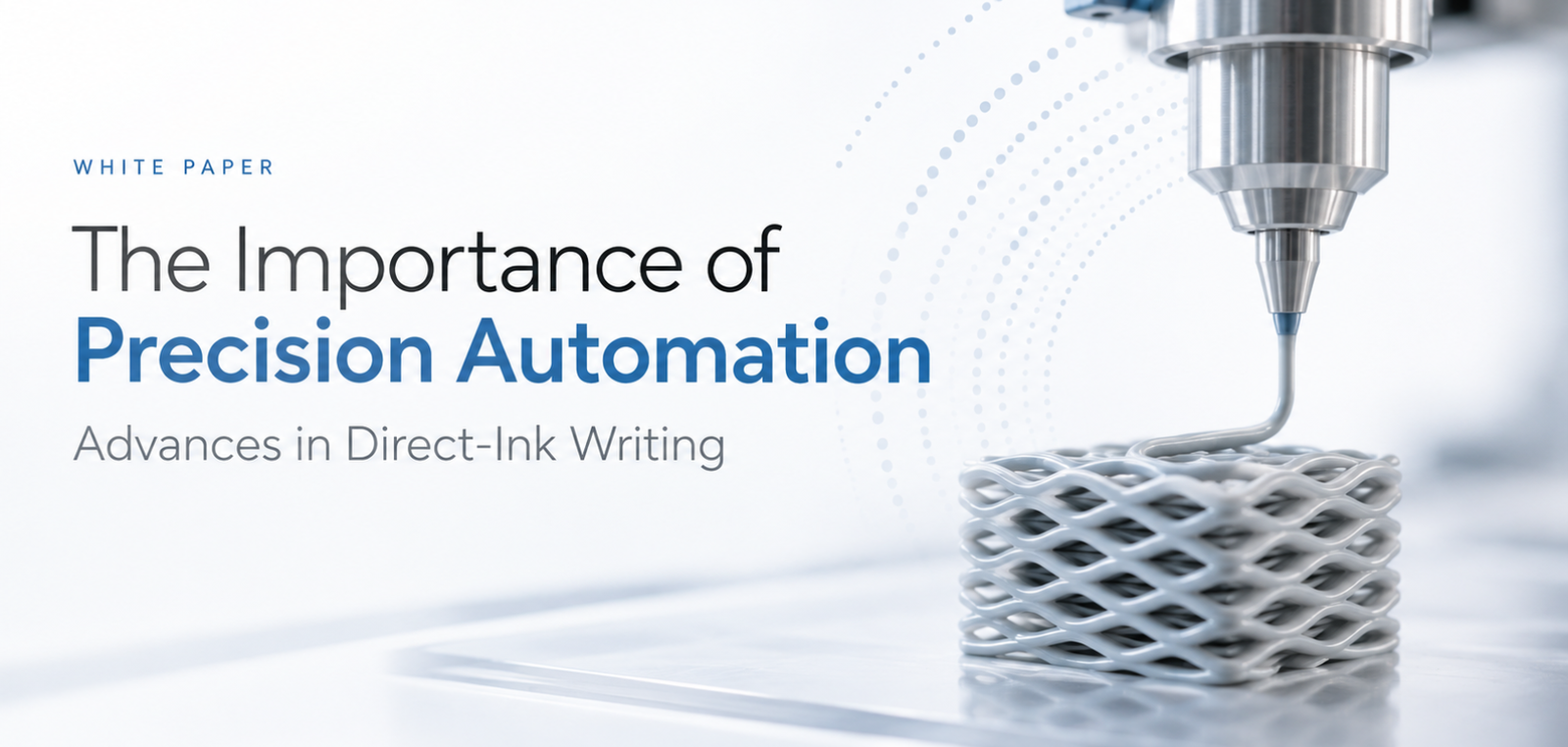
Discover how precision motion control and integrated automation are helping manufacturers overcome production challenges and scale direct-ink writing from laboratory prototypes to high-volume manufacturing.
From prototype to production: Overcoming the precision challenges of direct-ink writing
Higher throughput. Tighter tolerances. Fewer defects. How can manufacturers scale direct-ink writing without sacrificing quality?
Direct-ink writing (DIW) offers significant potential for producing complex geometries and high-precision components that conventional manufacturing methods struggle to achieve. But while the technology has proven successful in laboratory environments, scaling it for industrial production presents a new set of challenges.
As production volumes increase and feature sizes shrink, manufacturers must contend with motion inaccuracies, inconsistent material deposition, mechanical drift and increasingly demanding throughput requirements. Without precise coordination between motion control and fluid dispensing, these challenges can lead to costly defects, reduced yields and unreliable production.
So how can manufacturers bridge the gap between laboratory innovation and commercial-scale production?
In this white paper, The Importance of Precision Automation: Advances in Direct-Ink Writing, Aerotech explores how advanced motion control, integrated automation platforms and real-time process synchronisation can help manufacturers overcome the technical barriers to industrial-scale DIW.
Download the white paper to discover:
- How to scale direct-ink writing without compromising precision: Understand the challenges of moving from laboratory prototypes to repeatable, high-throughput manufacturing processes.
- Why motion control is critical to print quality: Explore how precise multi-axis synchronisation can minimise deposition inconsistencies, geometric defects and positioning errors.
- How to improve production yield and repeatability: Discover how integrated motion platforms and real-time feedback can help manufacturers maintain consistent quality while increasing throughput.
- The advantages of Position Synchronized Output (PSO): Learn how synchronising material dispensing with actual stage position can reduce material pooling and compensate for changes in operating conditions.
- How integrated automation simplifies production scaling: Explore the benefits of combining precision motion stages, high-performance drives, fluid controls and sensors into a unified manufacturing platform.
Turn precision manufacturing challenges into production opportunities
Whether you're developing advanced ceramics, printed electronics, biomedical components or other high-precision additive manufacturing applications, successfully scaling DIW requires more than optimising material formulations.
Discover how the right automation architecture can help reduce manufacturing risks, improve process reliability and support the transition from research and development to commercial production.
Download the free white paper today to explore the technologies and engineering approaches helping advance direct-ink writing towards industrial-scale manufacturing.