
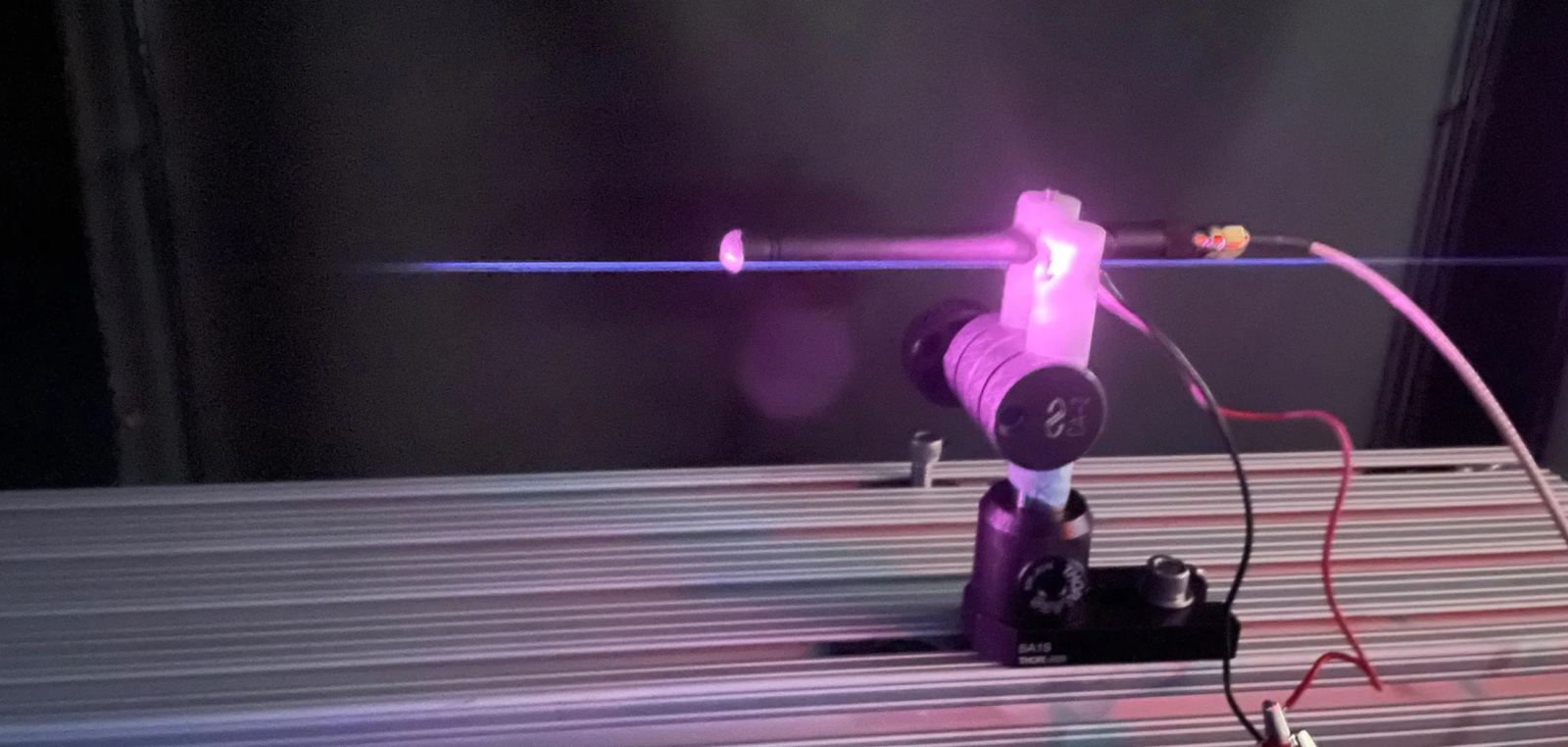
A laser-generated tunable plasma beam that, according to developers at NC State University, resembles a lightsaber, could allow wireless radio systems to change the size and direction of their antenna, without the need for complex engineering to move mechanical components.
A laser-induced plasma antenna, capable of transmitting radio waves at 30MHz, has been demonstrated by developers at North Carolina State University (NC State), establishing a proof-of-concept for antennas with optically controlled length and orientation, rather than the use of mechanical structures.
The experimental device uses a laser to ionise air, creating a narrow plasma filament that acts as the transmitting element. The research team at NC State says the approach could offer an alternative to conventional metal antennas in applications that require adjustable radio frequencies or directional control, such as satellite communications, radar and space exploration.
"The plasma beam antenna looks like a lightsaber and is tunable, meaning we should be able to transmit across a broad range of frequencies," says Prya Darshni, a corresponding author and PhD student at NC State.
Laser-generated plasma transmits radio signals
Conventional antennas rely on their physical dimensions to determine their operating characteristics. Their length, in particular, influences the radio frequencies they can efficiently transmit or receive. But adjusting an antenna for different frequencies or directions can require mechanical components, which can be a challenge for systems where weight, size or reliability are important.
Often described as the fourth state of matter, plasma contains free charged particles that interact with electromagnetic fields. By controlling the power and beam diameter of the laser, the NC State researchers found they could ionise air molecules to form a concentrated channel of charged particles, known as a plasma filament. However, in the demonstrated system, generating the filament is only part of the process. The plasma must also be coupled to an electrical signal to transmit radio waves.
To address the problem, the researchers used a contactless antenna feed. A metal ring acts as a capacitor, storing electrical energy in an electric field. The laser then passes through the centre of the ring to produce a plasma filament within the surrounding electromagnetic field. When a radio-frequency generator supplies a signal to the capacitor, the resulting field interacts with the filament, enabling it to radiate radio waves at the supplied frequency. The demonstrated transmission was at 30MHz, within the very high frequency (VHF) radio band.
"One of the questions we wanted to explore with this work was whether it would be possible to create plasma antennas using lasers, which would allow us to generate antennas at whatever length was needed," says Darshni. "And we have now shown that it is possible.”
The ability to control the characteristics of the plasma filament is “valuable for applications where you need an antenna that can sweep all frequencies. But there’s another benefit as well,” said Darshni. “It’s also important to control the angle of the antenna, to target the direction of radar sweeps or improve the strength of a signal you want to pick up.”
Satellite systems and space exploration are among the potential applications identified by the researchers. Spacecraft designers must minimise payload mass and volume and, while conventional antennas can require deployment mechanisms to extend structures after launch, a laser-generated plasma antenna could provide an alternative. Another operating environment where laser plasma antennas could have an impact is in low-Earth orbit, where there is sufficient air to form a plasma.
According to the NC State, the technology remains at an early experimental stage, and performance under operational space conditions has yet to be established. "This is the first step,” said Darsnhi, “but it is a big step. It is the first time anyone has ever demonstrated that plasma-filament antennas can work. Now that we've shown it is possible, we can begin improving its performance.”