When people ask me what makes the Scottish photonics landscape unique, I often start with the simple facts and figures: we are a country of roughly five-and-a-half million people, yet our photonics cluster generates well in excess of £1.5bn in annual turnover, employing approximately 7,200 people in high-value jobs, and exporting more than 95% of what is produced outside Scotland.
From deep-space optical communications and life-saving medical imaging to the foundational hardware powering global quantum networks, Scotland’s photonic technologies are woven into the fabric of the modern world.
But our true strength isn’t just our track record; it is how we are aligning photonics at the very centre of the UK’s broader innovation ecosystem.
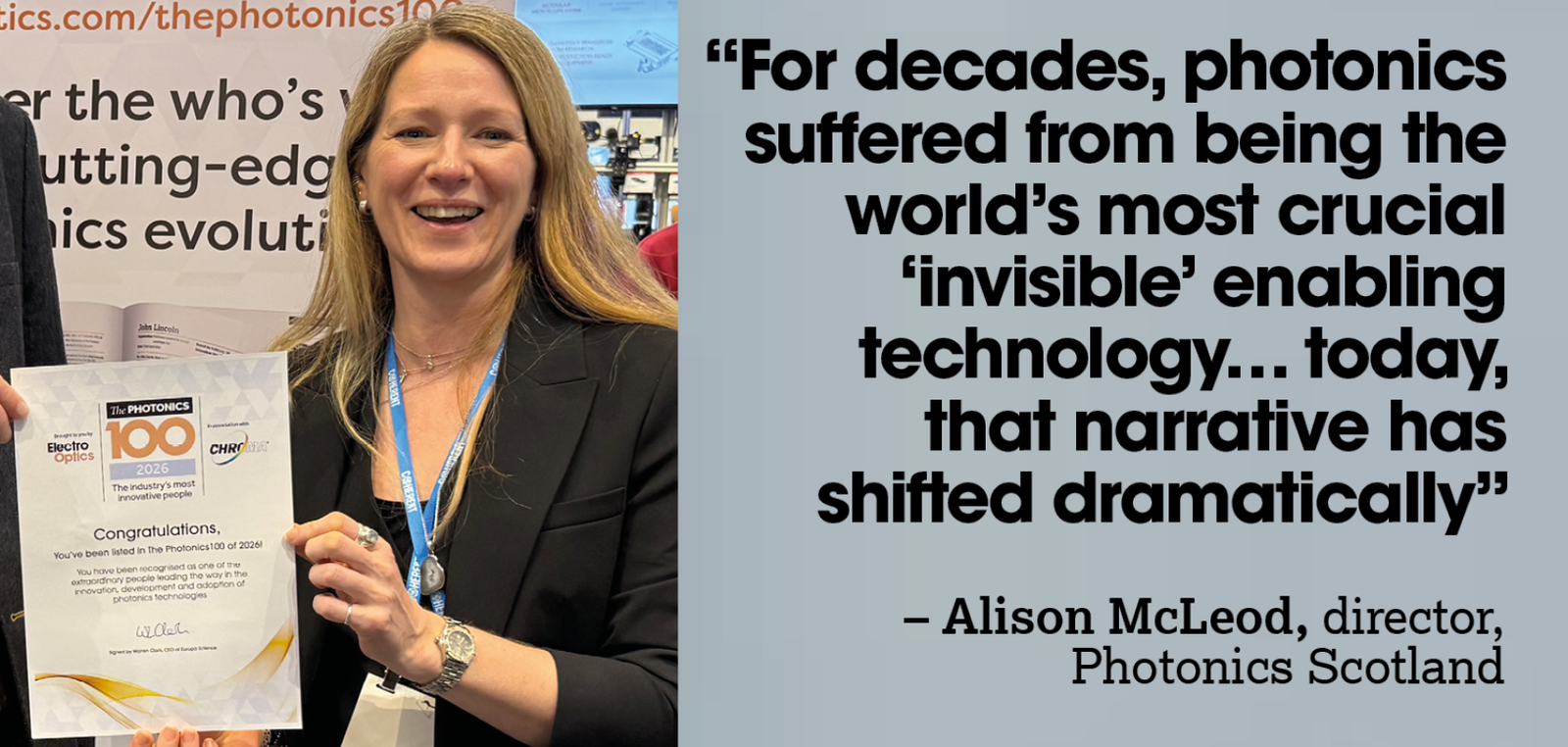
For decades, photonics has suffered from being the world’s most crucial ‘invisible’ enabling technology. We built the lasers, detectors and optical components that made other industries look revolutionary.
Today, that narrative has shifted dramatically. Photonics is now rightly being recognised by governments and industry leaders as a non-negotiable strategic pillar. Nowhere is this clearer than in Scotland’s Critical Technologies Supercluster. By linking our world-class photonics base with quantum technologies, semiconductors, and advanced sensing, we have created an integrated cluster targeting £10bn in revenue by 2035.
Quantum technologies provide the perfect example. You cannot have a quantum clock, a cold-atom quantum sensor, or a photonic quantum computer without incredibly stable, precise lasers and single-photon detection systems. Through close collaboration between academic powerhouses such as the universities of Strathclyde, Glasgow, Heriot-Watt, and St Andrews, alongside industry pioneers – from agile spin-outs to global giants, Scotland forms a vital piece of the hardware engine for the UK’s £2.5bn National Quantum Strategy.
Collaboration by design
A vibrant ecosystem doesn’t just happen by accident; it requires conscious cultivation. At Technology Scotland, my focus with the Photonics Scotland network is to ensure that our community isn’t just surviving, but actively championing
cross-collaboration.
Through initiatives such as Opening Up Photonics, we are actively tackling systemic industry challenges; broadening access, fostering diversity and building inclusive pipelines to retain and attract top-tier talent. As chip architectures shift toward optical interconnects to solve AI’s immense energy demands, and as sovereign defence relies increasingly on optical countermeasures and lidar, having a diverse, highly agile talent pool in Scotland isn’t just
a local advantage – it’s a national capability.
Of course, maintaining leadership requires tackling our bottlenecks head-on. As an ecosystem, our next big frontier is commercial scale-up. While our research and spin-out capabilities are second to none, we are focused on streamlining domestic supply-chain absorption and helping high-growth companies bridge the gap from pilot manufacturing to mass production within the UK.
The UK innovation landscape is at a pivotal moment. As energy limits computing demands, and global security challenges converge, light-based technologies offer the solutions we urgently need.
Alison McLeod is director of Photonics Scotland.
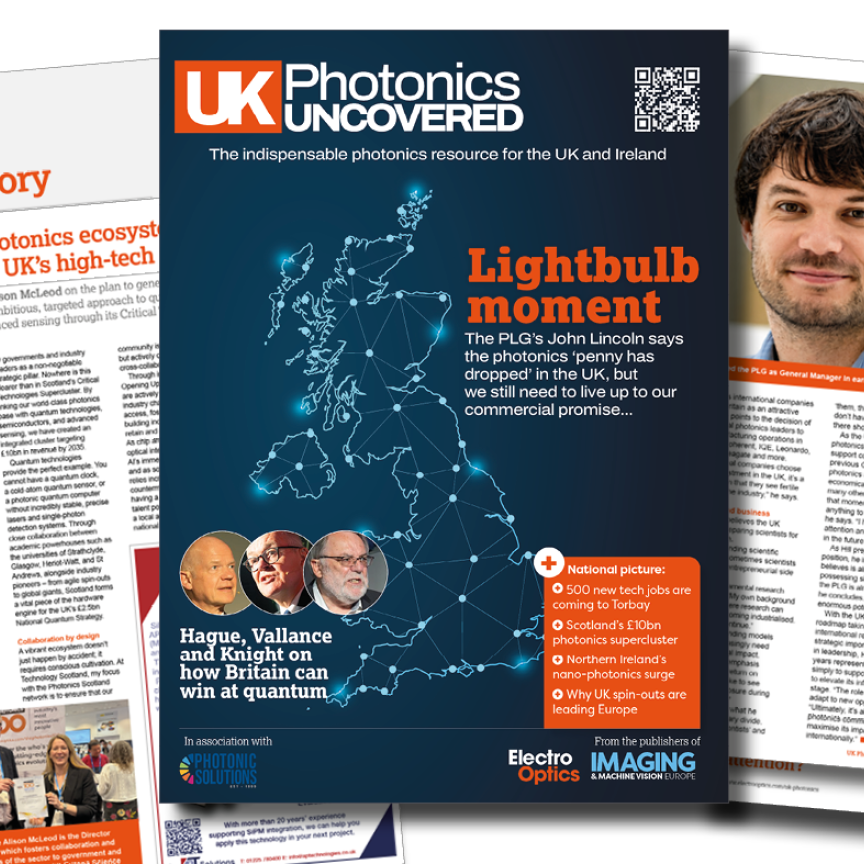
This article appeared in UK Photonics Uncovered, which will launch on the Photonics UK stage of Microelectronics UK event on Tues, 29 Sept, 2026. Come say hello to the Electro Optics team at Stand B50.