In a corner of Paignton in Torbay, better known – historically – for seaside tourism than semiconductors, a quiet technological revolution is gathering pace. At the centre of it sits the Electronics and Photonics Innovation Centre (EPIC), a facility that has quickly become one of the most important engines of high-tech growth in the South-West.
Since opening in 2019, the centre has brought together cutting-edge companies working in fields ranging from photonics and quantum computing, to aerospace supply chains and advanced manufacturing. Now, according to director Richard Scutt, the next phase is about something bigger: expansion, opportunity and creating a new generation of skilled jobs in Torbay.
“EPIC is completely full, the businesses here are growing quickly, and we’ve got a waiting list of companies wanting to move in,” he says. “The challenge now is making sure we have the space for them to stay and scale here in Torbay, rather than moving elsewhere.”
EPIC has 25,000 square feet of lettable space, and comprises 27 offices, 13 dry labs, cleanroom, and a £3m prototyping suite. It currently supports15 businesses, employing more than 250 people.
Work is under way on a new facility, which is just a stone’s throw away, that will provide about 19,000 sq ft of additional workspace. The building will be refurbished and fitted with specialist facilities such as a clean room and laboratory space before opening in Spring 2027.
“We have had amazing support from Torbay Council to procure this new space, which will be named Torbay Technology Park,” Scutt tells us, “and we have already purchased land for a third site for around 40,000 sq ft of additional space.”
If realised, the combined footprint would approach 100,000 sq ft – comparable to a small science park and a significant milestone for the area’s growing tech sector.
The growth of EPIC is closely tied to the wider Torbay Hi-Tech Cluster, a network of innovative companies that emerged from the region’s rich engineering heritage.
Many of today’s businesses trace their roots back to STC (Nortel) and SIFAM (JDSU), which have been around since the 1950s. At the peak of the first telecommunications boom, more than 7,000 people were employed across this industry around Torbay.
In the 1990s, Nortel, based in Paignton, was the second largest photonics manufacturer in the world and the world’s largest tantalum capacitor manufacturer.
When the dot-com market crash happened in the early 2000s, a generation of highly skilled engineers remained in the area after those businesses faltered. Some of them launched their own ventures, others joined start-ups, and gradually a cluster of photonics, electronics and technology companies began to form.
Global players joined the start-ups
Today, these businesses are developing everything from advanced sensors and communications systems to technology used in defence, aerospace and data infrastructure. Global businesses such as Keysight (formerly Spirent), Coherent, G&H (Gooch and Housego) have manufacturing and R&D premises in Torbay, thanks to that skilled workforce that remained in the area.
Research carried out with businesses based within Torbay Hi-Tech Cluster now suggest the sector could generate more than 500 new jobs over the next five years.
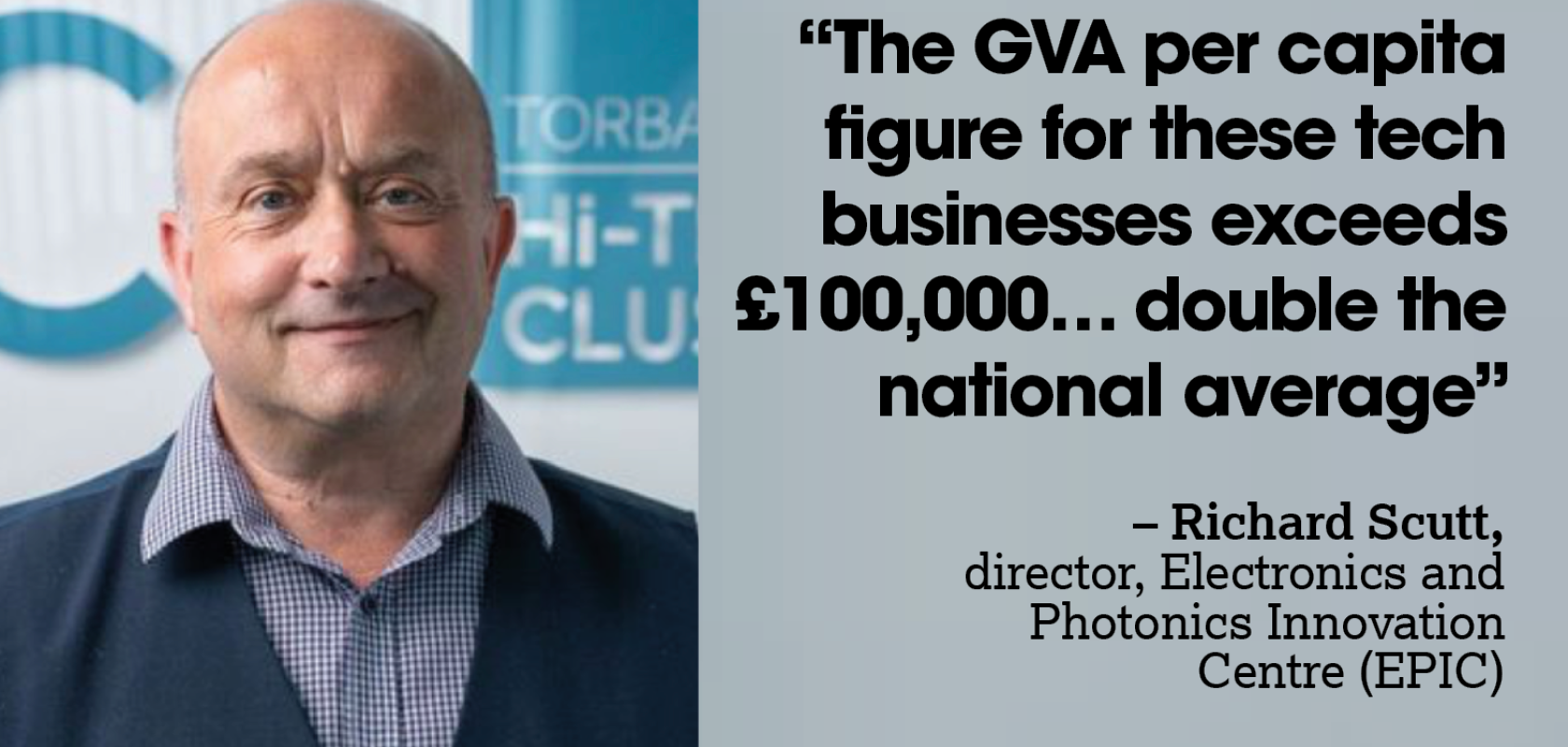
“For Torbay, that’s huge,” Scutt says. “These are high-value jobs in a sector where productivity is extremely strong. The GVA per capita figure for these tech businesses exceeds £100,000, which is double the national average and three times the regional average. That’s a massive contribution to the local economy.”
Yet despite the progress to date and the promise ahead, he believes the sector still faces a fundamental challenge: talent, or the lack thereof. “One of the biggest issues businesses face is skills,” he says. “We’ve got a lot of people in the industry who came through the high-tech industry era and are now in their 50s or 60s. There’s been a gap where the next generation hasn’t come through in the same numbers.”
Addressing that gap has become a central part of the cluster’s mission – and the approach starts much earlier than many might expect. Rather than focusing only on university graduates, the centre is now working with schools across Torbay to spark interest in science, engineering and technology from a young age.
One of the first examples of that approach is a partnership with White Rock Primary School, a few hundred metres away, whose students visit the centre to learn about the technology being developed close to their classrooms. Visits are supported by a new 16-page booklet created by Caroline Field, a Bay Photonics employee based at EPIC, who designed the project to help explain complex technology to younger audiences.
The idea is simple: take the innovations happening inside the centre and translate them into language that children can understand. “It’s about showing them real-world examples,” Scutt explains. “If they’re learning about light or electricity at school, we can show them there are companies nearby using those exact principles to develop advanced technologies.”
That connection between classroom theory and real-world innovation is something EPIC and the Torbay Hi-Tech Cluster hopes to embed more deeply in local education.
By working with teachers and curriculum planners, the cluster wants to ensure that topics such as photonics, environmental sensing and advanced manufacturing are linked directly to businesses operating locally. “For example, if students are studying greenhouse gases in geography, they could look at local companies here that are developing innovative technology to detect methane emissions,” he says.
Entrepreneurship and start-up programmes with coworking space provided are also forming that support the next generation of entrepreneurs at EPIC.
The cluster is also working closely with the likes of South Devon College, Exeter University, and Plymouth University, which are offering tech courses, qualifications, collaborations and programmes.
Scutt sums it up nicely when he described how these companies were ‘solving the world’s most complex problems’ – and right from the heart of Torbay: “This is the strapline of Torbay Hi-Tech Cluster, and long may these innovative tech businesses in Torbay continue to grow!”
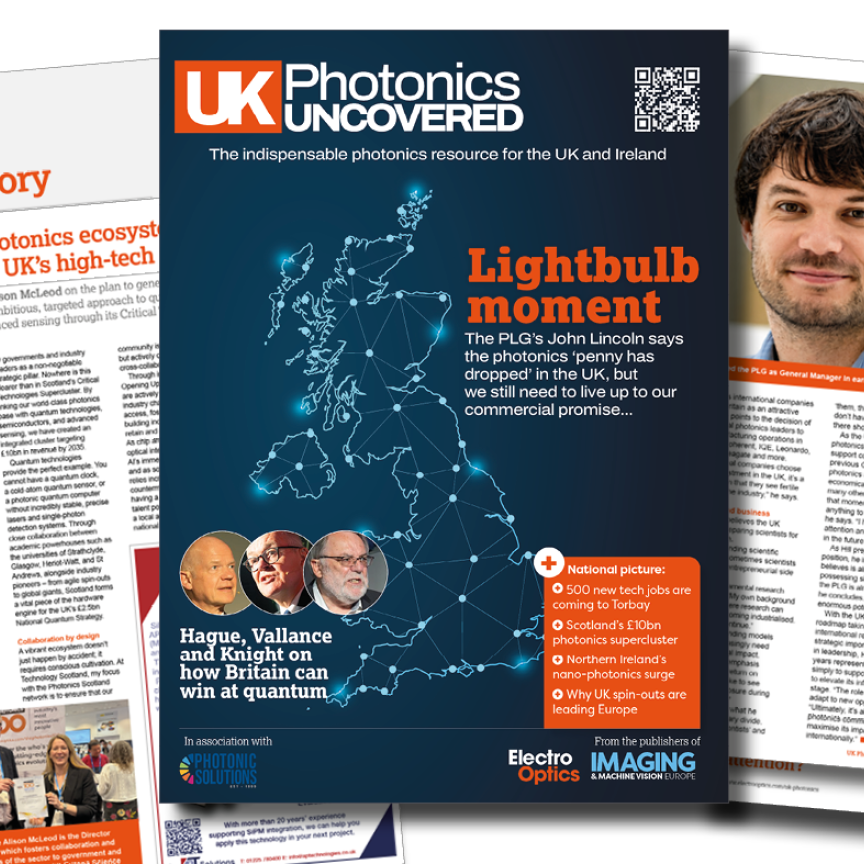
This article appeared in UK Photonics Uncovered, which will launch on the Photonics UK stage of Microelectronics UK event on Tues, 29 Sept, 2026. Come say hello to the Electro Optics team at Stand B50.