Diffraction gratings: Mastering precision optics from prototype to production
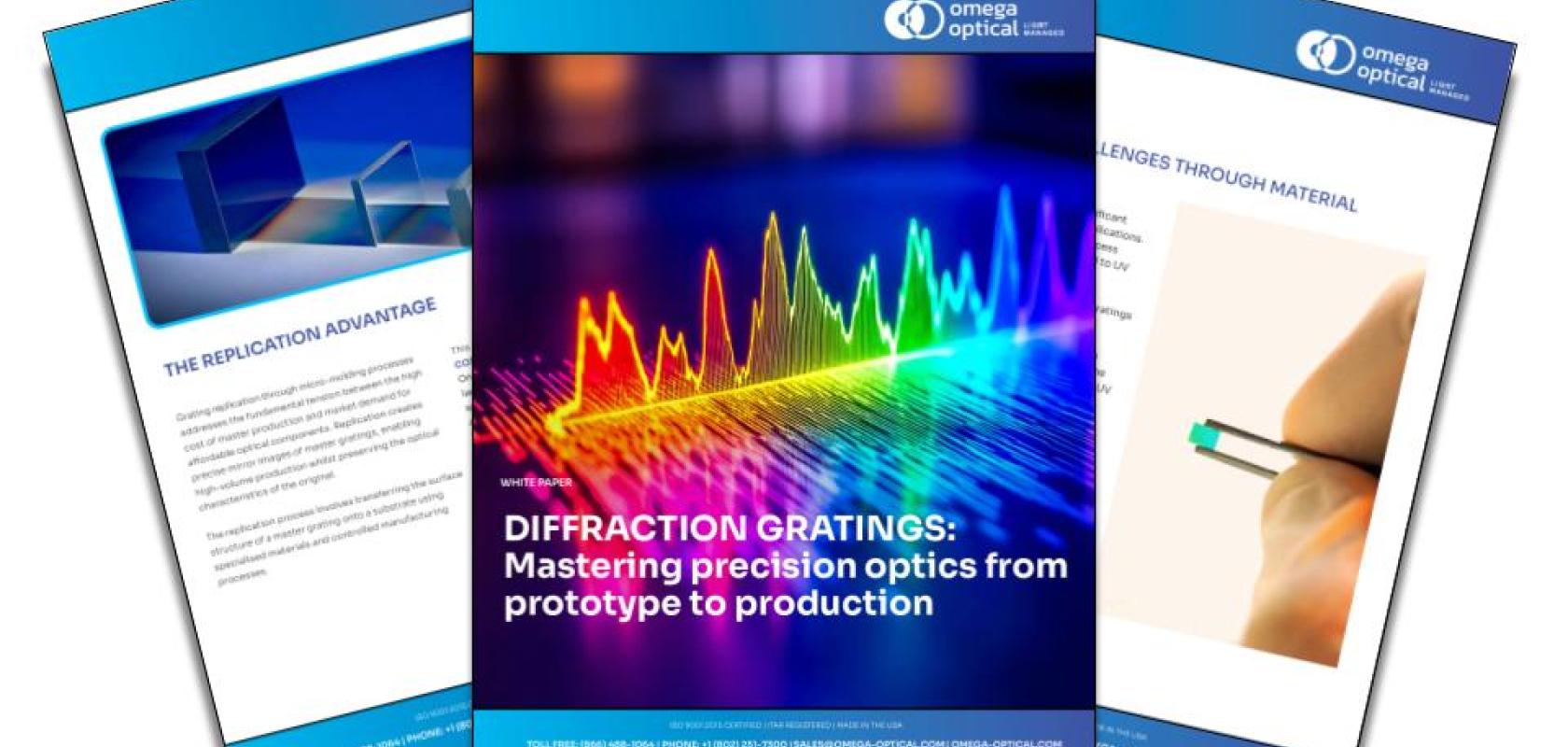
Diffraction gratings: Mastering precision optics from prototype to production - An Omega Optical White Paper
This White Paper from Omega Optical provides a complete technical framework to navigate the grating production lifecycle, evaluate master-to-replication trade-offs, and leverage established master libraries to eliminate custom engineering costs
What is a diffraction grating and how does it enable high-performance spectroscopy?
A diffraction grating is a high-precision optical component containing a periodic structure that splits and diffracts light into several beams travelling in different directions. By transforming complex optical signals into measurable, interpretable data, diffraction gratings serve as the critical hardware foundation for spectroscopic analysis across scientific research, industrial quality control, and telecommunications. Common applications include handheld spectrometers, pharmaceutical analysis, aerospace laser systems, and inline coating thickness monitoring in semiconductor manufacturing.
However, high fabrication costs and steep technological barriers mean that master grating production remains concentrated within a select handful of global manufacturers. This White Paper from Omega Optical provides a complete technical framework to navigate the grating production lifecycle, evaluate master-to-replication trade-offs, and leverage established master libraries to eliminate custom engineering costs.
Frequently asked questions about diffraction grating manufacturing
Who should read this technical White Paper?
This resource is engineered specifically for optical procurement specialists and engineering professionals, including:
- Optical system designers evaluating grating integration strategies for spectroscopic instruments.
- OEM manufacturers developing inline quality control systems or handheld spectrometers.
- Spectroscopy researchers requiring custom or standard optical grating specifications.
- Technical procurement specialists assessing long-term manufacturing supplier capabilities.
- Optical engineers balancing the trade-offs between master fabrication timelines and cost-effective replication.
What are the primary master grating production methods?
Master gratings are fabricated using two distinct engineering methodologies, each presenting specific manufacturing trade-offs:
- Ruled gratings: Produced via mechanical ruling engines. This method achieves sub-micron accuracy over millions of individual physical scribing operations, creating highly precise blaze profiles.
- Holographic masters: Created using interference fringe patterns from laser recording. While this method offers superior production speed and eliminates ghosting artifacts, holographic masters present inherent structural fragility trade-offs.
What is the replication advantage in optical manufacturing?
The replication advantage is an industrial micro-molding process that replicates an expensive, high-precision master grating onto cost-effective substrates. This manufacturing workflow transforms low-volume master production into repeatable, high-volume manufacturing while preserving original optical characteristics and introducing material flexibility for high-throughput scaling.
How do deep UV material innovations prevent grating degradation?
Next-generation replication materials extend the operational range of optical components from 300nm down to 200nm. This deep ultraviolet (UV) material innovation solves the industry problem of "yellowing" degradation % a common solarisation issue caused by prolonged UV exposure % thereby enabling new automated manufacturing applications such as mobile device coating verification.
How do master grating libraries reduce project non-recurring engineering costs?
Leveraging a supplier's existing library of master gratings removes the requirement for custom tool fabrication. Using an established master asset slashes development timelines, eliminates custom fabrication bottlenecks, and removes prohibitive non-recurring engineering (NRE) charges.
Why is early supplier engagement critical for optical system optimisation?
Engaging an optical component supplier early in the design phase % rather than late in the prototyping stage % uncovers system-level optimisation opportunities that are invisible when a diffraction grating is specified in isolation. Early collaboration prevents expensive, retroactive re-engineering and ensures rapid implementation at a lower total cost.
Why this technical framework matters for your engineering timelines
Selecting an optical component vendor involves evaluating system-level integration rather than individual part specifications. Access to comprehensive tooling libraries and single-source manufacturing capabilities determines whether an instrument moves rapidly to market or stalls in development.
Download this resource to understand the technical foundations of grating replication, streamline your procurement workflow, and accelerate your optical system from design to volume production.