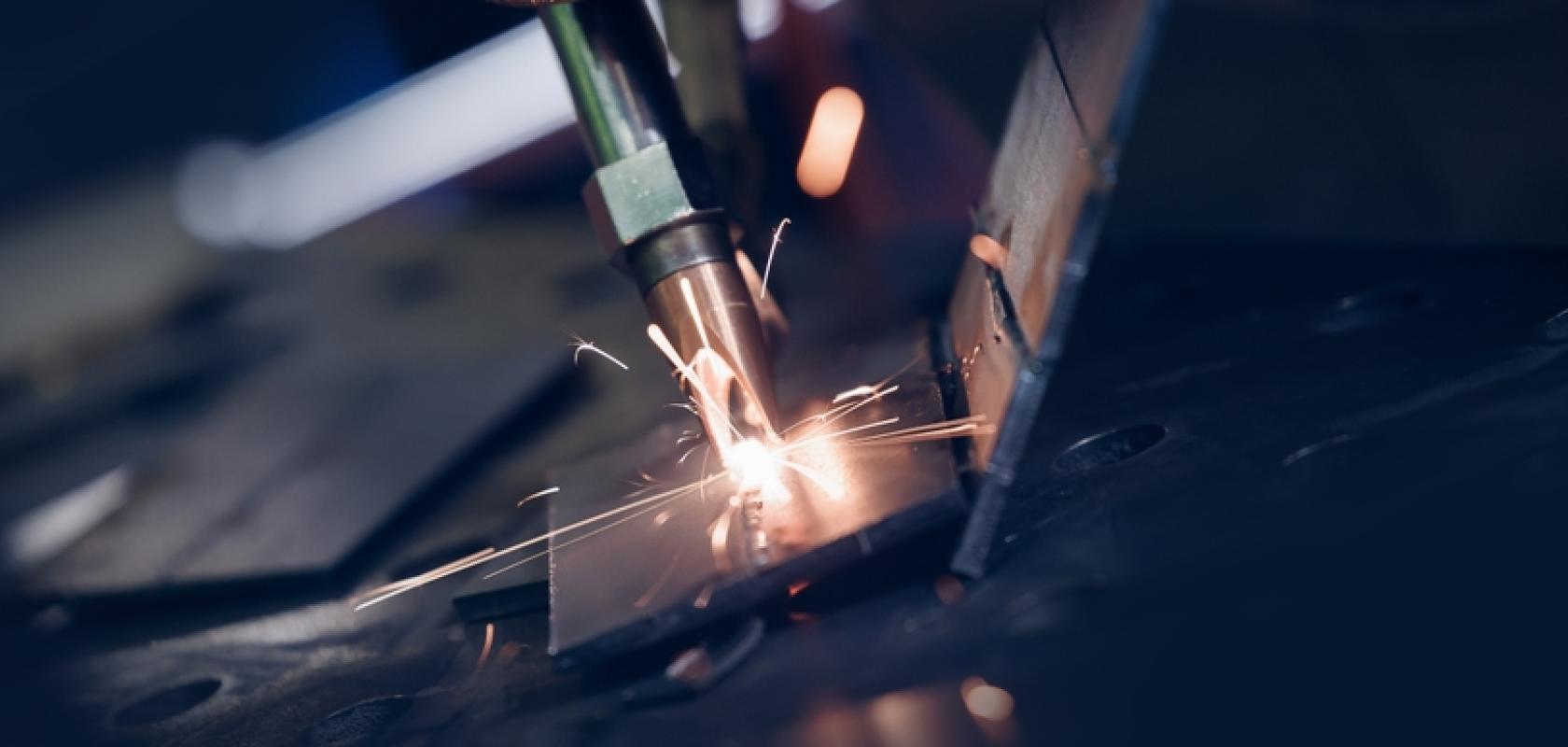
Traditional welding companies and individual professionals working in the space face challenges when it comes to maintaining safety with increasingly powerful handheld laser tools. As laser safety companies continue to develop and evolve their products, end users must navigate the market to find the right tools for their needs and applications. Therefore, increased guidance around the risks to consider with handheld lasers, and how to mitigate them, remains in high demand.
Our online panel discussion – featuring experts from Kentek, the Handheld Laser Institute and Miller Electric – explored the barriers and knowledge gaps that welders currently face, what to consider when ensuring the safe application of handheld lasers, and how to put the evolving laser safety market to the best use possible.
Major misconceptions
The panel session began with the most common misconceptions that tend to arise in welding environments, when it comes to handheld laser safety.
David Lawton, Market Development Manager at Kentek, said: “The interesting thing is the general move in laser safety over the past few years is to the – and I affectionately call it – the ‘put-it-in-the-box’ school of laser safety. So, wherever you can, contain the beam, lock it in behind interlocks, lock it in behind containment, and classify the system as low as possible; so it’s the ALARP (As Low As Reasonably Possible) approach to safety. The problem you have with handheld laser safety is that it is literally held in someone's hand, and it can't be anything else. And so, as a result, it can never be anything other than a Class 4 laser. So, that's the biggest single challenge. Instead of having a few watts in a university laboratory, you've got a few kilowatts in your hand. It's designed to process materials, to melt material, and it's literally like a gun. It's almost like Star Wars! That's the biggest single challenge – there's no way we can mitigate the risks. The risks come in training, risk assessment, and local rules.
“I’m not sure users understand the power of what they’re being asked to do, because the handheld laser welding generation has taken lasers into what has been hitherto a market they've never known about. Up to now, it would be high-value, high-precision manufacturing. Now, with handheld laserwelders, they're being found in job and manpower shops. Traditional welders have got a great deal of experience of the hazards and dangers around conventional welding. Complacency doesn't quite sum it up, but they believe that if they can handle the challenges, the hazards, and the risk challenges with conventional welding, then laser welding's just on top of that. But it's a whole new set of unexpected risks and hazards that they've just not been used to and are not ready for.”
Building on this, Rex Alexandre, President, Principal Engineer at The Handheld Laser Safety Institute, added: “I think there's a spectrum in terms of how people are approaching handheld laser safety. When I first started doing handheld laser welding, as David mentioned, the typical approach is to keep things in a box, and so all my background in laser processing was having it in a box with a robot or a CNC machine. When I got my first handheld laser, all my friends told me that this is the worst idea ever, and that I was going to go blind! At the beginning, I agreed with them… it was terrifying. As I became more familiar with operating the equipment and the proper PPE and procedures, I became less worried about it. Now, the flip side of that is I also know a lot of people that have no idea about laser safety with handheld welding systems, because there's not very much information out there. You get people who are very, very cautious about it, then you get people who are very, very flippant and don't understand it at all because of the lack of knowledge."
David Werba, Manager, Product Design Compliance and Senior Electrical Engineer at Miller Electric, said: “Another misconception that we see in the field is that most people using the equipment are not even aware of the intense power that these lasers need to emit, obviously, for melting metal, and for welding or cleaning. Another misconception is they don't think the laser beam is hazardous because it's invisible. And what they do see is the guide laser, for example, just like your laser pointer, and that gives them the misconception that it's not a dangerous or hazardous operation to perform.”
Knowledge gaps
Werba went on to explain where knowledge gaps and blind spots commonly arise among traditional welding companies: “What we're seeing is a massive proliferation of the use of these products, which led to a lag in adequate safety information and training for the users. Also, people using the standard arc welding processes are already aware of the necessary precautions, around issues such as electricity, fumes and gases, fire explosion, and burns, but they tend to believe that there are no additional laser beam hazards, and that's where the real training needs to come into play.”
When it comes to characterising laser safety processes, it depends on a number of factors, according to Lawton: “If the company falls on the side of a ‘safer’ company, if that's the right way to put it, then they will typically do a little bit of research before they actually even purchase the device. However, let’s go back to the comment that handheld laser welding's taken what was traditionally a high-precision, high-value research and development type product into the general fabrication market. They see it at a show, they buy it, and then worry about it after, because to them, they see the word ‘welding’, and they think, ‘we know welding’, and that's it. To them, it's just that the laser is different. You have TIG (Tungsten Inert Gas), you have MIG (Metal Inert Gas), and now you've got lasers as well, and so, therefore, it's treated in a similar way.
“As soon as you have one device for any sort of hazardous optical radiation source in your establishment, you have a lot of criteria you must comply with before you should, in theory, use it safely. However, traditional welding companies can be more gung-ho and go straight in, and then worry about the safety implications after.”
For Alexandre, “There's probably knowledge gaps everywhere, and it's not for the lack of information being out there. I think it's more about the publicity or the availability of that knowledge. Here in the United States, at least, we've got ANSI Z136.1 and OSHA guidelines, and some states also have requirements for laser safety. But I had a conversation with someone just recently, where I told them they were doing things horribly wrong, and I needed to leave, because it wasn't safe to be there, and I couldn't be seen with them. They asked me what law they were breaking, and whether they were going to be fined. I said that's not the point! A lot of these standards are still being developed for handheld lasers, but there are standards for Class 4 lasers. I had to go look up the OSHA guidelines here in the United States, and send them a table of all the things that were needed for Class 4 laser operations. So it's not that the information isn't out there, I think it's just that the information isn't well shared, or isn't easily accessible, and I think it falls not only on the manufacturers and the resellers or distributors, but it also falls on the end users themselves. So I think we're all responsible for trying to find that information. Unfortunately, it's just not easy to get at right now.”
Laser experience: a point of correlation?
The panel then discussed whether those end users who fall foul of these possibly hard-to-access guidelines and regulations are doing so due to a lack of experience using lasers.
“In the more problematic places I've been to, it's always the people who have no prior experience with lasers, because they have zero understanding of the hazards that are associated with it,” said Alexandre. “I think it's about the accessibility of this information to these people who might never have had experience with lasers before. If you look at the traditional approach to laser safety and creating laser safety officers, and sharing this laser safety information, it's typically a multi-day-course. It goes very in-depth into the laser’s composition, the underlying physical principles behind a laser, and how the laser is generated. There are all sorts of details that aren't really necessary for someone to understand how to safely use a handheld laser in an industrial scenario. Kentek has done a good job with its online laser safety training courses. It has the full two-day course, and then also runs a 30-minute course for welders. I think part of it is how we simplify that information for these people who have zero laser experience, and only give them what they need to know to be safe, without giving them all the extraneous information that's not actually useful to them.”
Lawton said: “It's generally the first time they've ever touched or been close to a laser – and that's part of the problem. There's scaremongering, where they fall into two extremes of the same camp: one of those says ‘You're going to go blind if you use that’. I would always love people like that, because we can educate them to be work safe. The problem is the other camp: the people who don't think there's a hazard. They're the ones who are the hardest to educate, because they can't see it… because it's an invisible, blinding thing. In some ways, we've got to blame James Bond for having a laser that you can see! Generally speaking, the people who have got the problem are the ones who have literally just seen it, seen what the results are, and bought it without any consideration for the ramifications and impact of the safety.”
Werba said: “Another thing that complicates the training and safety information in general is the fact there are companies touting these products to users with no training, saying ‘you can operate this because the welding process is very simple, and can be super efficient and easy to learn’. But the safety aspect has to be covered very thoroughly, as Rex just mentioned, with LSO training, organisations needing LSO on staff, and creating a laser-controlled area at every point of use.
“There are two documents that we've created for industry through the committee work that I'm involved in. The AWS Safety and Health Fact Sheet Number 46, which, if you go to aws.org, is there for free download. It's a concise, three- or four-page document highlighting the safety aspects of the use of the handheld laser welder. A second document was created through the International Institute of Welding (IIW) about the considerations for handheld laser welding. That's a longer, 38-page document, more like a White Paper, but has a whole section on safety, and it's available for free download for anyone that wants to learn more.”
Regulatory context
Next, the session explored where responsibility lies, from a regulatory perspective, when it comes to enforcing and maintaining laser safety standards.
Alexandre said: “I don't think It's right to put the responsibility on one single group of people, or one single organisation. I think we all have the responsibility, both as regulatory bodies, manufacturers, distributors, and end users. I think everyone shares that responsibility.
“There are things that each of those groups mentioned can differentiate to make this information more accessible and more digestible. From a regulatory standpoint, it would be great if we had one single regulatory statement about handheld laser welding. The guides that David has helped together, I think, are excellent guides. But, to my point earlier, where I was literally arguing with this guy on a show floor, and telling him I was going to leave because it wasn't safe. His point was,”Well, I'm not breaking any laws, so who's going to fine me?’ That's not the right approach, but we're going to encounter people like that. Without the regulatory bodies to enforce things, it's simply not going to happen.
“On the other side of that, I've worked with manufacturers, resellers and distributors who take safety very seriously, and make sure that their customers understand laser safety. But I've also worked with distributors who have zero regard for laser safety – almost independent of what type of equipment they're selling. So, I think they also share the responsibility, and then there's a little bit of responsibility for the end user to be at least somewhat curious about it, but if the people above them aren't doing their job, it's simply never going to happen.”
Lawton commented: “European law, definitely in Britain and continental Europe, is almost the other way round – it's the user that's responsible for safety. They're responsible for making sure equipment is working safely, and, if they feel uncomfortable by that, then they need to ask. That is a little bit different from the person that goes to jail if someone does get hurt. Generally speaking, the person that goes to jail is the director of that company, so they have a legal responsibility to make sure their people are safe.
“We've also got a lot of additional controls that say we can't bring in things that are unsafe – CE, for instance. You can’t import a product that is not inherently safe to start with. By ‘inherently safe’, I mean it meets the required standard. So a Class 4 laser is obviously applicable to CE, and it does go through a whole set of tests to make sure that it is what it says it is. Lasers are not legislatively controlled in Europe, other than through the Artificial Optical Radiation Directive. This is a very loose, generic term that says: if you've got a hazardous artificial optical radiation source, you need to do something about it to keep your employees safe. It gives guidelines, but ultimately, it's down to what I call the risk appetite of the organisation as to what level they need to do to make sure they're working safely. By ‘risk appetite', I mean you can have two organisations that are doing exactly the same process, and they approach safety from a different perspective. One will be ‘belt and braces’ and have everything completely covered, and one will be right on the minimum edge.
“But the one thing that is important is what I affectionately call the ‘laser police’. In the UK, it's a health and safety executive; in Germany, it's OSTRV; in America, OSHA, but I'm not sure exactly where their line of demarcation starts and stops. But the health and safety executive in the UK can come along, and if they don't feel that the industry's working safely enough – in any aspect, not just lasers – then they can shut down that organisation, and the level of fines in the UK are just beyond comprehension now. A few years back, there was a sea change in the level of fines, and these are criminal fines that you cannot buy insurance against. So this is forcing organisations to do things as properly as they can. You will always get what I call the Darwin effect, where you've got a user who believes they’ve been taught how to use it a certain way, and are not going to pay any attention to that. But ultimately, responsibility for working safely lies with the user, first and foremost.”
When asked how these different approaches manifest themselves in a particular organisation, Lawton said: “Mud slides downhill, and so it usually comes from the top. This might be because there's been a near miss with a director that they’ve managed to avoid, or it might even be that they’ve actually been prosecuted before. But, generally speaking, the principle is you want to look after your people, and an organisation is nothing without its people, so you look after people, and you give them the tools, resources and training to make sure they're working safely.”
Werba added: “As far as regulations go in the United States, there is the OSHA Technical Manual, Section 3, Chapter 6 around laser hazards. It does cover some aspects, and it's a relatively good guide. But it's not a Code of Federal Regulations – just a technical manual from OSHA. From our perspective, specifically back to the responsibility, it really lies with the organisation putting together three major things: appointing at least one laser safety officer (LSO) from within; having a documented laser safety program; and having a laser-controlled area (LCA) for each point of use. That gets really interesting, too, as everyone online knows. When you get into outdoor applications, and into unique, confined spaces, with all the things that happen with welding, an LCA might be a more difficult component to attain. I think OSHA has about the best thing available in the United States, but that, once again, is only guidance.”
Inspecting and acting on issues
Given the various applications in action, the experts explored the notion of inspections to seek out and act on hazards that may occur on welding premises.
Lawton said: “Organisations can, and do implement random inspections at any point. The problem we have is that users need to be educated and trained on those hazards around laser risks, and hazards around laser usage. The ‘laser police’ – and I'm using that phrase very generally – has got limited knowledge and experience of it as well, and so there's a dedicated team. The National Radiological Protection Board (NRPB), for example, has specialists in radiation. Are they going to go down and do a random inspection on a fabrication shop and a job shop that are using a laser welder? Well, they might, but the problem we have is that the sales of these things are just exploding, and there's just no way that this can be managed on an at-point-usage methodology. It's got to take a step back and look at something. And, I hate to say it, but it will take someone getting seriously hurt before a lot of focus goes on this… I would like to think that we're ahead of the curve on this one, and actually train people to make sure that we don't get in that position.
“Safety is safety, and it's not so much what they're doing, but how they're going about it. So, if they've actually produced risk assessments and anyone, whether they know anything about lasers or not, can read those risk assessments and decide whether they've looked at all the possibilities and manage the risk accordingly, then I would like to think any health and safety inspector would be able to do that.”
Alexandre commented: “My counterpoint to that is I've worked at places in the past where I knew more about laser safety than our appointed safety officer, and I think that's not uncommon with customers that I go to visit. Playing devil's advocate here, if someone from OSHA here in the United States visited a shop and saw handheld laser welding going on, I'm willing to bet there's at least a 50-50 chance that they have no clue about it. That's because of how new the technology is, and how little people understand about it. Unfortunately, it probably will take someone getting hurt for that to be looked into – I wish it wasn't that way.
“That being said – and I'm playing devil's advocate here – I think there's probably a happy medium in between China and our current standards in Europe and North America. If everyone was going blind from handheld lasers, no one in China could do their job. We've all seen the TikTok videos where, if you're lucky, they were wearing flip-flops; no laser safety glasses, gloves, nothing. And then on the flip side of it, in the States and in Europe, we've got safety glasses, and face shields, and the whole nine yards. Now, I say there's probably a happy medium somewhere in between there, but I'll be honest with you, I don't want to live in the happy medium. I want to live in a world where I've got full vision in both my eyeballs! When we're preparing for industrial safety incidents, we're preparing for everyday operations, but when two, three, four or five things go wrong all at once, we've got our bases covered. And so, while I think we are quite conservative with the way that we've approached this here in the States and in Europe, I think conservative is the right approach.”
Werba said: “Another thing we've noticed – and we're concerned about, obviously – is the standard arc welder’s PPE, training and equipment. They think it is going to be adequate to handle laser welding – but we all know it is not. You will not get the appropriate protection to the eyes and the skin. I also think there's, perhaps, a happy medium, but I think it needs to [edge] a little more towards the conservative [position], at least from my perspective.”
Progress made in handheld laser safety
The panel then pondered on how much progress has been made when it comes to ensuring handheld laser safety protocols globally, and how much work needs to be done.
“There's a very simple process – Laser Safety 101 – which is to understand your beam, and then contain it,” said Lawton. “That's laser safety in very simple terms. And when I say understand how risky your beam is, I mean, what is the safe distance from the eye? How far away do you need to be? Is it a few metres? Is it a few miles? It could be either. You can apply that principle in any way, shape, or form, with a 100kW laser, or with a 1kW handheld. In terms of the actual application, imagine if that beam was just fired straight at someone, which is the worst case scenario. We base our calculations on a diffused reflection on a reflector that's got 100% albedo – I know there's nothing in the world that will give 100% albedo, but we base our calculations on that, so it's the worst case scenario – but we can then ask “Is it conservative?’ Maybe. The other problem we've got is the standards aren't keeping up with the application, so one of the standards, for instance, expects the containment to be good for 100 seconds. 100 seconds is simply an eternity in welding. It's just unheard of.”
Alexandre added: “I would argue even those standards, David, are probably inadequate. I've done my own testing trying to replicate this, and it's not a matter of whether they are over-safe or under-safe. When it comes to the ANSI side of things, my big example here is curtains, and hard barriers. I've experienced hard barriers of the type where a corrugated plastic with a laminated sheet of aluminum on the outside is fine for a diffuse reflection, but not very useful elsewhere. Certainly, there are better materials, but I would argue that, from a handheld welding standpoint, if we're worried about intra-beam hazards, some of these materials that we might say are adequate beam stops for, say, laboratory lasers, are not entirely adequate for handheld laser welding.”
Educational aspects
When it comes to how much academic systems including universities and colleges prepare welders entering the industry about handheld laser safety, Werba said: “We work with a couple of universities up in Canada that are very well versed in handheld laser welding products. But, in general, throughout industry, universities and technical colleges, I don't think the coverage is very thorough, although there are pockets of really good areas. The other part of that whole thing is the knowledge and the training; how do we get these documents that we've already created for industry, and how do we get those into the training areas for new folks that are coming into the industry?”
For Lawton, “The other thing with handheld laser welders, is that they've actually de-skilled the welding process. It used to take a welder six months to be good at TIG welding, and that would be good, although not excellent. And now, after 20 minutes of training, I could weld aluminium. That is a scary thing.”
Alexandre added: “To play devil's advocate for just one minute: I can teach my grandma how to laser weld aluminum… I think this might be one thing that's overhyped with handheld laser welding; how simple it is to operate. Anyone can pull the trigger, but not anyone can make a high-quality weld day in, day out, on existing hardware. Running the Handheld Laser Institute was supposed to be part-time consulting for me after leaving SpaceX, but now I've got 3 employees, and we fly all over North America and train people everywhere, and I think it's still just the tip of the iceberg. If handheld laser welding was as simple as people say it is, I wouldn't have a business that's growing as rapidly as it is.
“I was at a community college recently, touring with them and discussing ways to build a laser welding program, and to create a curriculum that can be deployed across many schools to help educate people more simply. Now, I really hate the next thing I'm going to say, because I hate social media, but if you want to educate the masses; if you want to educate Joe Welder, who is sitting there on TikTok for 30 minutes during a bathroom break, the way to educate him about laser safety is, unfortunately, through a TikTok video. I say that tongue-in-cheek because I'm a data-based person – I'm an engineer; I don't do advertising, and I don't do videos, I don't like those kinds of things, but we're talking here about all the technical sides of things, and I think the way to educate the masses is to use the methodology that the masses uses, and so maybe we need to get together and do a TikTok around laser safety!”
Procurement best practices
The panel then provided advice on how best to go about safely making the right product procurement choices in an ever-crowded handheld laser market.
“Here at the HandheldLaser Institute, I try to be as agnostic as I possibly can,” said Alexandre. “I've been surveying the market for the past three or four years now, trying to find something that meets my requirements in terms of safety, repeatability, reliability, and after-sales support, and spare parts – those are the four things that I look for.
“I also realised that not everyone needs a $40,000 to $50,000 laser. Often, for people who are looking at getting started in the world of handheld laser welding, that's cost-prohibitive. For different types of manufacturers, perhaps there is a less expensive, yet safe and reliable system at half the price for a fabricator who's doing a bunch of one-off jobs, which would be a great solution. But if you're, say, an aerospace company looking at buying dozens of these machines, and you want them to be repeatable from one to another, then you probably need to spend more money.
“Consider what you actually need to do with it. Are you looking at dipping your toes in, or are you looking at beginning hardcore manufacturing and production? If you're just going to dip your toes in, find something that's safe, reliable, repeatable, and hopefully has good after-sale support and service – and you might not know that last one until it's too late. But safety is number one. Ideally, your system's got the nozzle interlock, and it's got an external interlock for a door; those are pretty common across all systems on the market. But I would argue that I wouldn't touch anything that doesn't have a dual trigger. I've seen too many people impact the nozzle safety with cheap Chinese equipment; pick up the torch with one hand; accidentally pull the trigger; and shoot themselves in the other hand while they're dragging the torch across the table. I personally will not touch anything that doesn't have two triggers, and I'm seeing more and more equipment come out on the market that does have two triggers at different price points.”
According to Werba, “This one's kind of close to my heart, as an equipment manufacturer and designer, but we detailed some of this very, specifically, once again, in that AWS Safety and Health Fact Sheet. Rex already mentioned some of it, but a key switch to secure the equipment would be ideal. Make sure there's not any unauthorised operation. There should also be an emergency stop button to terminate the laser emission immediately. These are all safety features I think the equipment needs to have. Connection for an external interlock, such as Rex mentioned; door interlocks for LCA, for example; and then even additional features. As Rex just mentioned, it's a two-stage trigger, but also in addition to that, plasma detection. If the plasma is not formed in a very short period of time, the equipment will turn the laser emission off. And then there's a workpiece contact circuit, and even an optical interlock circuit in the fibre optic cable to make sure the connections are there before you even begin to weld. So, those are just a few of the features, and once again, they're detailed in that document that we created from a guidance perspective, so I think that's a great place to start.”
For Lawton, “it’s a little bit easier in EU land, in CE land, because all of those criteria, with one exception, are absolute must-haves in order for it to be CE-compliant. The one exception is plasma detection. This is interesting because I believe, although I haven't read the standards, the new ISO 11553.2 actually does call for that, and that will then get adopted into CE. So in order to have CE in the future, you will have all of those things that you must have: key switch, interlock, grounding on the head, and you will also have to have plasma detection as well.”
Future trends
Finally, predictions were shared regarding how regulation and protocols are set to evolve in the next few years.
For Werba, "With whatever influence I can do with the committee work that I'm involved in, I am really trying to push for putting some requirements and making those OSHA regulations, for example, in the U.S, more specific in regards to pointing to those guidance documents we have. And then there are also the IEC and the ISO standards around the world. But also, the biggest push still needs to be in education and training, and how we get to disseminate that information.”
Alexandre said: “I would 100% agree that the most important thing that we need to do right now, in the near-term, is get that knowledge and information out there. I think that's what'll make the biggest difference. I think, unfortunately, David, we are going to have to make a TikTok to teach people about handheld laser safety. That will change things faster than regulation.”
Lawton concluded: “Higher and higher power levels – whether they're required or not is another question. That brings a whole set of risks and hazards that will come along with it. I would like to think that the standards and norms, certainly for the EU, will catch up and be written to the point where at least there is a benchmark for what we must do, as opposed to what we should do. I think there will be a point where it will become standard practice. The penetration of laser welding, whether it's handheld or not, is just enormous. I would like to think that our products will keep up to speed with development, and we're trying to keep ahead of that wave. The challenge we've got at the moment is how we declare that in terms of standardisation, because the standards are still too slow to keep up.”