
Inside the gas turbine: High-speed exhaust imaging for cleaner, more efficient engine development
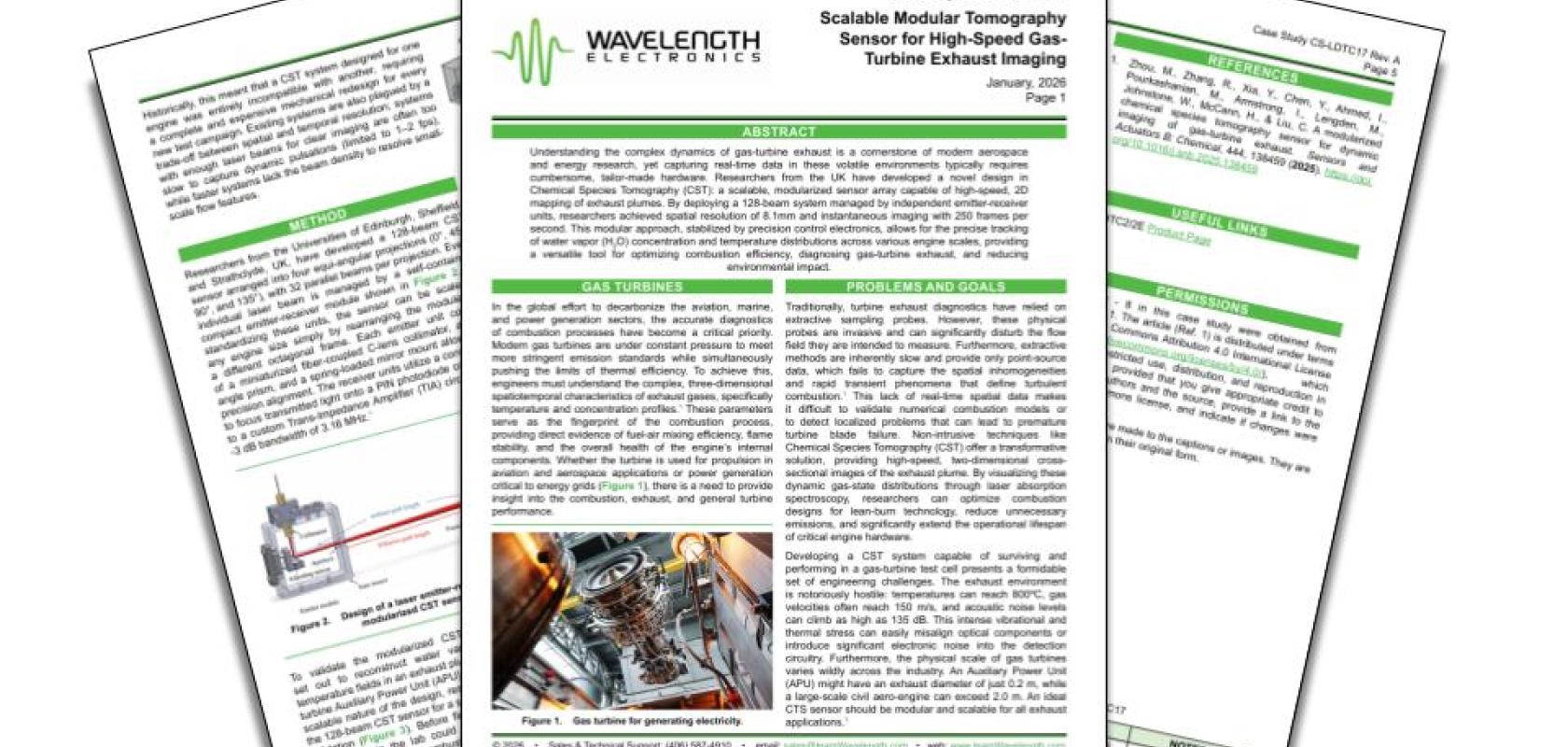
Scalable Modular Tomography Sensor for High-Speed Gas Turbine Exhaust Imaging - A Wavelength Electronics White Paper
See inside gas turbine exhausts in real time – without disrupting the flow
As pressure mounts on the aviation, marine and power generation sectors to reduce emissions and improve efficiency, understanding what happens inside a gas turbine has never been more important.
Yet obtaining accurate exhaust measurements remains a significant challenge.
Traditional diagnostic methods rely on intrusive probes that disturb the flow they are attempting to measure, delivering only limited point-source data while missing the complex spatial and temporal dynamics that drive combustion performance, emissions and component reliability.
A new generation of imaging technology is changing that.
This White Paper explores a breakthrough modular Chemical Species Tomography (CST) sensor capable of capturing high-speed, two-dimensional exhaust images at 250 frames per second, providing unprecedented visibility into gas turbine exhaust behaviour across a wide range of engine sizes.
Developed by researchers from leading UK universities, the system combines high spatial resolution, rapid data acquisition and a scalable architecture that overcomes many of the limitations that have prevented wider adoption of tomography-based diagnostics.
Why download this White Paper?
Discover how a modular 128-beam CST platform can deliver:
✓ Real-time imaging of dynamic exhaust phenomena
✓ High-speed measurements at 250 frames per second
✓ 8.1 mm spatial resolution across turbine diameters from 0.2 m to more than 2.0 m
✓ Non-intrusive diagnostics without disturbing flow behaviour
✓ Flexible deployment across multiple turbine platforms
✓ Improved insight into combustion performance, emissions and component health
What you'll learn
This White Paper reveals the engineering innovations behind a scalable tomography architecture designed for deployment in demanding industrial environments.
Key topics include:
Modular sensor architecture
Learn how standardised emitter-receiver modules enable rapid reconfiguration across different turbine sizes, eliminating the need for expensive, custom-built systems.
Capturing fast-changing exhaust dynamics
Discover how wavelength modulation spectroscopy operating at up to 250 kHz enables the detection of transient events and flow structures that conventional diagnostic methods simply cannot observe.
Validation in laboratory and industrial environments
Explore results from controlled combustion experiments and a successful deployment on a commercial Honeywell 131-9A Auxiliary Power Unit, demonstrating accurate reconstruction of water vapour concentration and temperature fields.
Operating in extreme conditions
Understand how the system maintains measurement accuracy despite severe vibration, thermal expansion, turbulent flow conditions and acoustic noise levels exceeding 135 dB.
Advanced flow visualisation
See how high-resolution imaging reveals previously hidden flow structures, mixing behaviour and combustion characteristics critical for improving efficiency, reducing emissions and supporting lean-burn engine development.
Who should read this White Paper?
This resource is recommended for:
- Combustion engineers developing next-generation turbine technologies
- Gas turbine OEMs and system integrators
- Aviation, marine and power generation engineers
- Turbine test facility operators
- Researchers working in combustion diagnostics and spectroscopy
- Technical leaders evaluating advanced sensing and measurement technologies
- Engineers responsible for emissions reduction and performance optimisation
Why it matters
The next generation of gas turbine development depends on better diagnostic data.
To improve efficiency, validate increasingly sophisticated combustion models and meet stricter environmental regulations, engineers need a complete picture of what is happening inside turbine exhaust systems.
This modular CST approach provides the high-speed, two-dimensional measurements required to achieve that goal—without the limitations of traditional extractive sampling or the cost and complexity of bespoke tomography systems.
The result is a practical pathway towards commercially deployable, scalable exhaust imaging for the global aviation, marine and power generation industries.
Download the White Paper
Learn how scalable Chemical Species Tomography is enabling deeper insight into combustion processes, supporting cleaner engine development and transforming gas turbine diagnostics.
Complete the form to access your copy today.