Ultrafast lasers have become indispensable across a diverse range of applications, from precision micromachining to neuroscience research. Drawing on more than 25 years of successful partnership with Light Conversion, now the world’s leading manufacturer of femtosecond lasers, Photonic Solutions brings unique expertise and insight across the UK and Ireland markets.
Growth across multiple fronts
Despite significant funding challenges facing some sectors, academic-led R&D in the UK remains particularly strong in advanced materials processing applications such as nanoscale surface texturing, dissimilar material welding, 3D waveguide writing and EV battery production. There is also sustained interest in advanced IR spectroscopy techniques, deep-UV generation, and applications requiring post-compression of femtosecond laser pulses down to sub-10fs.
The UK is also very much a global leader in neuroscience and multi-photon microscopy, where femtosecond lasers are essential for both optical stimulation and imaging at depth, especially in the developing area of three-photon imaging. The growth in demand for ultrafast lasers in industrial micromachining applications shows no signs of slowing either. We see this in artificial intelligence (AI) and in the need for large data centres, where manufacturers are pushing the limits of semiconductor packaging.
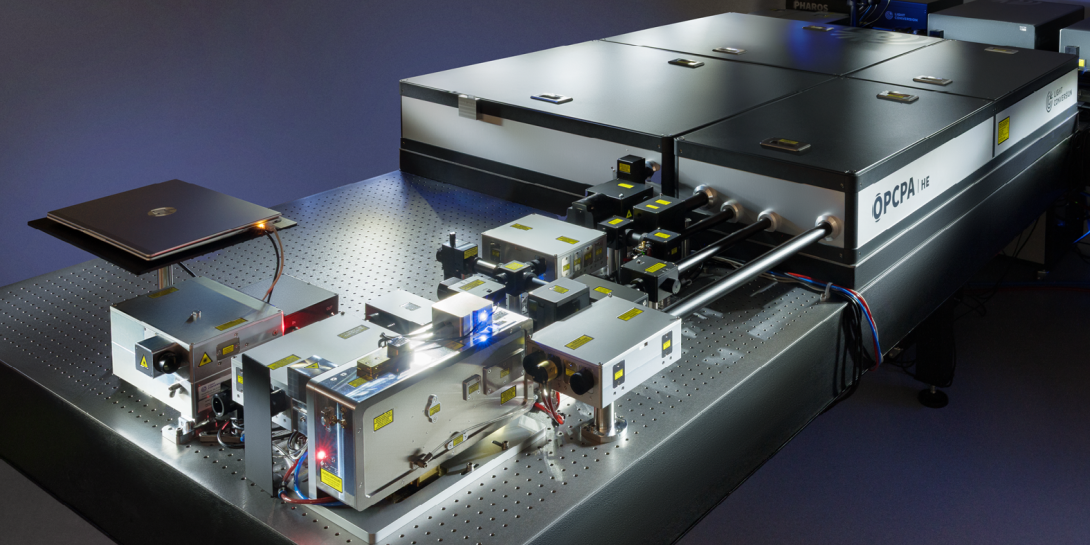
There is mounting pressure to develop ultrafast lasers capable of higher and higher average powers (Images: Photonic Solutions)
Recent major upgrades to large user facilities, such as those at the Central Laser Facility at the RAL complex in Oxfordshire, will continue to provide researchers with invaluable access to state-of-the-art ultrafast laser technology, where demand remains high.
Looking ahead, the semiconductor packaging industry will continue expanding steadily, while medical device manufacturing is also set to increase. We will see further developments in EV battery technology and, of course, sustained growth in quantum technology where silicon photonics manufacturing plays a key role.
The challenge of scale and reliability
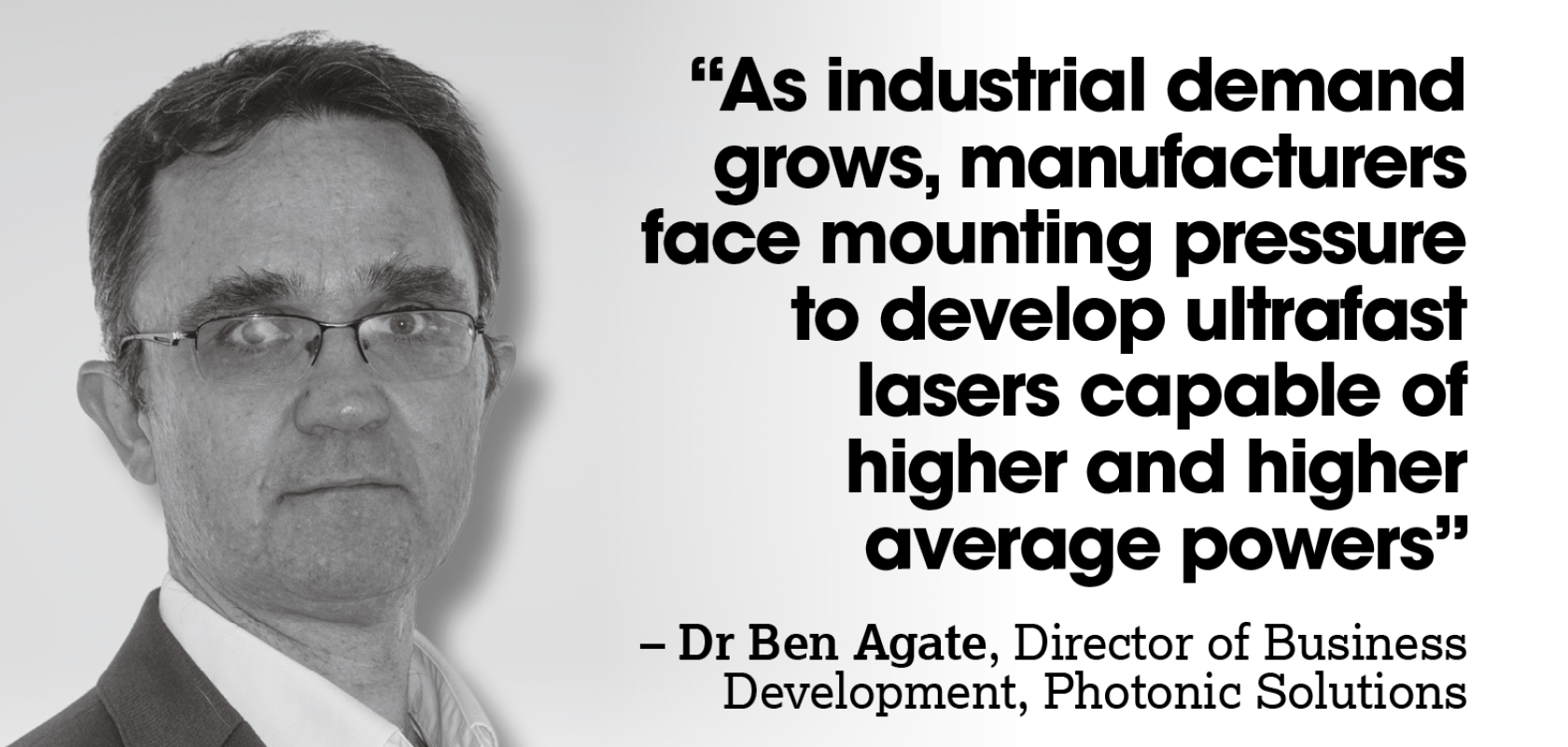
As industrial demand grows, manufacturers face mounting pressure to develop ultrafast lasers capable of higher and higher average powers, thereby enabling increased manufacturing throughput and volume production scaling. The challenge then lies in creating commercial solutions robust and reliable enough to operate 24/7.
There is also growing demand for reliable, long-lived deep-UV laser sources, but operating at such short wavelengths usually means short optical lifetimes of only a few hundred hours before critical components need replacing. Given the demands of industrial clients, many manufacturers have historically struggled to bring robust deep-UV sources to market, though ongoing engineering developments are slowly closing this gap.
Burst mode and the shift to Ytterbium
One of the most exciting developments in recent years has been in burst mode technology, where the ultrafast laser pulse train is modified to provide small packets of pulses at much higher repetition rates, typically into the MHz and even GHz regime. The primary driver here has been in precision micromachining, where burst mode can notably increase material removal rates while minimising cracking and chipping in target materials, an approach of particular interest in semiconductor processing and glass cutting.
Looking ahead, we anticipate a continued acceleration away from Ti:Sapphire technology towards Ytterbium-based systems, where stability, flexibility and long-term reliability are often superior.
Burst mode adoption will likely increase further as key applications develop, particularly in EV battery production and through-glass vias (TGVs) for advanced electronic packaging.
Dispelling misconceptions
Most industrial users already understand the capabilities of ultrafast lasers, which are designed to be robust and reliable enough for an industrial setting. What some may not realise is that flexibility need not come at the expense of performance.
Indeed, many industrial laser manufacturers now offer systems with easily changeable output parameters, including variable pulse duration, flexible repetition rate, adjustable pulse energy and even wavelength switching – all controlled through simple, user-friendly software. Remote service capabilities are also improving constantly, with most minor faults now diagnosed and resolved within minutes.
A trusted partnership
Through our partnership with Light Conversion, Photonic Solutions combines world-class ultrafast laser technology with the invaluable long-term support needed for complex, high-value projects. We’ve worked hard to establish ourselves as a trusted partner for major ultrafast laser infrastructure projects, building a strong track record of success in supporting research facilities, national laboratories and flagship research programmes.
One recent example can be seen in the major upgrades to the HiLUX laser systems at the STFC Central Laser Facility, which represent a significant step forward in ultrafast laser spectroscopy capabilities, bringing improved data quality, superior system reliability and reduced energy consumption.
The ultrafast laser industry is developing quickly, so we caution against making assumptions about what these systems can and cannot do.
We can help clients use one of our applications labs to demonstrate proof of concept before committing to a particular technology or approach.
To explore how we can help you navigate this fast-moving technology, visit the Photonic Solutions website (photonicsolutions.co.uk) to get in touch with our team of experts today.