Spectral imaging is quietly reshaping farming, environmental monitoring, mining, and recycling. Rob Holmes and Steve Washkevich of Omega Optical explain what is driving this growth, and why the humble optical filter matters more than ever.
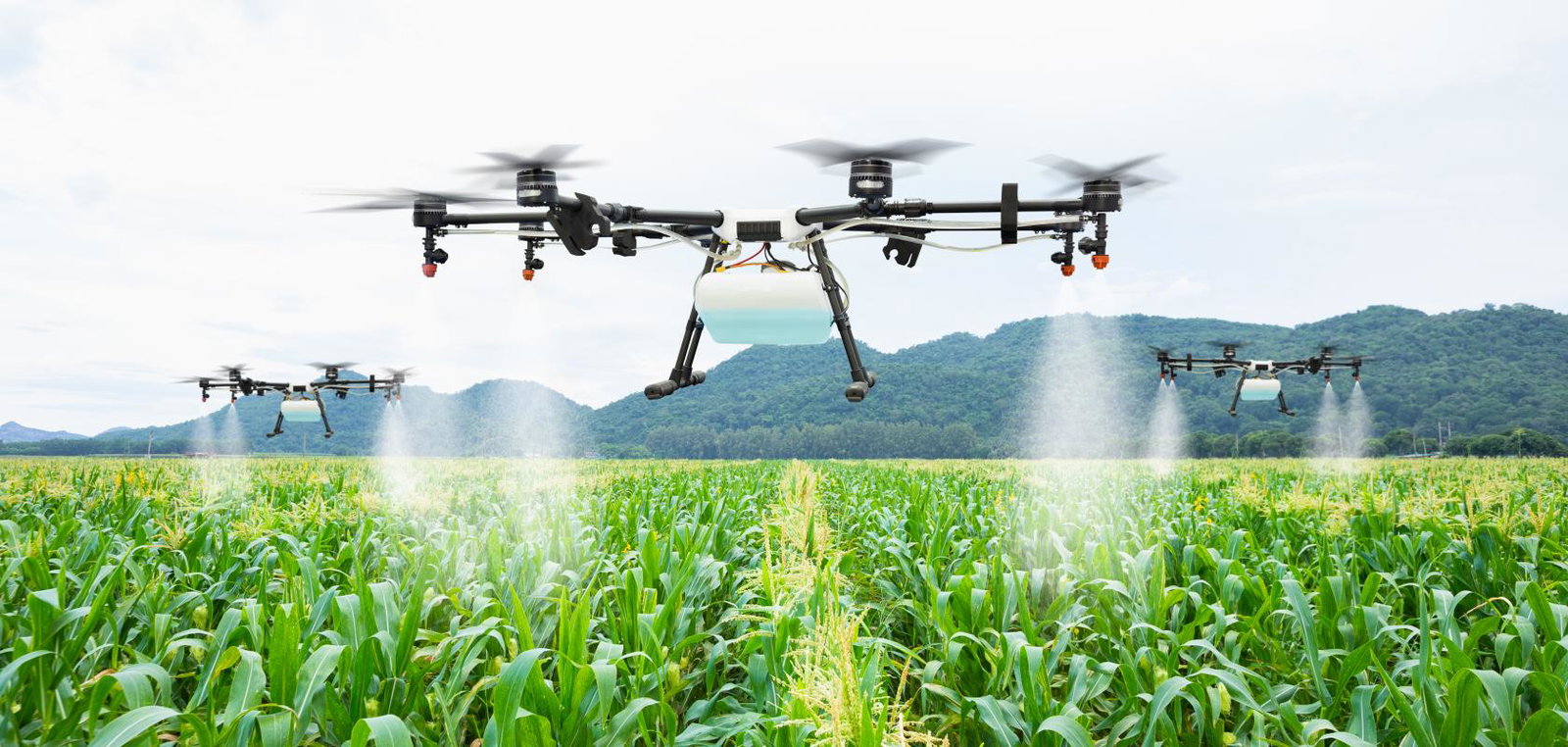
Drive through farmland today and you may spot something that would have seemed like science fiction a decade ago: a drone gliding a few metres above a crop, mapping the health of every plant below. It is an arresting sight, and it is one of the most visible signs of a technology that is spreading rapidly across industries.
That technology is spectral imaging. In its multispectral and hyperspectral forms, it allows machines to see far more than the human eye can, revealing stress, disease, minerals, gases, and materials through the way they interact with light. And at the core of every system is a set of precision optical filters.
Seeing what the eye cannot
The principle is simple. Healthy plants, dry soil, an iron deposit, or a plume of methane each respond to light in a characteristic way. Capture that response across the right parts of the spectrum and you can identify what is there.
"A healthy plant is green; one that needs water or nutrients turns yellow-green; one that is dead or infected goes well beyond that," explains Rob Holmes, Senior Account Manager at Omega Optical. "Multispectral cameras on drones can differentiate between those states, so growers know which areas are thriving and which need attention."
The most valuable information often lies outside the visible range. "In many cases they cut out the green light entirely and look at how plants respond in the near infrared," says Steve Washkevich, Applications Technology Specialist at Omega Optical. "Because humans don't see that, it gives information about plant health that isn't obvious, whether that is a lack of a particular mineral or a blight that is starting to spread."
The result is farming with far greater precision. Rather than treating a whole field, growers can add phosphorus to one patch and nitrogen to another, saving money and reducing environmental impact.
Multispectral: Beyond the farm
Agriculture may be the most visible application, but it is far from the only one. Where multispectral imaging captures a few carefully chosen bands, hyperspectral imaging records hundreds of narrow ones, producing a complete spectral fingerprint for every pixel.
That richness is transforming resource exploration. "A lot of people in the oil and gas industries are starting to use hyperspectral imaging to identify places that are good targets for development," says Washkevich. "They also use it to look for different ores, based on the absorption lines of minerals. From satellites, manned aircraft or drones, they can blanket a large area and collect vast volumes of data."
Many of the companies doing this are, in essence, data businesses. They survey huge areas, process the results, and sell them on to energy companies or to goverments tracking erosion, flooding, and deforestation.
The atmosphere is another target. "Aside from methane, you can measure a lot of gases from space, including nitrogen dioxide and sulphur dioxide," says Holmes. "Monitoring common pollutants is a big driving factor." Unsurprisingly, there is a strong push to build hyperspectral payloads into the next generation of Earth observation satellites.
New frontiers: Hospitals, recycling plants, and factories
Spectral imaging is also finding its way into medicine. "I've seen people use it for triage, quickly identifying the severity of wounds from tissue," says Washkevich.
In recycling, hyperspectral systems scan conveyor belts piled with metal, glass, and plastic, identifying each material by its spectral signature so it can be sorted automatically. "That is a big space, and it is very much hyperspectral, because you need fine detail to sort a lot of these materials," says Holmes.
Manufacturers are applying the same idea to process control. If a temperature, a material composition, or the correct quantity of an ingredient produces a recognisable spectral signature, the production line can be monitored and adjusted continuously.
The technology even has a military pedigree. "Hyperspectral imaging was actually a DARPA programme from the 1970s," Holmes notes.
Why the filter matters
Whatever the application, filters decide which wavelengths reach the detector, and therefore what the system can actually see. Multispectral cameras typically use band pass filters, each tuned to a specific region linked to a known condition. Hyperspectral instruments often rely on linear variable filters, whose pass band shifts continuously along their length so that each row of pixels captures a different slice of the spectrum.
Getting these right is not trivial, and it is where many projects run into difficulty. "There's a difference between being able to prototype with an off-the-shelf filter and say, 'I understand the science, I can make one of these that works okay,'" says Washkevich. "A designer who doesn't know a lot about filters or manufacturability will make assumptions based on their prototypes or what's publicly available. Where we really shine is coming in and asking: what do you need it to do? How can we help you optimise your system, not only for performance, but for the cost of deploying and maintaining it?"
That is why Omega Optical encourages developers to get in touch as early as possible. Bringing a filter specialist in at the design stage avoids costly rework later, when a half-built system turns out not to perform as expected.
The company's track record helps. "We've been involved with some of the largest companies in agricultural imaging from the very beginning," says Washkevich. "That background in partnering with people as they develop these applications gives us a strong start in helping them optimise."
How to find out more
As spectral imaging spreads from farm fields to factory floors, and from drones to orbit, the demands on optical components will only grow. Omega Optical supplies every optical component found in common hyperspectral designs, from gratings and mirrors to filters, and supports customers from first concept through to volume production.
That support now goes further. Following its acquisition by Optikos in September, Omega Optical is part of a combined organisation spanning optical design, fabrication, coatings, and metrology, able to deliver everything from a single filter to a complete optical system.