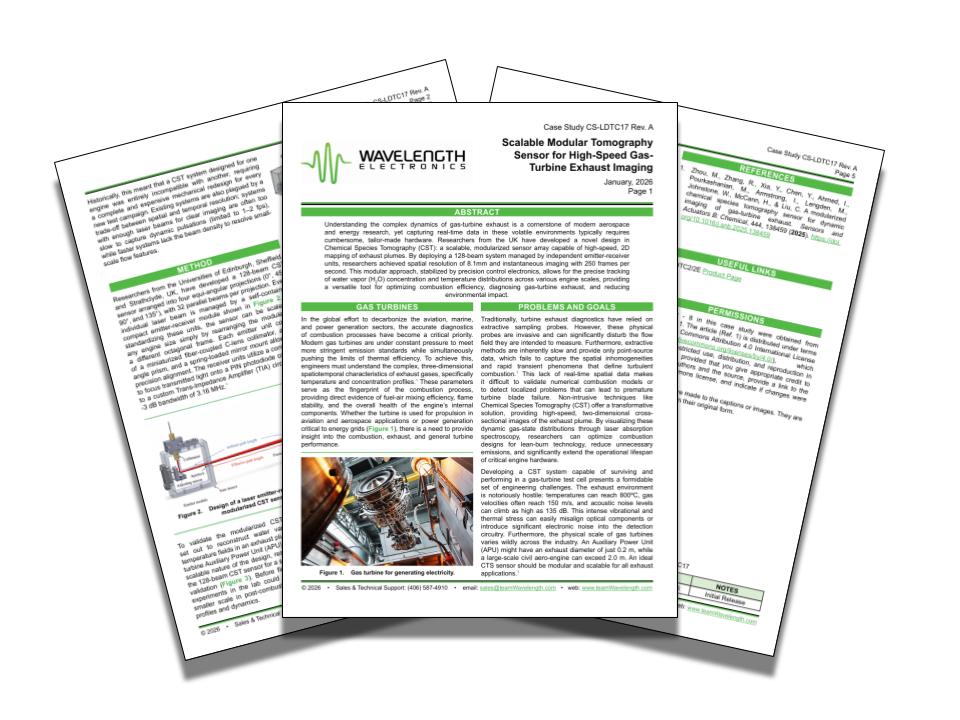
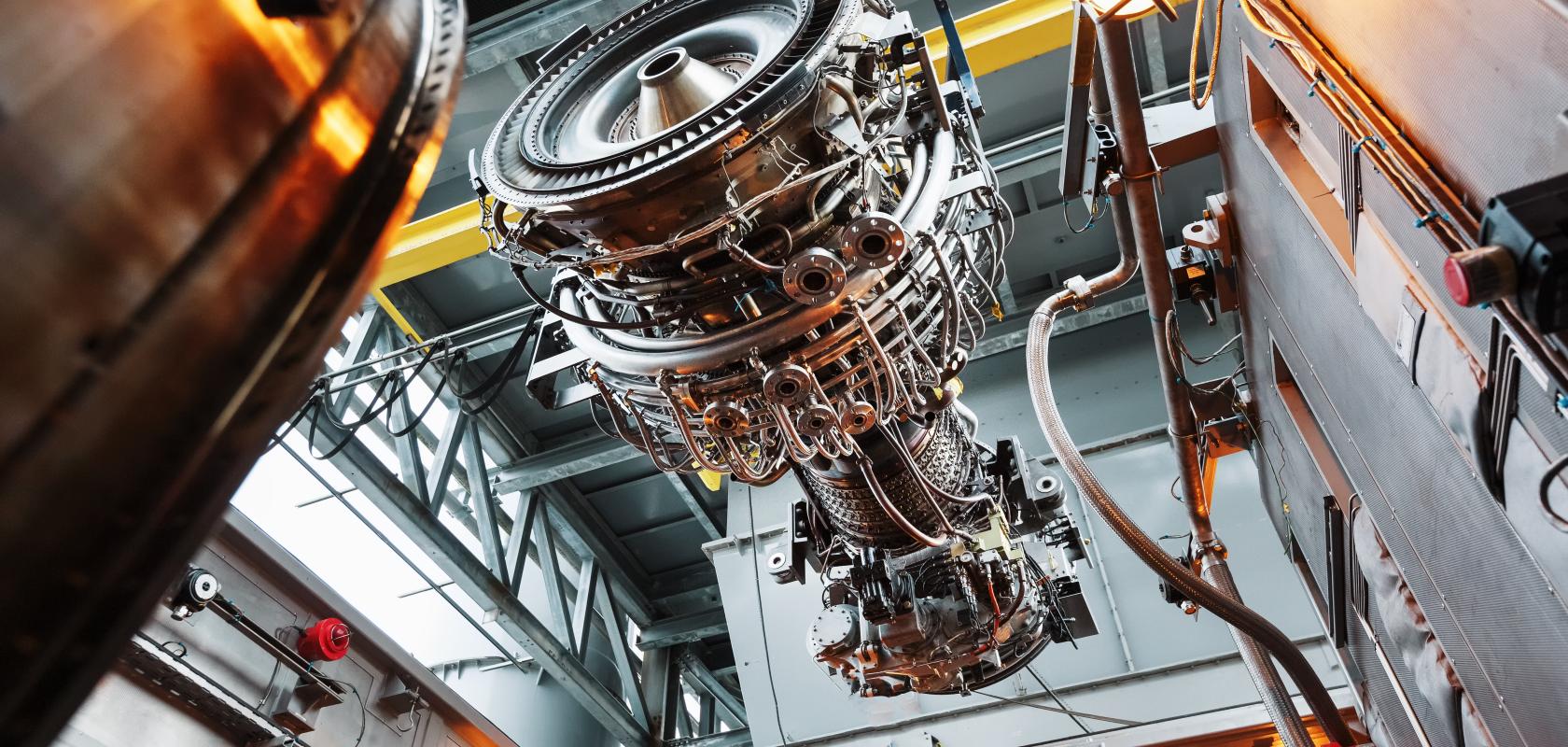
Capturing real-time data from gas turbine exhaust plumes has traditionally required expensive, custom-built hardware that couldn't be adapted across different engine sizes. Now, researchers from the Universities of Edinburgh, Sheffield, and Strathclyde have developed a modular Chemical Species Tomography (CST) sensor that changes this entirely.
The 128-beam system achieved 8.1mm spatial resolution whilst capturing imaging at 250 frames per second. By deploying standardised emitter-receiver units, the researchers created a plug-and-play solution that scales from small auxiliary power units to large civil aero-engines simply by rearranging modules on different-sized frames.
The challenge of turbine diagnostics
Gas turbines power aircraft, ships, and electricity grids, but diagnosing their combustion processes presents formidable challenges. "Real-time imaging allows engineers to understand the complex spatiotemporal characteristics of exhaust gases, which serve as the 'fingerprint' of the combustion process," explains Jeremiah Hashley, a technical writer with Wavelength Electronics. "These parameters provide direct evidence of fuel-air mixing efficiency and flame stability. This data is essential for assessing engine performance, validating emission models, determining turbine efficiency, and supporting quality monitoring to prevent localised problems that lead to premature turbine blade failure."
Traditional approaches have relied on extractive sampling probes, but these introduce significant limitations. "Traditional extractive sampling is invasive, physically disturbs the flow field, and provides only point-source data that is slow to process," says Hashley. "In contrast, CST is a non-intrusive and fast technique that offers high-speed, two-dimensional cross-sectional images."
The testing environment presents extreme conditions: temperatures reaching 800°C, gas velocities hitting 150m/s, and acoustic noise levels climbing to 135dB.
A scalable solution for turbine diagnostics
Perhaps the most persistent problem has been the wide variation in turbine sizes across the industry. An auxiliary power unit might have an exhaust diameter of just 0.2m, whilst a large civil aero-engine can exceed 2.0m. "Gas turbines vary widely in size, from small Auxiliary Power Units to large civil aero-engines," Hashley notes. "Historically, CST systems were custom-tailored to a specific engine size, meaning a system designed for one engine was incompatible with another. This necessitated expensive and complete mechanical redesigns for every new test campaign. With a scalable CST design, the unit can be used for a variety of gas turbines of different sizes, saving time and money."
The breakthrough came through modular architecture. "The design implements each laser beam as a self-contained, compact emitter-receiver unit," says Hashley. "By standardising these units, the sensor can be scaled to any engine size simply by rearranging the modules on a different octagonal frame without any further hardware modification."
Each emitter unit consists of a miniaturised fibre-coupled C-lens collimator, a right-angle prism, and a spring-loaded mirror mount. The receiver units utilise a convex lens to focus transmitted light onto a PIN photodiode connected to a custom trans-impedance amplifier.
Overcoming the speed-resolution trade-off
Historically, CST was a "pick-your-poison" technology. Engineers were forced to choose between seeing a sharp image of a static flame or a blurry image of a fast-moving one, capturing both simultaneously was physically impossible with existing hardware.
"This 128-beam system overcomes that traditional trade-off, where high beam density was too slow to capture dynamic pulsations," Hashley explains. "By achieving an 8.1mm spatial resolution at 250fps, the system is finally fast enough to identify complex periodic vortex shedding in the APU exhaust."
The system targets two water vapour absorption transitions at 1391nm and 1343nm to perform ratio thermometry, providing sensitivity across 300 to 1800K.
Precision control in extreme conditions
Achieving this performance required wavelength modulation spectroscopy with injection currents scanned at 1kHz and modulated at 188kHz and 250kHz. "High-speed WMS requires scanning and modulating laser injection currents at very high frequencies to achieve a high signal-to-noise ratio," says Hashley. "The primary challenge is maintaining stable laser operation (current and temperature) in a volatile environment where acoustic noise reaches 135dB and temperatures hit 800°C, as any drift can significantly distort the tomographic reconstruction, which is based on laser absorption."
The researchers chose Wavelength Electronics' LDTC2/2E controllers to manage the current and temperature of the distributed feedback laser diodes. "The LDTC2/2E controllers were integrated to precisely manage the current and temperature of the DFB laser diodes," Hashley explains. "Their high-frequency modulation support and stability enabled the WMS setup that achieved the necessary signal-to-noise ratio for 250fps imaging."
Temperature stability proved particularly critical. With stability as low as 0.0009°C, the controllers ensured the lasers remained locked onto specific water vapour absorption transitions. "This prevents spectral drift caused by the 800°C thermal stress, ensuring consistent and accurate measurements," says Hashley.
The dual-wavelength approach placed additional demands on the control system. "Ratio thermometry requires targeting two different absorption transitions to calculate temperature across a wide range," Hashley notes. "The two LDTC2/2E controllers managed the separate DFB lasers for each wavelength, providing the specific current and temperature control necessary for simultaneous high-speed modulation and data acquisition."
The importance of laser stability extends beyond immediate measurement accuracy. "Tomographic reconstruction relies on laser absorption spectroscopy," Hashley explains. "Because reconstruction algorithms are sensitive to measurement noise and laser wavelength, any instability in the laser's wavelength or intensity would be amplified, leading to inaccurate temperature and concentration maps."
From laboratory to industrial deployment
The system was first validated through laboratory experiments on propane/air flames before deployment on a commercial Honeywell 131-9A auxiliary power unit. In triple-flame tests, the sensor accurately localised three distinct hot spots, with measured distances deviating by only 1.5mm from actual layout. At 250fps, it captured a 9Hz fluctuation in the annular flame from periodic vortex shedding – a dynamic feature slower systems would miss.
"It demonstrates for the first time that modular CST can successfully resolve non-uniform gas-state distributions in commercial gas turbine exhaust," says Hashley. "The system proved robust enough to maintain signal integrity and localise hot spots with a geometric accuracy within 1.5mm, even in an active industrial test cell."
The practical applications extend across the aerospace and energy sectors. "By providing real-time 2D maps of combustion, the technology helps engineers optimise lean-burn designs and improve fuel-air mixing," Hashley explains. "This allows for the development of engines that meet more stringent emission standards whilst maximising thermal efficiency. It can also show when a turbine is at or near the end of its life."
A blueprint for standardisation
The modular approach opens possibilities for widespread adoption across the gas turbine industry. "Because the units are standardised and plug-and-play, the system provides a versatile and cost-effective blueprint that can be easily commercialised and adapted for various engine scales across the industry," says Hashley.
Future developments in laser control technology will further enhance these capabilities. "The case study emphasises that the combination of fully featured, compact controllers and high performance is essential for executing such complex projects," Hashley notes. "Future developments likely include further miniaturisation and even lower-noise electronics to support higher beam densities and faster frame rates in even more extreme environments."
By replacing rigid, custom hardware with a modular, scalable architecture, the researchers have created a practical pathway toward standardised, commercial-grade CST instruments for global aviation and power industries. The successful deployment on a commercial APU validates not just the technology, but a new paradigm in industrial combustion diagnostics.
Find out more about this exciting development in the latest White Paper from Wavelength Electronics