
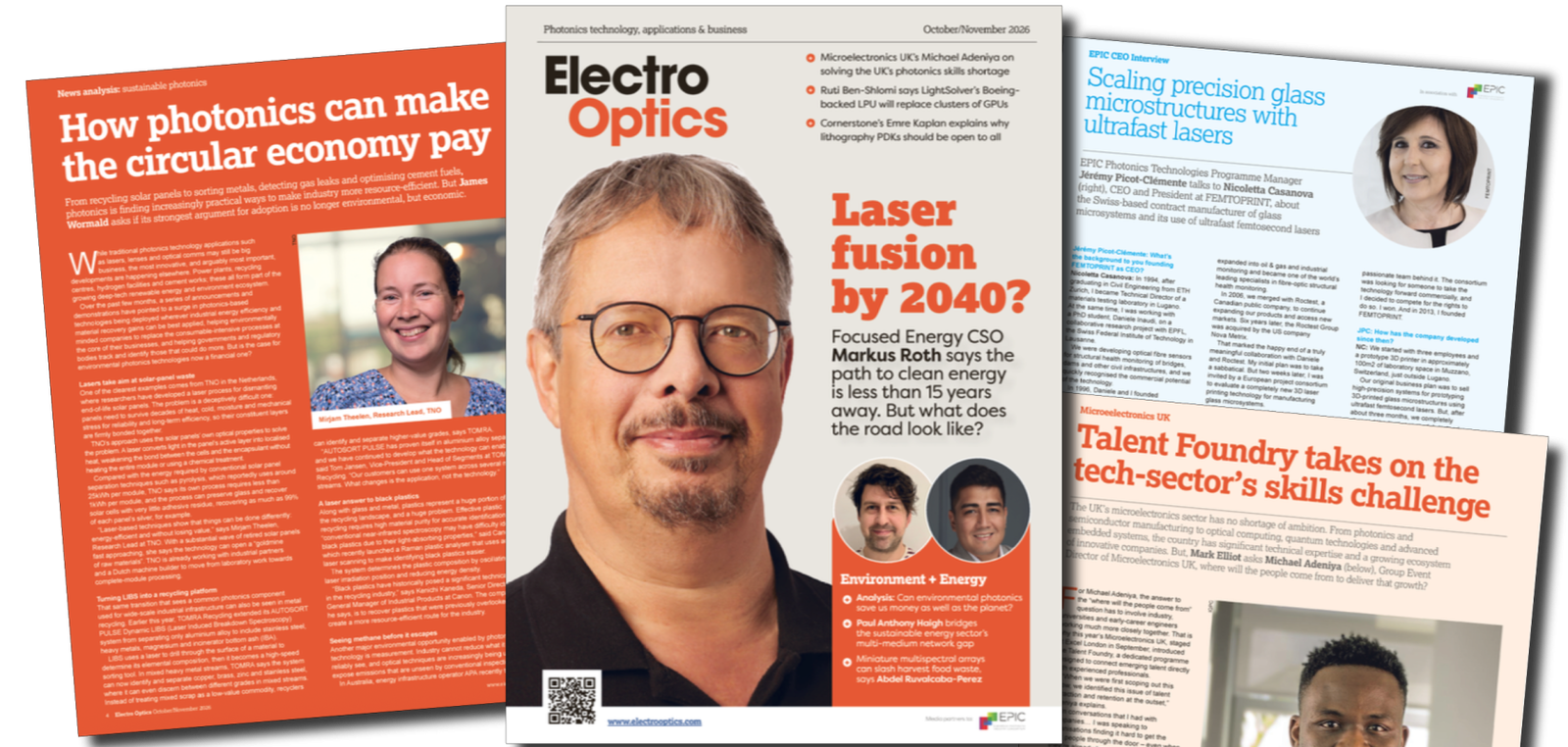
From laser fusion to smarter farming, the Oct/Nov issue of Electro Optics explores how light-based technologies are tackling energy, environmental and industrial challenges, while opening new routes to commercial innovation.
The latest issue of Electro Optics is here, and we're looking at how photonics could help reshape the way we generate energy, use resources and build the infrastructure of tomorrow. From making recycling more cost-effective to scaling laser-driven fusion, the issue examines the technologies moving from research towards real-world applications, and the people working to bring them to market.
The economics of a greener industry
Sustainability is increasingly a question of industrial efficiency as well as environmental responsibility. Our lead news analysis examines how photonics is helping manufacturers make better use of resources, from recovering valuable materials from discarded solar panels and sorting metals to detecting gas leaks and optimising alternative fuels for cement production. As these technologies mature, the case for adoption may be as much about cost savings and recovered value as environmental benefits.
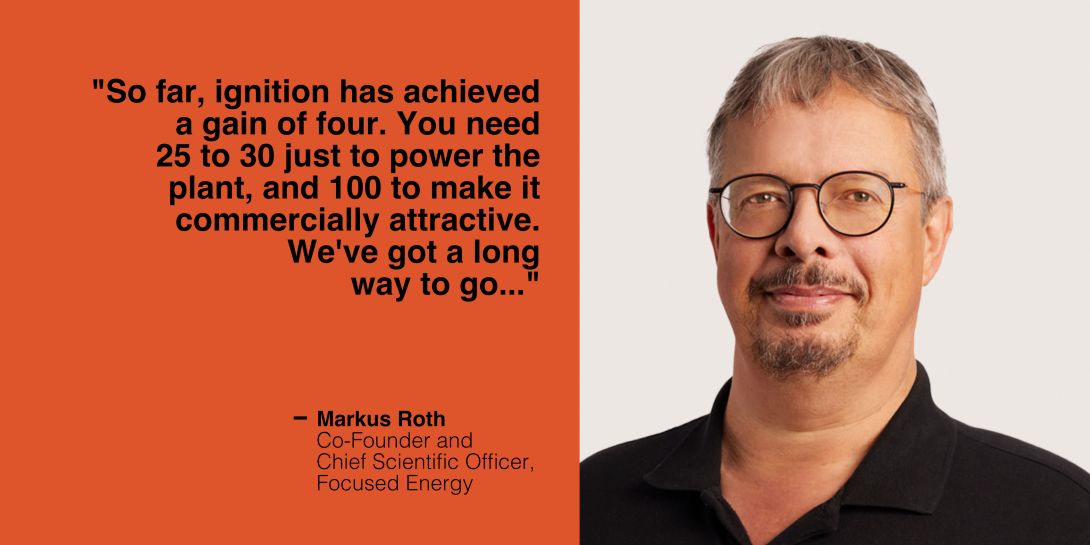
“We don’t want Germany [to become] a Natural History Museum," says Markus Roth, Chief Scientific officer and Co-Founder of Focused Energy, "but we need constant, cheap power" (Image: Focused Energy)
Fusion: the next-gen energy frontier
Few energy technologies carry ambitions quite like laser fusion. Following the National Ignition Facility's 2022 breakthrough, the challenge now is to turn scientific achievement into a commercially viable power source. In an interview with Electro Optics, Focused Energy Co-Founder and Chief Scientific Officer Markus Roth discusses the technology, manufacturing hurdles and milestones that must be overcome to scale commercial laser fusion.
Elsewhere, Abdel Ruvalcaba-Perez explores how a hybrid multispectral sensor that combines silicon and gallium antimonide detectors in an array smaller than a fingernail could help growers tackle food waste. By improving the timing of harvests, more precise sensing could offer a new way to protect crops and reduce losses across the food supply chain.
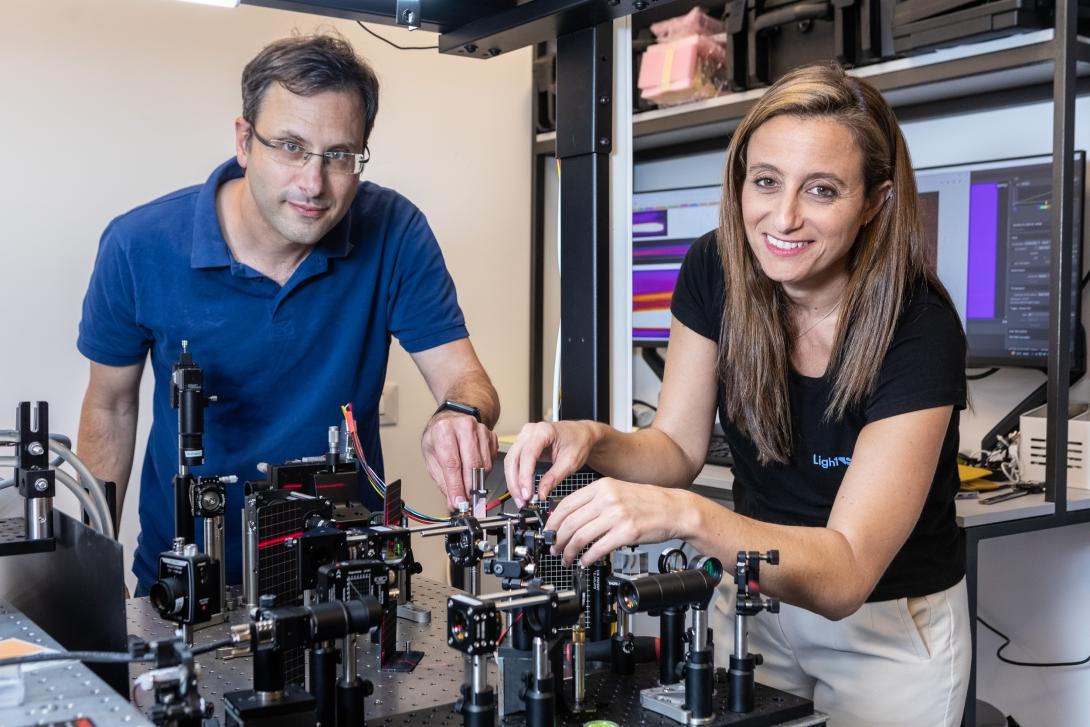
(left to right:) LightSolver's CTO, Chene Tradonsky, and CEO, Ruti Ben-Shlomi (Image: LightSolver)
Connecting the next generation
The issue also looks at the optical networks underpinning future infrastructure. Paul Anthony Haigh of Queen Mary University of London examines the challenge of integrating fibre, free-space, satellite and underwater optical communications, with implications for connecting systems across environments, including offshore renewable energy infrastructure.
Meanwhile, LightSolver CEO and Co-Founder – and Photonics100 honouree – Ruti Ben-Shlomi explains how the company's laser processing units could accelerate engineering simulations by working alongside existing high-performance computing infrastructure. With further development backed by Boeing, the company is targeting commercial deployment by 2027.

“Glass has the potential to transform many fields, including quantum computing, photonic integrated circuits, co-packaged optics and technologies related to artificial intelligence,” said Nicoletta Casanova (Image: FEMTOPRINT)
From the lab to the production line
Innovation also depends on the ecosystem behind the technology. Cornerstone's Emre Kaplan explains how open-source photonic process design kits could lower barriers to silicon photonics development, and FEMTOPRINT's Nicoletta Casanova discusses scaling precision glass microsystems using ultrafast femtosecond lasers.
And, with the UK’s skills challenge a key conversational trend at the recently wrapped Microelectronics UK show, Event Director Michael Adeniya talks about how the event is helping the country develop the talent needed to turn technical ambition into industrial growth.
The event also saw the launch of another essential resource for the UK photonics community, the Electro Optics-published UK Photonics Uncovered 2026 supplement, bringing together more in-depth interviews and market analysis features exploring the people, policies and regional clusters that shape British photonics. The special print edition and online channel examine the challenges of commercialisation and scaling homegrown technologies, two key themes to come out of Microelectronics UK.

"DUV lithography involves processing silicon technologies on multiple prototyping chips with up to 200mm-sized wafers," says Emre Kaplan from Cornerstone, "and [you] can pattern them all instantly, so it’s really good for scalability (Image: Cornerstone)
Curious?
From cleaner manufacturing and next-generation energy to advanced sensors, photonic computing and scalable production, the Oct/Nov issue explores how light-based technologies are creating new possibilities across industries. Read the latest issue and discover more at electrooptics.com, or register to receive the printed magazine and stay up to date with the innovations shaping photonics.