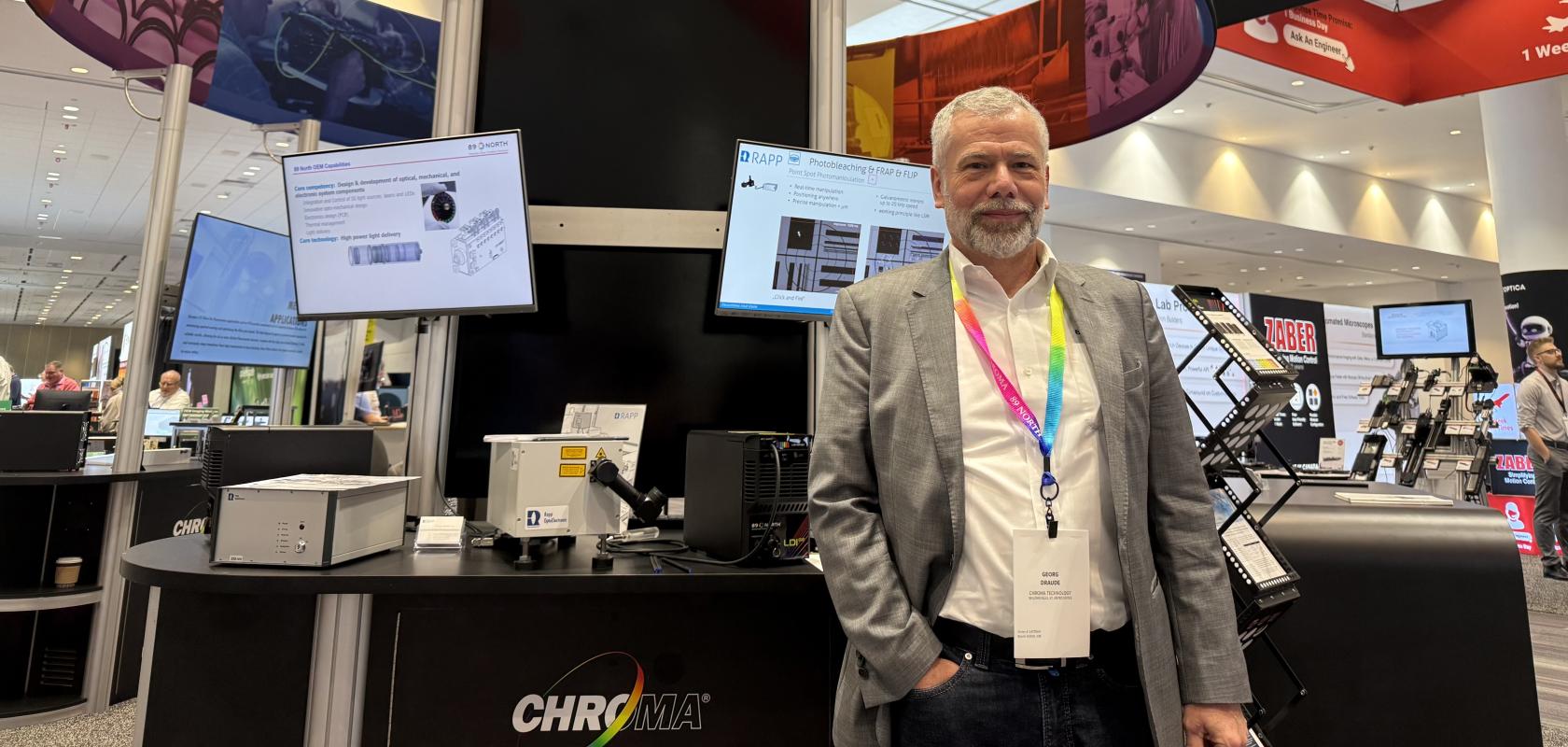
In a global photonics industry shaped increasingly by uncertainty, consistency has become a competitive advantage in its own right. It's been a year since Electro Optics last talked to Chroma Technology at Photonics West, and the past 12 months have delivered exactly that steadiness: steady growth in core markets, a measured resilience against the threats of geopolitical and funding pressure, and continued demand for high-performance optical filters in a range of applications, but particularly life sciences and medical diagnostics.
Reflecting on the company’s current fiscal year, Georg Draude, the Munich-based General Manager at Chroma, admits expectations were cautious at the outset of 2025. “We started the year with concerns,” he says. “There were research budget cuts in the US, trade tensions worldwide, and ongoing uncertainty around China. But overall, it turned out to be a pretty easy year, despite many of those things still in play today.”
That positive outcome – the company’s fiscal year closes in April – is being driven largely by sustained demand in life sciences and diagnostics – markets where Chroma has long focused its technical and commercial efforts. Performance exceeded the previous two years, although not matching the exceptional pandemic-era highs. “It’s better than expected, and better than the two years before,” Draude summarises. “Not as good as the pandemic year – but no one wants that back.” It’s the sort of personable, no-nonsense summary everyone expects from one of the Vermont-based organisation’s most admired leaders.
Looking ahead, Chroma’s outlook reflects a broader industry realism. High-growth narratives have given way to more disciplined forecasts, particularly in mature optical component markets. “I don’t expect crazy-fast growth,” Draude says. “Five to 10 per cent per year is what we commonly see across the industry now. If we achieve that, I’d say we’re happy.”
This tempered optimism reflects both macroeconomic uncertainty and structural changes in photonics manufacturing – especially increased global competition and evolving customer expectations. One of the most significant changes over recent years has been the rising capability of Asian – particularly Chinese – optical filter manufacturers. Where competition was once largely confined to low-cost catalogue parts, it now extends into customised and OEM-level components. “We take Chinese filter manufacturers very seriously,” Draude states. “The quality has improved significantly. It’s no longer just cost versus quality. That’s why we remain very focused on doing what we do well, but continuing to innovate and change.” This competitive threat is closely linked to manufacturing scale. Larger coating machines capable of processing many wafers simultaneously require high utilisation to remain economical, pushing suppliers toward volume OEM business rather than one-off sales. “In this business, you don’t want to sell a single filter,” Draude explains. “You want to sell thousands.”
Chroma’s response has been to invest in both large-scale coating capacity and smaller, single-wafer systems – maintaining the flexibility needed for custom work and prototyping while remaining competitive in volume production. It’s a powerful addition to a broad business proposition: a strong catalogue offering balanced by market-leading customisation capability.
Rapid prototyping as a differentiator
Rapid prototyping has become a defining element of Chroma’s market position, particularly among start-ups and OEMs operating under tight development timelines. However, internally, the company resists rigid definitions. “We discussed defining rapid prototyping as two to four weeks,” Draude says. “But that doesn’t really make sense. What matters is what the customer needs.”
In practice, a single custom filter can be designed, coated, and shipped in around two weeks, assuming suitable substrates are available in-house. Multi-filter sets or more complex designs naturally take longer, but smart internal prioritisation ensures momentum. “If something is identified as rapid prototyping, everyone jumps on it,” he notes.
The capability needs some boundaries – Chroma naturally has to place restrictions on special materials and non-standard substrates – but, where applicable, it serves as both a technical service and a long-term commercial strategy. “Customers experience it, they like it, and they come back,” Draude says. “And ideally, that prototype becomes a production part.” That approach is indicative of the sharp market understanding that has stood the company in good stead for decades, and is celebrating its 35th anniversary this year.
From a process perspective, Chroma applies broadly the same development workflow across markets, but with application-specific requirements layered on top.
“Space applications demand extreme performance and extensive testing,” Draude explains. “Biomedical diagnostics are typically higher volume, and while quality is still critical, the tolerance window is different.”
Fluorescence microscopy remains one of Chroma’s strongest application areas, and here the spectral trends are well established. “There’s a clear move toward the near-infrared,” he says. “That’s been coming for years.”
Alongside spectral shifts, the fundamentals remain constant: higher transmission, steeper edges, and improved blocking — incremental but essential improvements that define competitiveness in optical filtering.
From academic labs to commercial start-ups
Across Chroma’s 35-year history, the profile of its customers has changed markedly. In the early years, collaboration was primarily with academic researchers, often resulting in bespoke filter sets closely associated with individual scientists.
“Today, we don’t meet those people at universities anymore,” Draude observes. “We tend to meet them at spin-offs and start-up companies.” This reflects the increasing professionalisation of the life sciences ecosystem, where research, commercialisation, and scale-up are more tightly linked. With that comes greater pressure on timelines, documentation, and performance guarantees.
“In the early days, things were more ‘best effort’,” Draude says. “Today, everything needs to be specified. It’s more considered overall.” That shift places greater emphasis on structured engineer-to-engineer dialogue, particularly during early-stage development. “You need someone in the room who understands how to speed things up – without losing control of the process,” he adds.
What customisation really means
Customisation at Chroma spans a wide range of complexity. At its simplest, it may involve cutting an existing filter to a specific size or shape. At the other end of the project spectrum, it can mean starting from scratch. “You have customers who come with a complete drawing,” Draude says. “And others who come with an idea, a light source, and say: ‘help’.” Both scenarios are common, and projects often evolve over time. It’s also true, of course, that long-term catalogue customers may eventually request customised variants as their systems change or scale.
But Draude maintains that highly complex custom projects are typically resolved within a few months of active work, although overall timelines can extend if there are customer-side development pauses, something that the geopolitical uncertainty has affected.
Chroma’s experience with legacy soft-coated filters highlights the long tail of optical component lifetimes. Although the company phased out soft-coating technology in 2014, customers still occasionally report issues with them – particularly in high-humidity environments. It speaks, perhaps, to the longevity of the products Chroma creates. “These filters can literally mould away in some environments,” Draude says. “They really shouldn’t be used anymore.”
Modern hard-coated filters eliminate most of these issues, even if they can introduce trade-offs such as greater angular sensitivity. Overall, durability, repeatability, and manufacturability now dominate design decisions – and that’s a good thing.
Despite advances in coating technology, development timelines have not shortened dramatically. “The work is still the same,” says Draude. “In some cases, coating times are actually longer, but that’s as much about the care we take on the process.”
Speaking at BiOS, Draude was clear about how motivated he is by the uses of Chroma’s products – and many others’ – in the life sciences market. “For example, following the Nobel Prize being given to super-resolution microscopy in the 2000s, progress then largely focused on incremental resolution gains rather than new biological insight, with many demonstrations limited to thin, standardised samples,” he says.
“Over the past two to three years, however, spatial genomics and related fluorescence-based ‘omics’ approaches have shifted the focus toward volumetric imaging, enabling detection of RNA and DNA targets hundreds of micrometres deep within intact tissue. This transition from surface resolution to deep-tissue molecular mapping represents a meaningful technical advance with direct relevance to cancer research.”
Finally, asked what he wishes more people understood about Chroma, Draude points to the company’s ownership structure rather than just its product portfolio. “We are one of the last independent coating companies,” he says. “Employee ownership is something that we’re very proud of.”
That independence underpins Chroma’s willingness to invest in close customer collaboration and extensive customisation, even where short-term returns are uncertain. In an industry increasingly shaped by consolidation and scale, Chroma’s trajectory offers a different model: one where steady growth, technical depth, and long-term relationships remain central to success.