
A lot can change in a year, even more in nine months. For more than a decade, the Photonics Leadership Group (PLG) has championed the cause of photonics. Many of us involved have campaigned for more than 30 years to make clear the impact of photonics on the UK and global economy.
Our friends and colleagues at Photonics Scotland pioneered the photonics cluster with the same aim – to make photonics bigger, stronger, greater than the sum of the parts, and have its contribution recognised and prioritised in government and company strategies.
In February 2026, the UK Government’s own Council of Science and Technology (CST) wrote an open letter to the Prime Minister entitled ‘Photonics: Capturing the Opportunities for Growth and Global Leadership’, identifying photonics as a UK strength, vital to our economic and societal future and calling for action to support the further growth of the industry.
The photonics penny has dropped
‘UK photonics is a fantastic success story’ is the new mantra from the UK Government and its advisors. Civil servants are running their own analysis confirming – and often exceeding – the figures produced by the PLG.
The penny has dropped; the UK not only needs photonics, our futures depend on it, and we are good at light-based tech. By the PLG’s own analysis, some 13% of all global innovation (as indicated by peer-reviewed publications) contains a photonics component.
Even better, the UK is the third most prolific publisher of that innovation, behind only the US and China.
Why now? Photonics was not explicitly identified in the 2023 UK industry strategy. Optics and lasers were not invented yesterday. I contend at least four key elements have aligned.
When experts have looked beneath the high-level growth-driving sectors identified in the Industry Strategy – advanced manufacturing, defence, energy and the frontier technologies of AI, quantum, connectivity, semiconductors and cyber – it is photonics that is driving the advances within these sectors. Just look at the UK’s latest AI hardware plan.
Then there is the economic reality that the absolute increase, in jobs and revenue, from growing an established industry is much greater in the medium-term than growing a new industry from scratch.
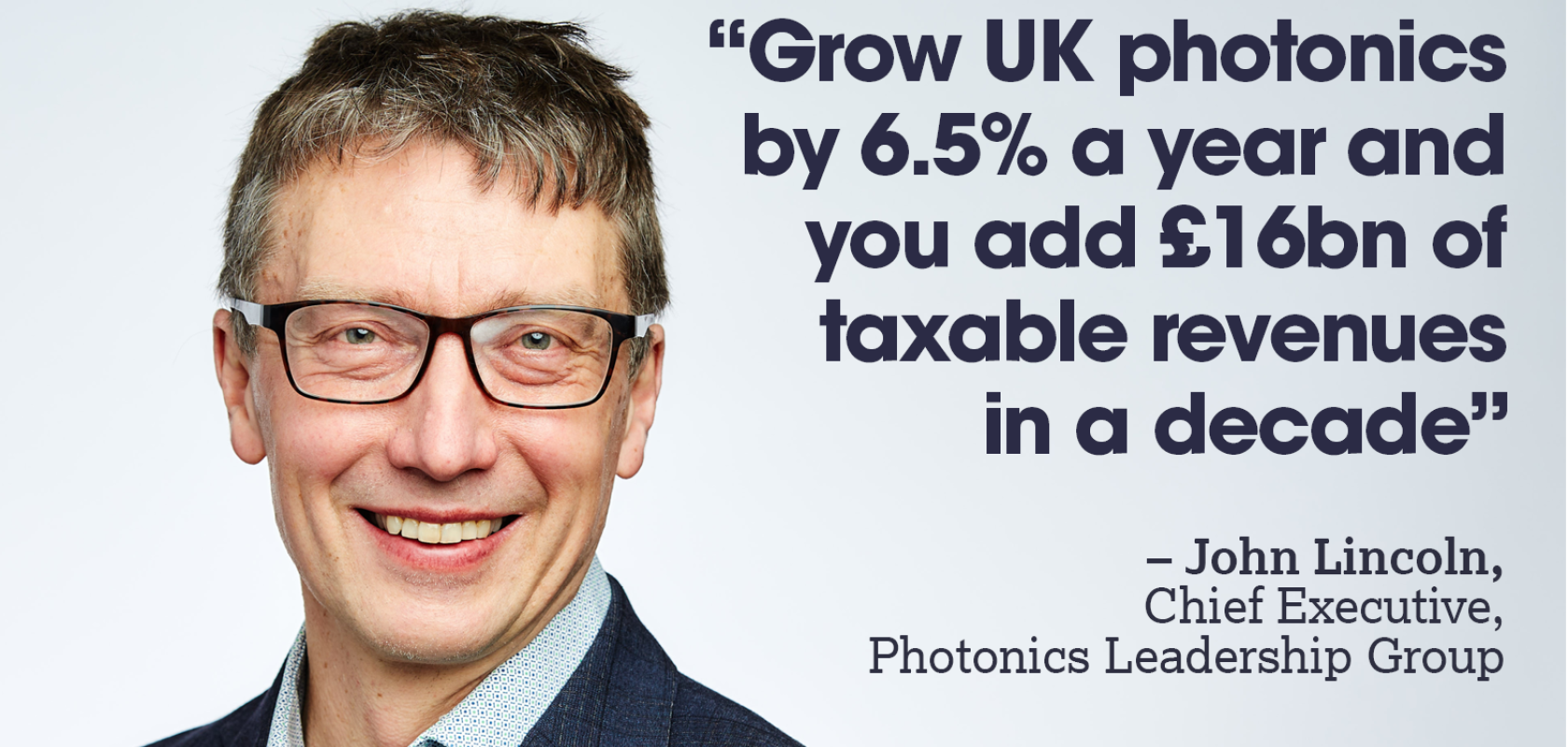
Grow UK photonics by just 6.5% a year and you add £16bn of taxable revenues in just a decade.
Then there is the imperative of ensuring economic resilience and, for a country that is small in total size, securing a place at the table among the tech giants. That requires having key enabling components – the smart bits of photonics – that open up giant markets, from the lasers that anneal mobile phone screens, to the hollow-core optical fibre connecting data centres, or the optical AI accelerators of the future. Think what ASML has done for the Netherlands!
Finally, there is the timeliness of technology disruption. We are on the cusp of an integrated photonics revolution that changes how we design, manufacture and scale-up photonics. It is a one time step-change in technology that will upend many photonics supply chains and create huge opportunities – the biggest of which are in those key growth sectors identified in the UK Industry strategy. The future is certainly integrated.
UK photonics is, therefore, in the right place, at the right time, with the right opportunities to make a difference – and that gets attention.
A new UK National Roadmap for Photonics will be published by the UK Government this year. It will make clear links between photonics, key growth markets and the underpinning optical technologies. Fully focused around industry, the roadmap will identify the opportunities and the enablers of further growth, including skills, international collaboration and a more proactive role for Government. We await the details with high interest.
Funding is not bottomless
What does all this attention mean? Certainly not endless money… in the UK, we are between – indeed, almost at the start of – a spending review period. Departmental budgets have been set, fiscal policy is tight and tightening. Highly focused interventions, supported by industry, that are making a difference will be key. Links and collaboration with the vertical markets that stand to benefit from more photonics, such as defence, AI, connectivity, data centres and diagnostics, will likely become the norm.
Our hope is that we will also see support for enabling infrastructure and scale-up, particularly through the whole integrated photonics value chain.
Already we are seeing a qualitative difference. Multiple regions are now analysing the role and importance of their photonics sectors, which is the first step towards more proactive support.
Northern Ireland has a new photonics cluster. The innovation agencies are reaching out to understand what they can do for photonics. Cross-government departments are talking about photonics, advice and input is being sought from the PLG at a rate never previously seen. TechUK has had a deep dive on photonics; Techworks’ August semiconductor summit was full of photonics. Investors are looking again at trends and opportunities in photonics hardware.
Photonics has quietly got on with being successful for the past three decades – how will it respond to increased attention?
The CST letter correctly identifies that the “photonics sector currently lacks coordinated Government oversight”. Will more oversight be welcome? With attention will certainly come expectations of growth and continued success.
UK photonics has a long history of being good at what it does, understanding where it adds value and the fundamentals of sustaining growth and profit. This will not change; indeed it may well accelerate. For any industry to grow, it needs investment, ideally private investment.
Strong messaging from the UK Government that photonics is a great success story will certainly help unlock more private investment and attract more people to work in the sector.
A National Photonics Roadmap may be new in the UK, but they are common elsewhere. Photonics21 published its latest Strategic Research and Innovation agenda (SRIA) ‘Light Driving the Future’ in June 2026 – a roadmap for the future of photonics in Europe. Yet the future of photonics within the next European Framework programme is uncertain. Much of European photonics support will be absorbed with the next Chips Act 2.0, potentially opening access to significant funds, but at the risk of less focus, especially for areas outside integrated photonics. The PLG looks forward to continuing our work with European colleagues and support efforts to ensure photonics is fully represented in the next framework programme and that the UK has access to such programmes.
Changing of the guard
While 2026 has seen huge change in the recognition of the key role photonics plays in the economy, it will also mark a personal milestone. After 13 years in post and more than 35 years in the industry, I will step down as PLG Chief Executive in October.
Stepping back to enjoy the twilight of my lifetime career in photonics, I will be focusing on advising boards and mentoring stars of the future. Dr Lewis Hill has joined us as the new PLG General Manager, at the dawn of a new era for the PLG.
With an updated vision for the PLG, set out at our AGM in October, he will be able to focus on building on the recognition of photonics and responding to the new attention the sector is receiving. It is with immense pride that I pass the reins on to Lewis, and look forward to seeing him take the PLG to the next level.
I trust the community will give him the fullest support and backing.
Over, but not out!
Read our interview with the PLG’s new general manager, Dr Lewis Hill. Hill will also be appearing on the PhotonicsUK stage of Microelectronics UK on Tues, 29 Sept 2026, at 10:45 - 11:25 discussing 'What Will the Photonics Roadmap Mean for the UK Photonics Market?'
The Electro Optics team will also be at the Microelectronics UK event on Tues, 29 Sept, and Wed, 30 Sept, 2026. Come say hello at Stand B50.