Achieving parts per quadrillion gas detection with laser spectroscopy
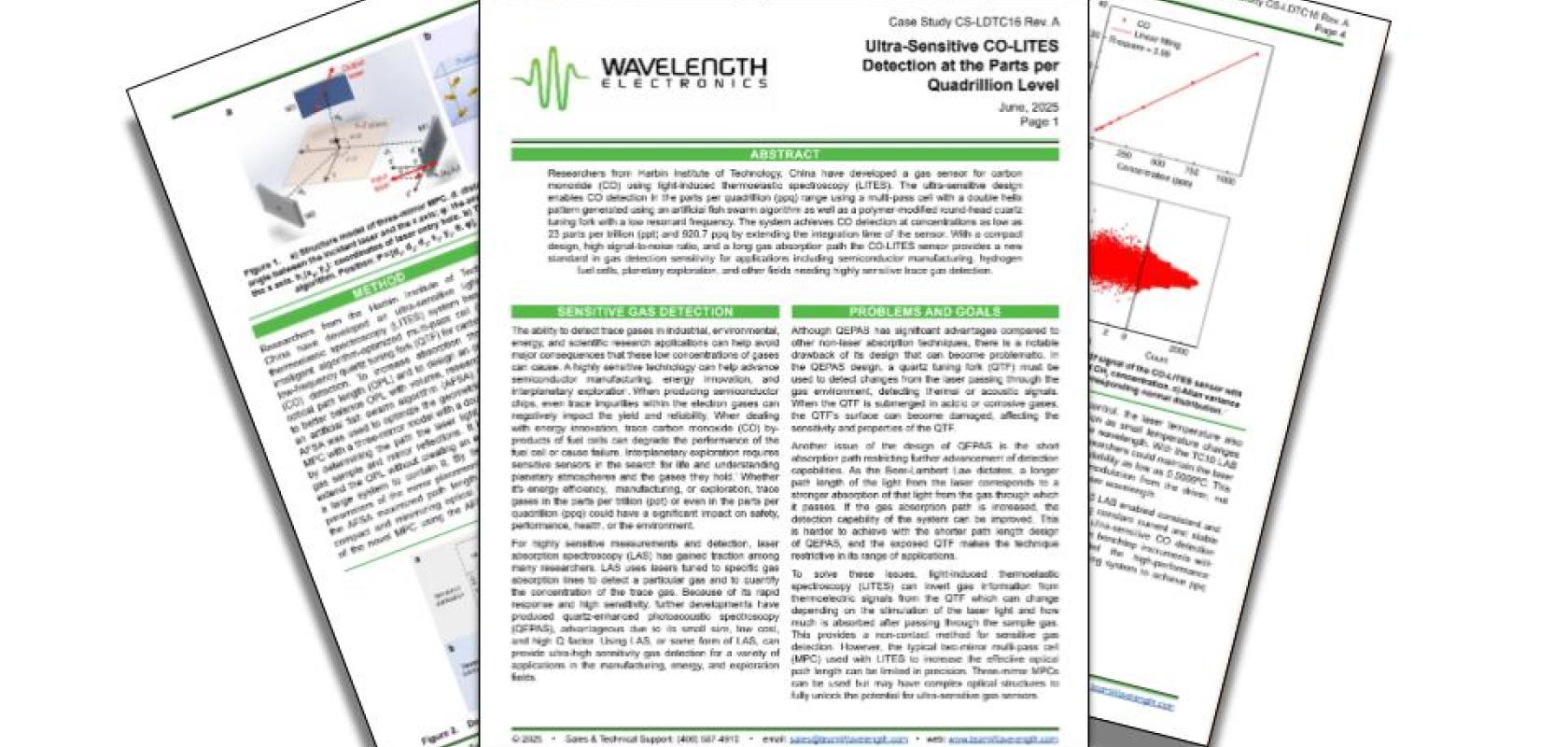
Ultra-Sensitive CO-LITES Detection at the Parts per Quadrillion Level - A Wavelength Electronics White Paper
In semiconductor manufacturing, hydrogen fuel cell development, and planetary exploration, detecting trace gases at parts per trillion (ppt) or parts per quadrillion (ppq) levels is essential. Even minute contamination can compromise chip yield, degrade fuel cell performance, or obscure critical scientific discoveries about planetary atmospheres and potential signs of life.
Why conventional detection falls short
Traditional techniques such as quartz-enhanced photoacoustic spectroscopy (QEPAS) face significant limitations: quartz tuning forks exposed to corrosive gases become damaged, and short absorption path lengths restrict sensitivity. Achieving breakthrough detection limits requires extended gas-light interaction times and exceptional laser stability, demanding both innovative optical designs and precision laser control.
What this White Paper delivers
This White Paper, Ultra-sensitive CO-LITES detection at the parts per quadrillion level, examines groundbreaking research from Harbin Institute of Technology that achieved carbon monoxide detection at 920.7 ppq, setting a new standard in trace gas sensing.
Inside, you'll discover:
- Advanced optical architectures: how artificial intelligence algorithms optimise multi-pass cell designs to maximise absorption path length whilst maintaining compact system volumes
- Sensor optimisation techniques: the role of low-frequency quartz tuning forks and polymer modifications in dramatically improving signal-to-noise ratios
- Critical laser requirements: why wavelength stability and temperature control are fundamental to achieving ppq-level detection sensitivity
- Real-world applications: from semiconductor manufacturing quality control to breath analysis and planetary atmosphere characterisation
- The role of precision instrumentation: how Wavelength Electronics' QCL drivers and temperature controllers enable the laser stability essential for ultra-sensitive measurements
Who should read this White Paper
This White Paper is useful reading for research scientists, instrumentation engineers, and technical managers working in trace gas detection, laser spectroscopy systems, or applications requiring ultra-sensitive chemical analysis.
Why you should read it
Gain the technical insights needed to evaluate laser control requirements for next-generation gas sensing systems, understand the relationship between laser stability and detection limits, and select appropriate instrumentation for demanding spectroscopy applications.