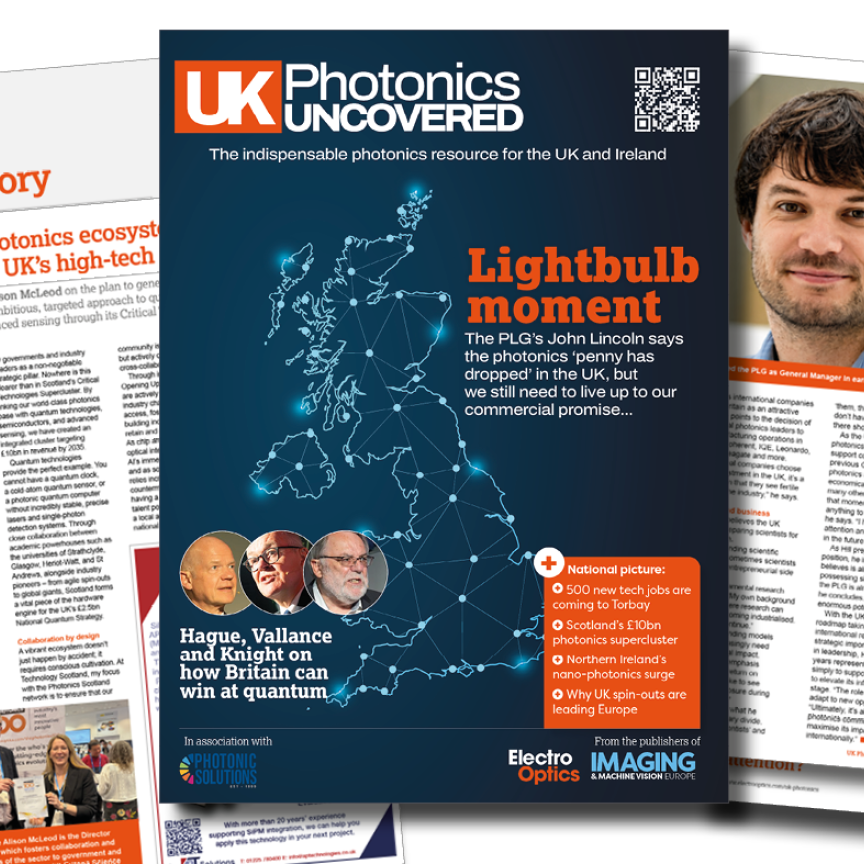
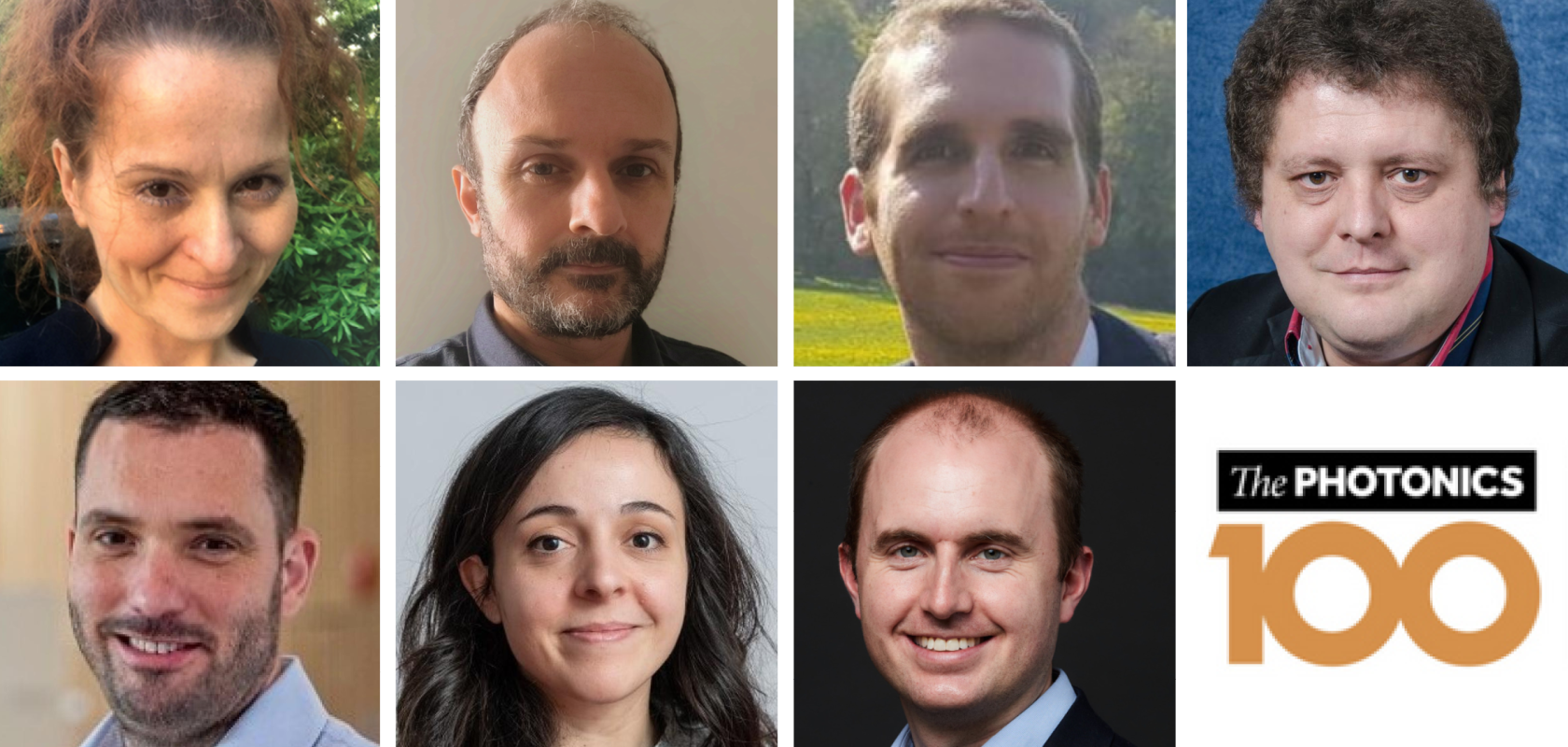
Seven Photonics100 alumni from across UK academia – from Southampton to Cambridge, Birmingham to Aston – spoke candidly with us for this year's UK Photonics Uncovered about the skills gap, the funding ‘valley of death’, procurement bureaucracy and where the UK's next big opportunities lie. Their answers paint a picture of a sector rich in world-leading science, but still struggling to convert that science into products, companies and careers.
Curricula built for a different era
The clearest consensus across the responses is that training in physics and engineering has not kept pace with how photonics is actually practised in industry. Frederic Gardes, Professor at the University of Southampton, argued that curricula should place “greater emphasis on hands-on training in photonic integrated circuit (PIC) design, foundry processes, packaging, testing, reliability, and design-for-manufacture”, adding that graduates need “industry-standard design tools (although these are likely to evolve towards AI-assisted design environments coupled with expert systems) as well as experience working in multidisciplinary teams and undertaking substantial industrial placements as an integral part of their studies”.
Ben Mills, Principal Research Fellow at the Optoelectronics Research Centre, University of Southampton, made a similar point about breadth rather than depth: “Physics and engineering courses should give students more experience of complete systems, not just individual components. In photonics, graduates increasingly need optics, electronics, software, data analysis and machine learning, alongside some understanding of manufacturing and reliability. More project-based teaching with real hardware and industry-led problems would help bridge the gap between a laboratory result and a working system.”
Igor Meglinski, Professor in Quantum Biophotonics & Biomedical Engineering at Aston University, went further, arguing that the shortfall is not conceptual but practical: “The gap is not in fundamental knowledge but in practical fluency. Graduates often have strong analytical skills yet lack experience in writing maintainable code, using version control, building reproducible simulation pipelines, or integrating AI tools into scientific workflows.” He said GPU-accelerated modelling and data analysis are “routinely taught from scratch after graduation, whereas these should be core components of modern physics and engineering curricula”, and emphasised that “projects should be problem-driven rather than topic-driven. A student who has spent a year tackling an open-ended research or engineering challenge is far better prepared for industrial R&D than one who has solved a series of well-defined exercises.”
For George Gordon, Assistant Professor in the Department of Chemical Engineering and Biotechnology at the University of Cambridge, the curriculum gap is now inseparable from generative AI. Curricula, he said, “need to reflect how scientific and industrial R&D workflows are being transformed by generative AI. Graduates should learn how to use tools such as Codex, Claude Code and Google Antigravity to rapidly develop and run optical simulations, analyse data, help control experiments and interrogate complex technical documentation”. Crucially, he added, students “must also learn how to build robust and reliable AI-assisted pipelines, validate the outputs at every stage and recognise when they are wrong.” Gordon said this thinking is shaping a new MRes in Sensor Technologies and Applications that he is developing at Cambridge.
Pola Goldberg Oppenheimer, Professor in Microengineering & Bionanotechnology at the University of Birmingham, framed the fix as systems-level and cross-disciplinary: curricula “need to shift further towards practical, systems-level training that reflects how photonics is actually deployed in industry”, with “stronger integration of instrumentation, data analysis and real-world device development alongside core theory” and “collaborative, cross-disciplinary training early in degrees, particularly between physics, engineering and computational science.”
Retention – money is necessary but not enough
On how to stop researchers leaving the UK, respondents were unanimous that salary alone will not solve the problem. Gardes called for “greater long-term career stability through competitive fellowships, continued access to world-class fabrication infrastructure, and stronger incentives for joint academic/industry appointments”, alongside encouragement for “researcher participation in spin-outs and technology translation activities”.
Luana Olivieri, Research Fellow at Loughborough University, pointed to a specific and worsening structural gap for early-career researchers. “The UK's academic system is under increasing pressure, with a widening gap between recent PhD graduates and researchers progressing towards independent academic positions,” she said.
“If the UK aims to retain outstanding talent, it should introduce structural incentives that create opportunities for early-career researchers – for example, dedicated fellowship schemes in photonics. At present, UKRI and EPSRC offer no postdoctoral fellowship programmes specifically targeted at early-career researchers in physics and photonics.”
She cited a concrete data point: “The declining success rate of the Marie Skłodowska-Curie Postdoctoral Fellowships in 2026 [the programme had a record 17,058 proposals for its last call, according to EURAXESS, up 65% on the year before] reflects this growing imbalance: rather than narrowing, the gap is widening.”
Meglinski's answer reframed international mobility as an asset rather than a leak to be plugged. “Retaining world-leading researchers requires much more than competitive salaries. The UK needs stable long-term investment in research, reduced bureaucracy, and clear career pathways,” he said, before arguing that “international mobility should be encouraged. Researchers who spend several years in leading laboratories abroad gain invaluable experience and international networks, which ultimately benefit the UK. The problem is not that talented researchers leave. It is that there are often too few attractive opportunities for them to return.” He proposed that “the UK should create a sort of internationally competitive 'return pathways', combining long-term support, research independence, and prestigious positions. China has demonstrated how effective this approach can be.”
Universities, he added, “are at their strongest when scientific priorities are led by scientists, with professional services focused on enabling research rather than directing it”.
Gordon linked retention to visibility of industry itself, noting that “students often do not see the genuinely innovative work taking place within UK photonics companies”, and calling for “more industrial placements and joint university-industry projects, including opportunities for researchers to undertake short internships during their PhDs, which is not currently the norm”.
The valley of death, and how to climb out of it
If there was one phrase that has recurred in our conversations about UK photonics start-ups over the past 12 months, it was some version of the "valley of death" – the gap between a working lab prototype and an investable, manufacturable product.
Goldberg Oppenheimer used the phrase explicitly in her response: “The most persistent bottleneck remains the gap between excellent academic proof-of-concept work and de-risked, investable technology. This ‘valley of death’ is still structurally under-supported, particularly for hardware-intensive photonics innovations where prototyping and iteration costs are high.” Her proposed fix combined “more sustained bridging funding, coupled with access to shared pilot-scale facilities and experienced translational engineering support”.
Gardes too described “the lack of sustained, patient capital to bridge the gap between a successful laboratory demonstration and a manufacturable, customer-validated product”, calling this the “mid-TRL [Technology Readiness Level] funding gap” and noting it is “particularly challenging for integrated photonics ventures” because spin-outs “require substantial investment in fabrication runs, advanced packaging, reliability qualification, and application-specific trials long before meaningful revenues can be generated”.
Meglinski offered perhaps the most structural diagnosis, comparing UK provision directly with the European Innovation Council: “UK research funding is very effective at taking ideas to laboratory proof of concept, while investors look for technologies that have already been demonstrated in realistic environments. The difficult and expensive stage between these two points receives very little support.
"The European Innovation Council addresses this through a sequence of Pathfinder, Transition, and Accelerator programmes, where each stage builds naturally on the previous one. The UK has strong funding for early research and later commercialisation, but lacks an equivalent mechanism to bridge the middle stage. As a result, many promising photonics technologies remain as publications instead of becoming products.”
Meglinski was careful to frame this as a design flaw rather than a resourcing one: “This is not a shortage of ideas or investors. It is a structural design problem.”
Christopher Holmes, Professor at the University of Southampton, said “the biggest commercialisation bottleneck is the gap between a good lab result and something a customer believes”.
He illustrated the problem with a project that had already achieved public visibility. “In our own work at University of Southampton, we demonstrated an optical 'nervous system' on a drone, which picked up BBC coverage,” he said. “The science was nontrivial, making stable optical speckle that could be used to interpret loads on the aircraft.
“The commercial challenge was equally hard – making a compact system that was light enough, stable enough in aerobatic flight, robust to vibration and convincing enough that an industrial partner could trust the data.” He argued that the missing ingredient is rarely a single breakthrough: “It is packaging, calibration, reliability testing, field trials, etc. and getting close enough to early customers to understand what they will actually buy.”
Holmes credited UKRI's Impact Acceleration Awards for helping his team's drone work move “beyond a lab demonstration towards something much more credible”, but warned that “there are too few schemes like this, and they are very competitive”.
“If the UK wants more photonics spin-outs, more flexible translational funding at this stage would make a real difference.”
Ben Mills described the same gap in terms of engineering effort rather than invention: “The biggest barrier is often the gap between proving that an idea works and showing that it works reliably in an industrial setting. Early-stage research can be funded, and established companies can attract investment, but the engineering work in between is much harder to support.” He called for “more funding for prototypes, reliability trials and access to industrial equipment,” alongside “earlier involvement from product engineers and commercially experienced people”.
Gordon added a human dimension often missing from funding-gap discussions: the demands placed on academic founders themselves. “Researchers often do not know where to begin and would benefit from a low-risk 'taster' of entrepreneurship,” he said, noting that “academic founders must then move rapidly from being hands-on technical innovators to leaders responsible for people, facilities, finance, regulation and HR.” He wants entrepreneurship treated as “a credible career path, rather than an exceptional, high-risk route associated, for example, with dropping out of university,” supported by “small translational grants, accessible incubators, practical training and experienced commercial support”.
Procurement: the invisible tax on research time
The supply chain question drew some of the most pointed and specific answers of the whole survey, with several respondents identifying university bureaucracy, rather than global supply constraints, as the principal obstacle.
Gardes pointed to physical infrastructure gaps, highlighting “the lack of available 8-inch research epitaxy facilities” in the UK and arguing that existing small-scale epitaxial growth services “are generally designed for sample-scale research rather than manufacturing-oriented demonstrators”. He called for “shared UK purchasing frameworks, transparent supplier directories, and subsidised access to established national facilities such as Cornerstone for silicon photonics,” and for “expanding multi-project wafer programmes” to lower entry barriers.
Meglinski contrasted the cost of components with the cost of process: “Time, not price, is the biggest procurement challenge. Research moves quickly, but procurement processes often do not. The issue is rarely the supplier or the cost; it is the time lost navigating internal procedures.”
He described a specific episode involving computing hardware: “When Apple released the newer M-series processors, our numerical modelling ran faster on a laptop than on the discrete GPU hardware we had. That modelling is not incidental to the physics, it is how we interpret the experiments. But buying an Apple laptop outside the preferred supplier required a special justification and a committee. We eventually got them. The delay had nothing to do with the supplier, the price, or the shipping. It was the internal process."
He described biological sample transfer as “the harder version of the same problem”, explaining that it “requires ethics approval that each institution grants on its own terms and its own timetable, a material transfer agreement negotiated between two legal offices with no incentive to hurry, and shipping under regulations written for pathogens rather than for optical phantoms”. The result, he said, is that “a measurement two groups could complete in a week takes months, and sometimes the collaboration simply does not happen. The science is not blocked by any single rule. It is blocked by the accumulation of separately reasonable ones, none of which has an owner responsible for the total delay.”
His proposed remedy was “not necessarily more money, but greater flexibility and trust”, including “a fast track for research-specific equipment”.
Gordon echoed this diagnosis with figures of his own: “The greatest supply-chain challenge in academia is often public-procurement bureaucracy rather than the availability of technology.”. He described how specialist components “frequently come from small overseas suppliers that face lengthy university onboarding, due-diligence checks, inflexible payment terms and codes of conduct containing requirements they may be unable or unwilling to sign”.
“I have spent up to six months trying to procure specialist components because of these processes.
“Export controls, particularly for ‘dual-use technologies’, create further delays, even when the component and its intended use are innocuous as far as I can tell. We need proportionate deregulation and a much lighter process for purchases below perhaps £5,000. Otherwise, UK researchers risk being unable to access and integrate innovative components from around the world into new technologies and products.”
Mills and Goldberg Oppenheimer both pointed to supplier concentration and lead times as compounding factors. Mills noted that “specialist optics, coatings, fibres and detectors may only be available from a small number of suppliers, sometimes outside the UK”. He called for “better visibility of UK suppliers, shared procurement arrangements and access to shared manufacturing and testing facilities”.
Goldberg Oppenheimer described “fragmented access to specialist photonics components, long lead times and limited flexibility from suppliers for low-volume academic orders”. She proposed “improved frameworks for aggregated academic procurement, preferred supplier agreements and more responsive UK-based distribution channels”.
Where the UK can actually win
Asked to look three to five years ahead, our respondents agreed that AI-photonics convergence would be a dominant theme, but diverged in what they saw as the UK's specific edge.
Mills described AI's changing role within optical systems themselves: “AI is moving beyond analysing optical data and is starting to become part of the optical system itself, controlling lasers, designing optical fields and optimising processes in real time.” He expects “strong progress in self-optimising laser manufacturing, programmable coherent light sources, intelligent sensing and automated scientific instruments”, arguing that the UK's task is “to bring these together to create optical systems that are adaptive, reconfigurable and able to learn from their environment”.
Gardes pointed to hardware for AI infrastructure, specifically “photonic hardware that enables energy-efficient AI and high-performance computing, alongside high-capacity optical interconnects for data centres and satellite communications”. He predicted that “integrated quantum photonics also holds considerable promise, although its commercial trajectory and market timing remain less certain”. He warned that without “sustained investment in manufacturing infrastructure and pilot-line capabilities”, there is a risk that “breakthrough technologies developed in UK laboratories will ultimately be scaled and commercialised elsewhere”.
Olivieri highlighted a less conventional frontier: computing paradigms built directly on optics. “I'm particularly excited about alternative ways to compute in optics, like neuromorphic and analog computing: they offer speed-of-light computation time and high parallelism,” she said, noting that “this trend is quite strong in the UK, with the establishment of several neuromorphic centres, start-ups and established companies turning to alternative computing methods”.
Meglinski offered a unifying view and argued against treating AI, quantum, bionanotechnology and space communications as separate opportunity areas. “The question invites a list, but I think the list is the problem,” he said. “AI, quantum technologies, bionanotechnology, and space communications are often treated as separate opportunities, whereas for photonics they share the same fundamental challenge: transporting structured optical information through media that scramble it.” He argued this is where the UK holds “internationally recognised expertise in structured light, orbital angular momentum, topological photonics, and polarimetric imaging” and warned that funding divided strictly by application area risks different communities “solving the same scattering and information transport problem independently, duplicating effort and slowing innovation”.
Goldberg Oppenheimer pointed to healthcare and diagnostics as a near-term growth area, citing “the convergence of photonics with AI-driven sensing, quantum-enabled technologies and biomedical diagnostics”, and predicting “strong growth in portable, intelligent photonic systems for healthcare, environmental monitoring and secure communications, with UK academia well positioned to lead if translational pathways continue to strengthen”.
Gordon set out perhaps the broadest map of opportunity, spanning “physics-informed AI that uses optical models to improve imaging and sensing; programmable photonics, including reconfigurable chips and phase-change metasurfaces; and fibre-based or chip-scale biophotonics, embedding imaging, spectroscopy and biosensing into minimally invasive probes, microfluidic devices and tools for studying cells, tissues and organoids”.
From an industrial standpoint, he pointed to data centre demand driving “advanced optical switching, reconfigurable photonic integrated circuits, photonic AI accelerators and potentially hollow-core fibres for lower-latency interconnects,” alongside “integrated photonics for quantum processors” and “space-based laser communications, where turbulence compensation and rapid, high-precision beam tracking will become increasingly important as satellite networks expand”.
Electro Optics will launch its annual UK Photonics Uncovered initiative at Microelectronics UK in London's ExCel on Sept 29-30, so drop by our stand at B50 to pick up your copy, or just to say hello.
At 13:05 on Tuesday, 29 September, our COO, Mark Elliott, will chair a panel discussion on “UK Photonics Distribution: What Manufacturers, Startups & OEMs Need to Know”