Douglas McRobbie, Service Team Manager at Photonic Solutions, explains how deep technical expertise and long-term partnerships keep complex laser systems running for decades
When a PhD student is in their final year, waiting for that last crucial set of results, the last thing they need is for their laser system to fail. This scenario plays out more often than you might think in university labs across the UK. Recently, my colleague Craig repaired a system just in time for a researcher to finish their doctorate. For that student, we played a vital role in them completing their degree. That’s the kind of moment that reminds you why this work matters.
At Photonic Solutions, we’ve built our service capability on a simple premise: we support systems for their lifetime, not just for a year after purchase. I regularly speak with customers who have systems that are 20 years old. Some work beautifully; others are limping along. We support them all until they become genuinely obsolete and parts are no longer available. Only then do we have that difficult conversation: "It’s really time to think about upgrading."
The hidden knowledge advantage
One unusual aspect of Photonic Solutions is that the majority of employees started in technical or service capacities. Most people here have been laser engineers, creating a wealth of shared "hidden" knowledge. Several of our current directors started in service roles, and around 40-50% of our engineers hold PhDs in photonics or electro-optics. This gives us enormous technical expertise across a broad area of the photonics world.
This depth is invaluable when maintaining complex systems under the supervision of PIs and professors. This experience and knowledge is crucial in gaining the trust of some of the smartest people in the country. More importantly, this technical depth gives us the confidence to know what we don’t know, and to ask the right questions rather than hoping for the best.
Testing before deployment
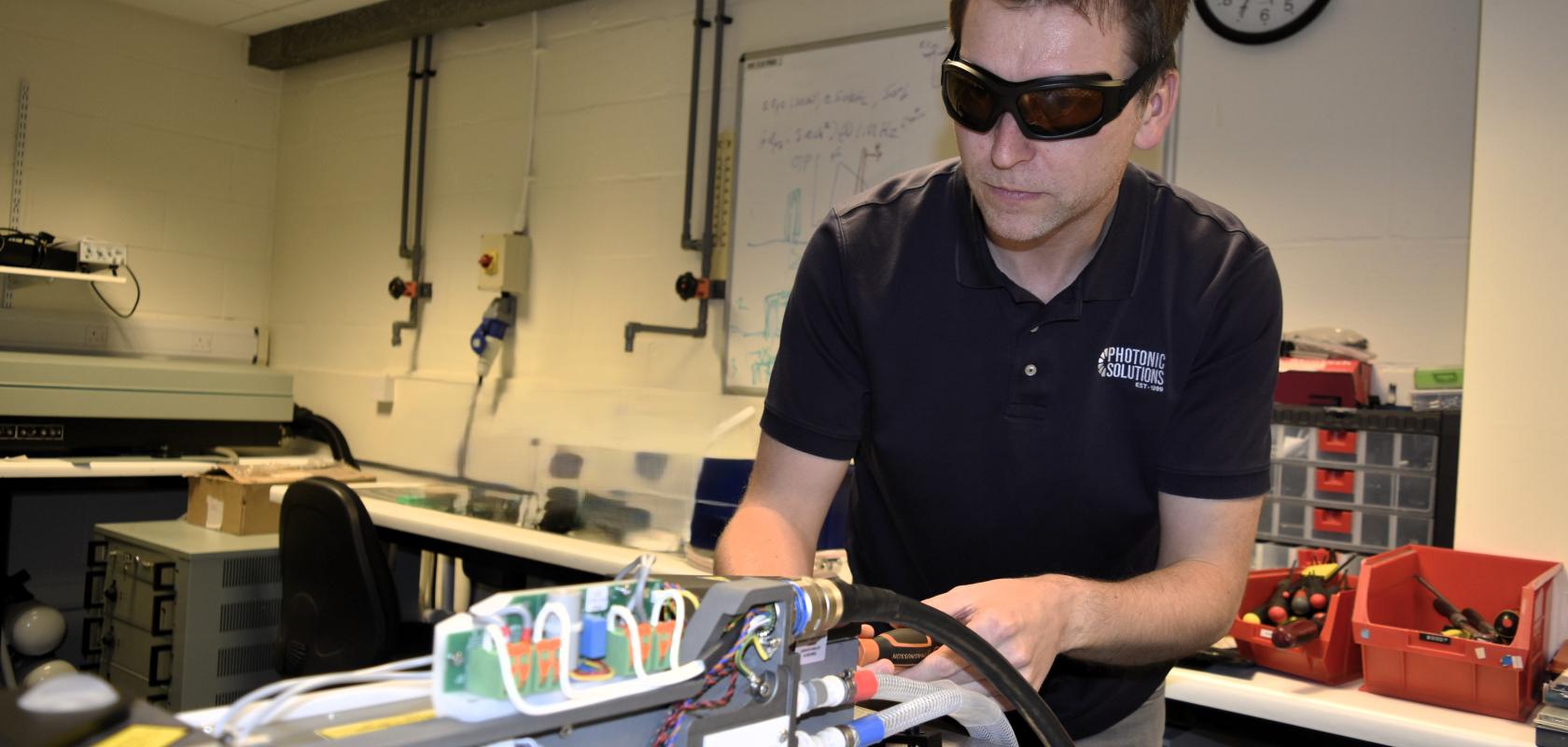
We are fortunate to have a well-equipped photonics lab in our building, allowing us to test every new system before it reaches the customer. This ensures customers never experience "failure out of the box" faults. We catch issues before they leave our facility: whether it’s a loose cable or something fundamental that slipped through quality control.
Sometimes problems occur in transit. We once had a laser system fall off a forklift and land upside down. It arrived badly damaged, but we replaced the components and got it working perfectly in our lab. The customer never had to see that problem. Testing also means we fully understand how each system works before installation. By the time we install it, the customer receives equipment that has been factory tested and then tested again by us. It should just work.
The variety challenge
Because we represent multiple manufacturers, we have a broader range of products to support than any single OEM. This means no two days are the same. You might visit a modern facility in Cambridge, then the next day find yourself in an industrial-era physics building in the city centre. Some buildings in Oxford and Cambridge look more like castles than university departments, yet they house cutting-edge research.
The systems themselves vary enormously. Sometimes you find equipment that looks pristine; other times, you discover a system that’s been "cannibalised" by multiple users over the years. Tracking down missing pieces and understanding the social history of equipment that has moved between labs can be surprisingly challenging.
One unusual project involved a laser system in the back of an articulated lorry: a mobile atmospheric lidar system. They drive this truck to specific locations, open the roof, and fire laser beams upward to measure atmospheric gases. Working on that felt like something from Knight Rider, a fully functioning laser lab on wheels.
What makes it worthwhile
There are two particularly rewarding aspects to this work. First, when you walk into a lab and see despair because a system has failed, then leave a few hours later with everything "singing and dancing" again, that's priceless. You can have a whole team of researchers back in business because of your visit.
Second, mastering a particularly challenging problem is immensely satisfying. Not every job goes to plan, but we always try to ensure progress. Even if the system isn’t fully functional, identifying the root cause means we can order the necessary parts and fix it on the next visit.
Building on strong foundations
We’ve recently doubled our facilities, adding manufacturing capability for OEM assembly. This leverages our team's background in assembly, testing, and quality control. However, manufacturing is an addition to our core business: selling and supporting products from other manufacturers.
Some of our supplier relationships stretch back 26 years. We sold the first-ever laser for the German company SIRAH and have worked with them ever since. These relationships often cross the boundary into friendship; you become a trusted extension of their technical capability.
In university labs, where funding is difficult to secure, researchers fight to keep older systems operational. The role we play in maintaining their progress is critical. When they do secure funding for new systems, they remember who supported them for the last 25 years. The thinking is uncomplicated: look after people well, and they tend to remember. That’s what lifetime support really means, being there when it matters most, for as long as it matters.