
Is China overcoming technical hurdles faster than the West? The short answer is yes, through aggressive vertical integration and a willingness to iterate on hardware at software speeds. The distinction is not that China picks better technologies. It runs all bets in parallel – geometric waveguides, diffractive waveguides, MicroLEDs, LCoS, DLP – and commercialises whichever path delivers a shippable product first. This portfolio approach means China is mastering multiple available paths while aggressively scaling the ones that enable lightweight consumer forms now.
The more critical question is ‘how are they doing this?’.
While Western firms often wait for a technology to be perfect before scaling, Chinese players are industrialising ‘good enough’ solutions while simultaneously funding the ‘holy grail’. Three specific areas that illustrate this stood out at CIOE:
AR optics
It is a misconception that China is only focused on one type of optic. I saw a robust ecosystem for geometric waveguides (Raypai and Shoujing, for example) delivering high image quality. However, the clear strategic bet for the mass consumer future is on diffractive waveguides paired with microLEDs.
Why? Because Chinese OEMs are prioritising form factor (thinness/weight) above all else to crack the ‘everyday wear’ market. They aren't waiting for the perfect optic; they are optimising what fits in a 50g frame today.
MicroLEDs
The ‘red light’ efficiency problem has been a global bottleneck. At CIOE, I saw firms such as Raysolve and Hongshi demonstrating monolithic full-color microLED chips that solve this on the wafer level, bypassing the bulky prism-combiners the rest of the industry still relies on. They are moving from lab concept to pilot line at a pace I haven't seen elsewhere.
Automotive HUDs
Chinese EVs are leaping past the ‘postage stamp’ HUDs common in European cars. Players such as Huawei and XPeng are already deploying ‘panoramic’ HUDs that turn the entire windshield into an AR canvas. These are powered by locally produced, high-brightness LCoS (liquid crystal on silicon) and DLP (digital light processing) engines, driven by software-defined optics that lock graphics to the road. The iteration cycle is annual - closer to smartphones than automotive.
Whether walking through CIOE or Shenzhen itself, there are clear signs that China is developing the scale to dominate, by building a self-reinforcing supply chain that is increasingly immune to external shocks.
The most telling signal at CIOE was Lingxi AR launching a mass-production waveguide for $50. This shatters the BOM (bill of materials) cost barrier. When optics become commodities, Western firms competing on price will be wiped out. And the effects of this cost collapse are already visible on the streets of Shenzhen.
The ‘Huaqiangbei effect’
Walking around Shenzhen's electronics markets, such as the famous Huaqiangbei, I was shocked by what I saw: a massive variety of AR/smart glasses from competing manufacturers are available right now at varying price points. They aren't just building one ‘Pro’ device – they are filling every market tier, from cheap notification glasses to high-end AI assistants.
China is building the ‘Android of AR hardware’ – a diverse, commoditised ecosystem. By the time Western ecosystems fully mature, Chinese consumers will already be accustomed to wearing smart glasses, and their supply chain will have optimised the costs down to smartphone levels.
The ‘iPhone moment’ for AR glasses will likely happen in China first, and within 20-30 months. With access to $50 waveguides and cheap microLED engines, domestic brands can flood the market with consumer-grade smart glasses in the $200-$300 range, establishing the dominant OS and app ecosystems before Western hardware is even affordable.
So what should European photonics firms do?
Europe cannot win a volume war against this machine. The strategy must be one of ‘precision and partnerships’.
Europe still leads in complex, high-precision manufacturing equipment (NIL tooling, metrology) and advanced materials (high-index glass). European firms should double down on being the ‘arms dealers’ of the industry – making the tools and materials that China's volume factories rely on. Companies such as SCHOTT, whose specialty glass substrates are already embedded in Chinese waveguide production lines, show this model works. They do not compete on volume; they supply the inputs that volume depends on.
It should also pivot to ‘specialised’ quality. China is winning on consumer volume (diffractive waveguides). Europe should dominate the high-performance niches (geometric reflective) required for enterprise, medical and defence, where image quality and privacy (zero light leakage) matter more than price.
Thirdly, European companies should move ‘up the stack’. They need to stop selling components and start selling modules. If you just sell a lens, you will eventually be replaced by a lower-cost domestic/international supplier. If you sell a calibrated optical engine that solves a system-level problem (like motion sickness in VR), you remain indispensable.
Final observation
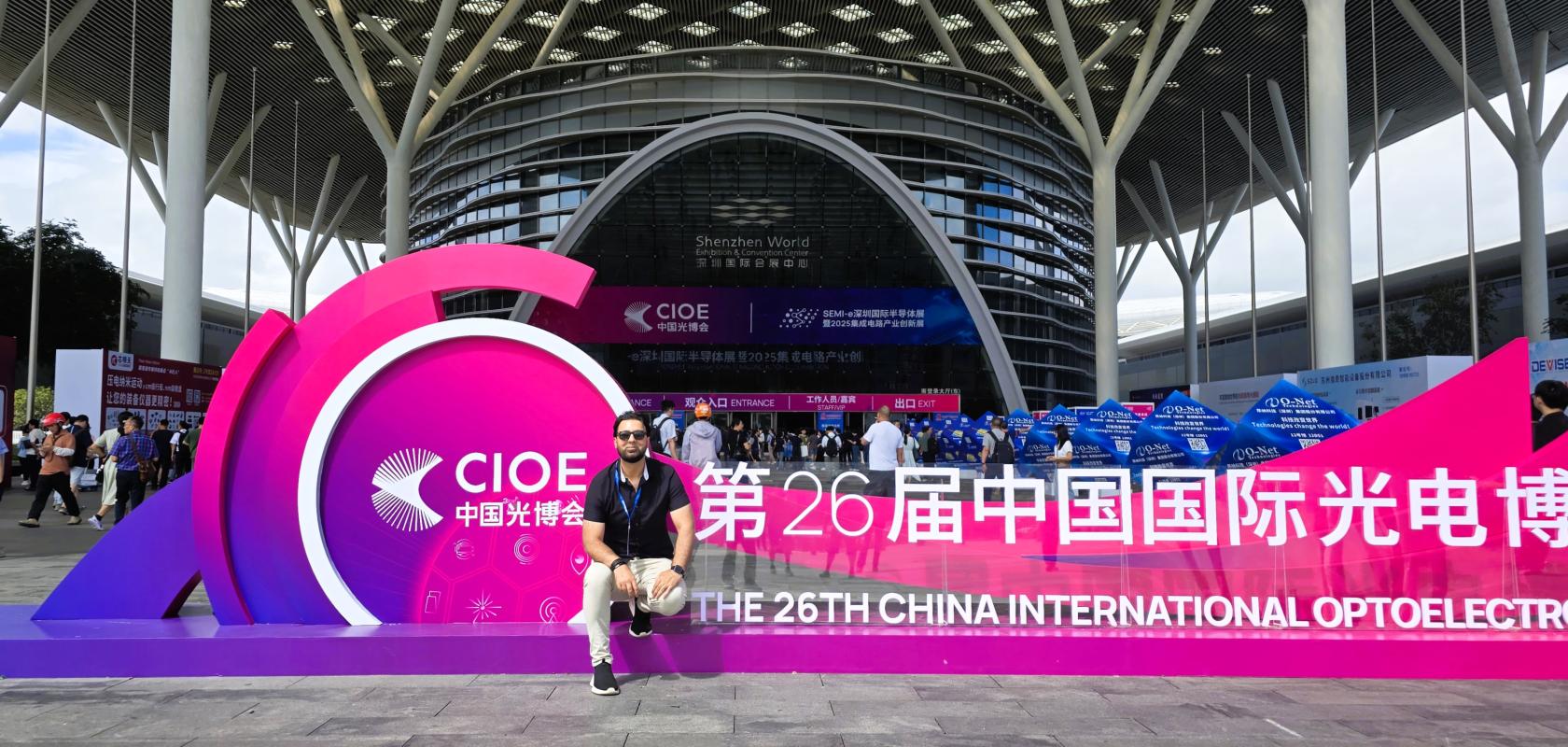
Walking the floor at CIOE, the energy is undeniable. It reminds me of Silicon Valley in the early 2000s – a relentless drive to build, ship, and iterate. I knew the word scale, but understood and saw it in China.
It's a wake-up call: The centre of gravity for optical manufacturing has already shifted. The question now is whether the centre of innovation will follow.
Dr Faisal Kamran, a Photonics100 alumnus, is a public speaker, the Principal Technology Analyst and CE & Sustainable Business Strategist at Sony Technology Partnerships Europe.