
The latest optical prisms in 2026
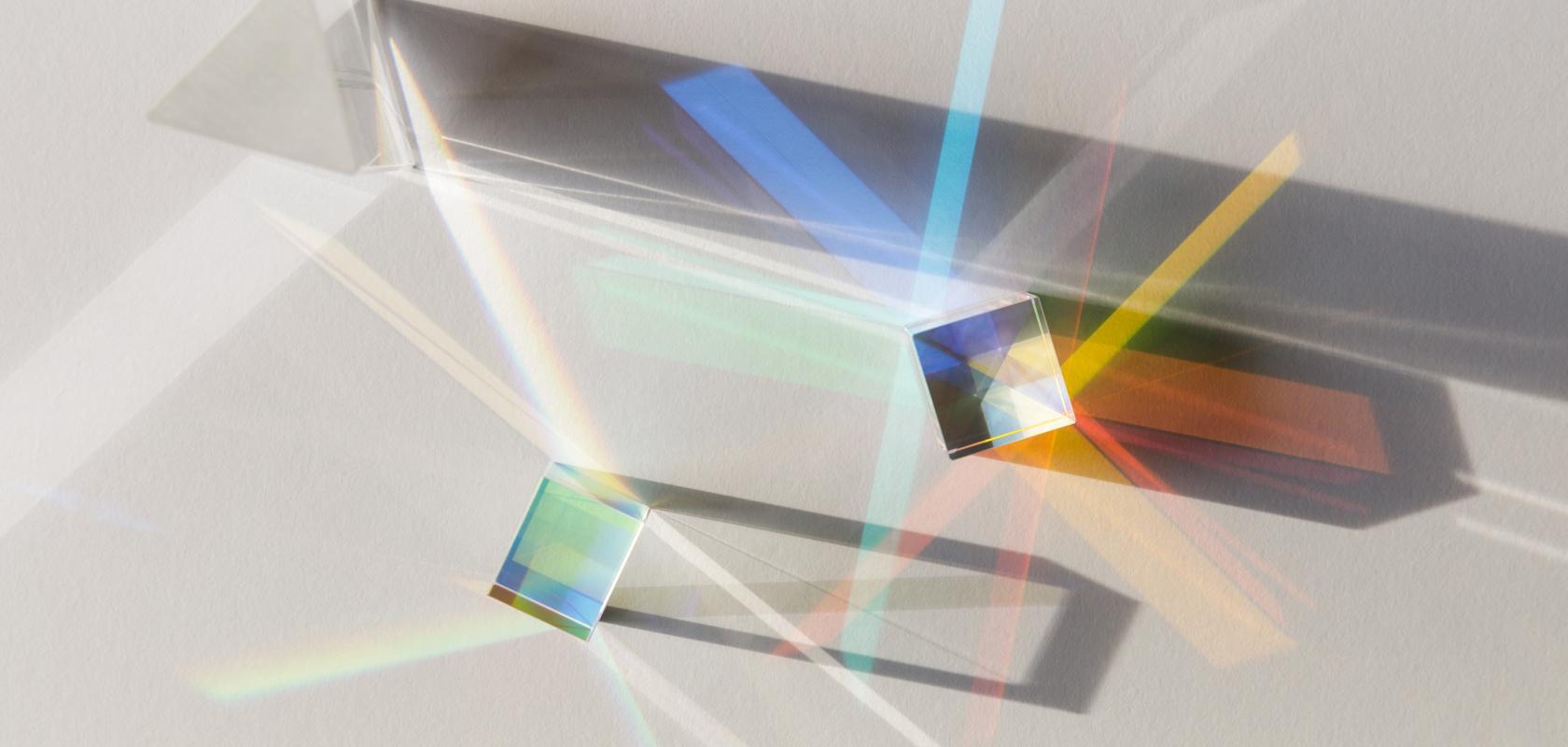
Prisms work using refraction, bending the light as it passes through a material with a different refractive index (Credit: Magic cinema/Shutterstock.com)
Prisms are an established part of numerous photonic technologies, having been in existence for a very long time.
One of the first documented uses of these solid glass optics dates back to the 1660s, when Isaac Newton conducted a series of experiments with sunlight. He identified the ROYGBIV colours (red, orange, yellow, green, blue, indigo, and violet) that make up the visible spectrum of clear white light.
What is an optical prism?
An optical prism is a transparent object with flat, polished surfaces that refract light. Prisms are used to split white light into its component colours or to recombine colours that have been separated.

Find the right component for you with Knight Optical’s range of stock and custom Optical Prisms
Ideal for a range of applications; from laser optics and metrology to imaging systems and beam steering, Knight Optical can provide a wide and varied range of stock optical prisms to ensure you’re able to deliver your next project to the highest standard.
We provide high-precision right-angle prisms, corner cube retroreflectors, roof prisms, homogenising light pipes, and more. Every piece is individually tested by our highly skilled technicians in our state-of-the-art metrology lab to meet our, and crucially our customers’, exacting standards - all available for fast, reliable worldwide dispatch.
SPONSORED BY
They are also used in instruments such as binoculars, periscopes, and telescopes to change the direction of light.
In early 2026, the field has seen a shift towards meta-prisms. These are ultra-thin structures that use nanostructures to bend light, offering a lightweight alternative to traditional glass for augmented reality and wearable tech.
How optical prisms work
Prisms work using refraction, bending the light as it passes through a material with a different refractive index. When light enters a prism, it slows down and changes direction because the angle of incidence is not equal to the angle of refraction.
This results in a separation of the light into its component colours (dispersion). The amount of dispersion depends on the angle and shape of the prism and the refractive index of the material it is made of. The different colours are bent at slightly different angles, causing them to exit the prism at slightly different locations. This is why white light entering a prism looks like a rainbow.
Types of optical prisms
Types of prisms include:
- Dispersive prisms: Used to break up light into its constituent spectral colours.
- Reflective prisms: Used to reflect light in order to flip, invert, rotate, deviate, or displace it.
- Beam-splitting prisms: These use thin-film optical layers deposited on the hypotenuse of one right-angled prism, cemented to another to form a beam-splitter cube.
Optical prism solutions on the market now
Vendors that offer optical prism solutions include Artifex Engineering offers a variety of custom prisms, including all typical designs tailored to requirements. Its range includes right-angle, dove, and wedge prisms, as well as pentaprisms and corner cube reflectors.
CeNing manufactures a range of precision prisms including right-angle, wedge, and rhomboid designs. These are offered in both standard and custom configurations for industrial applications.
Ecoptik provides optical prisms for various applications, including roof, tetrahedral, and Powell prisms. They specialise in creating complex geometrical shapes to meet specific client specifications.
Edmund Optics remains a leading global supplier, offering a vast array of designs, substrates, and coating options. In 2025, they expanded their precision fabrication capabilities and now offer specialised coatings such as UV-VIS and VIS-NIR for high-power laser applications.
FOCtek provides high-precision prisms including beam-splitter penta prisms and corner cubes. Their micro-prisms are widely used in the 2026 optical communications market, particularly in high-speed optical switches.
G&H produces prisms for a wide variety of applications, from high-energy laser cavities to broadband imaging systems. In 2026, they have focused on vertically integrated photonics platforms for scalable deployment in life sciences and aerospace.
IRD Glass manufactures custom optical prisms for applications spanning laser optics to imaging devices. They specialise in basic and complex variations, including roof and penta prisms, with a focus on high-durability materials.
Kingsview Optical can manufacture optical prisms for a range of requirements, from 0.8mm diameter micro-prisms up to 100mm periscope prisms for the UK market.
Knight Optical offers a versatile range of optical prisms, including customisable options. Their UK metrology lab rigorously tests each component using Zygo Verifire XPZ interferometers and Trioptics PrismMaster systems to ensure precision.
Optoman supplies optical filter coating designs in short-pass, long-pass, and band-pass configurations. Their IBS-coated optics are optimised for high-power applications and feature spectral drift-free performance.
Perkins Precision Developments manufactures custom prisms in materials such as fused silica, YAG, and ZnSe. They provide low-loss, high-energy IBS thin-film coatings for applications in the UV, visible, and near-infrared (NIR) spectrum.
Precision Optical produces ultra-precise prisms in sizes ranging from 3mm to 300mm. They specialise in intricate custom geometries and multi-component prism assemblies for aerospace and defence.
Sydor Optics has significantly expanded its capabilities in early 2026 following its acquisition of Vertex Optics. They provide custom optical wedges for laser beam steering and offer advanced stitching interferometry for large-scale optical flats.
Taiyo Optics provides a comprehensive range of prisms, including Brewster prisms and corner cube reflectors. They continue to offer a high degree of customisation for the global photonics market.
This is not an exhaustive list. If you want your company included, please email: editor.electro@europascience.com.