The full conference programme for Photonics UK, the dedicated photonics stage running as part of Microelectronics UK, has been published ahead of the event's return to ExceL London this September.
Across two days, the agenda brings together speakers from defence, space, telecoms and academia to address the technologies and policy questions shaping the UK photonics sector, with sessions spanning satellite communications, quantum, optical computing and next-generation sensing.
Electro Optics will also launch its annual UK Photonics Uncovered initiative at the event, so drop by our stand at B50 to pick up your copy of the yearbook, or just to say hello.
At 13:05 on Tuesday, 29 September, our COO, Mark Elliott will chair a panel discussion on “UK Photonics Distribution: What Manufacturers, Startups & OEMs Need to Know”, where marketing executives from some of the UK's most prominent photonics distributors will give their frank perspective on the state of the market, the challenges distributors face, and crucially, what they need from the companies they work with throughout the supply chain.
As for the rest of the event, it is broken down into two strong content streams.
Day one: space, defence and distribution
The conference opens on Tuesday, 29 September, with a chair's welcome from Mark Elliott, before moving into a panel examining what the Photonics Roadmap will mean for the UK photonics market, featuring John Lincoln, CEO of the Photonics Leadership Group.
Space applications dominate the morning, with Robert Atchison of ClearspaceUK addressing free space optical communications, followed by a panel on photonics for space-based systems and orbital infrastructure. That session brings together Alison McLeod of Technology Scotland, Zhixin Liu of UCL and Nibras Communications, and Nikki Antoniou of Airbus Defence and Space to cover lidar and optical remote sensing, photonic payloads for satellite architectures and laser-based debris mitigation. Rory Holmes of UK Space follows with a session on photonics manufacturing in low Earth orbit.
Mark Elliott returns to chair the Electro Optics session on UK photonics markets. Henny Sands of the UK Space Agency then addresses spectrum policy for satellite communications networks.
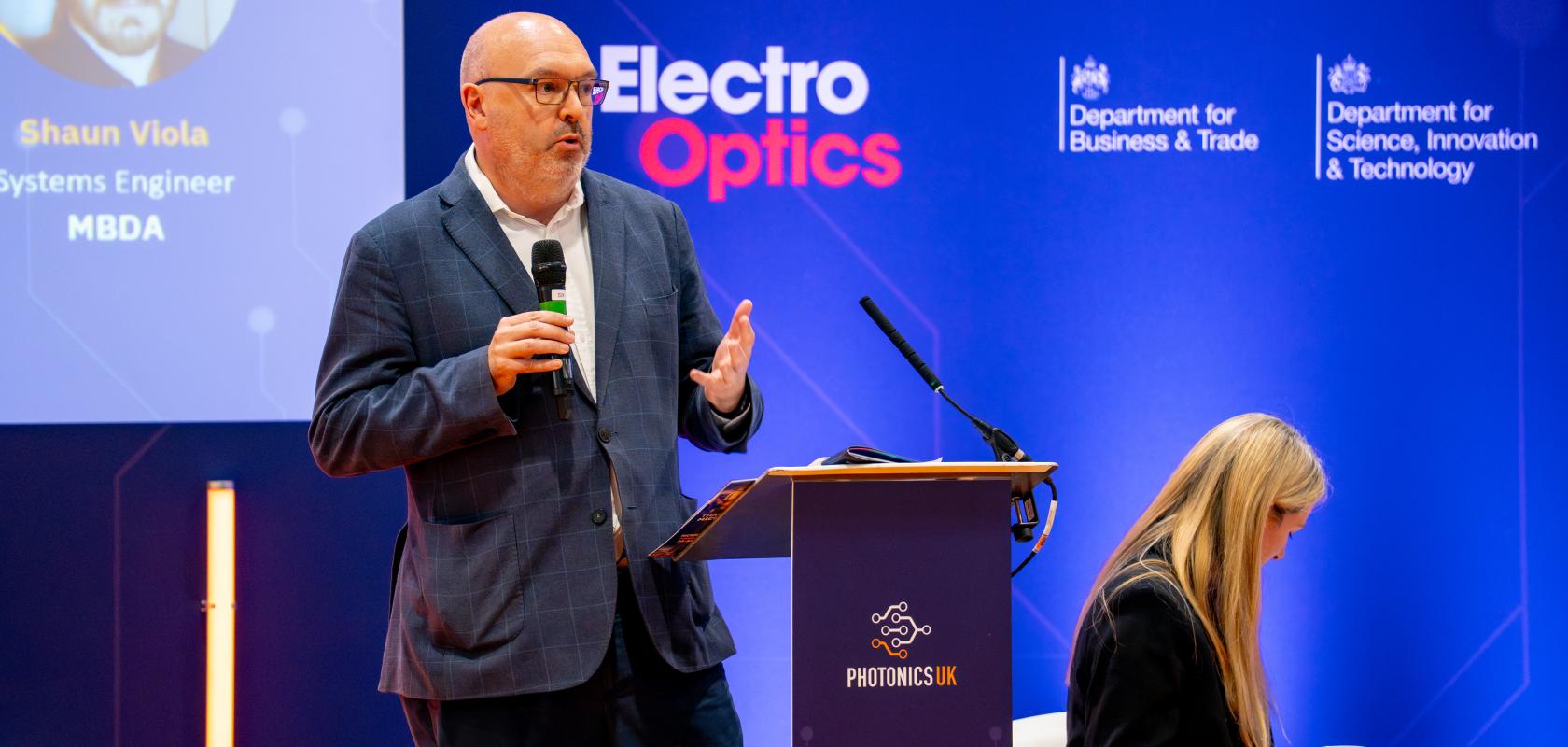
The afternoon turns to defence and security applications. A panel on enhancing airborne operations with photonic technologies brings together Shaun Viola of MBDA, John Robertson of DSTL, Martin Agnew of Airbus and Jack Chynoweth of Leonardo, covering photonic payloads for UAVs, jam-resistant optical communications and SWaP constraints. Robertson returns for a solo session on multi-domain sensing for defence, before a further panel on optical systems for ground and naval security featuring Joseph Cotter of Imperial College London, Chester Butterworth of the Royal Navy and Jonathan Murrell of General Dynamics. The day closes with a session on Earth-based sensing for environmental monitoring and climate solutions.
Day two: integration, computing and quantum
The second day, Wednesday, 30 September, opens with a panel on advances in compact photonic integration, addressing silicon photonics for co-packaged optics, III-V on silicon integration and the manufacturing challenges behind miniaturisation for AR/VR, 5G and edge computing. Speakers include MBDA’s Shaun Viola, Frank Yao of Innofocus Photonics Technology, Colin Mitchell of the University of Southampton's Optoelectronics Research Centre and Adam Carter of OpenLight.
Fibre optic technology features prominently through the late morning, with sessions on modern fibre tech for security and transfer speed, and a review of fibre sensing in urban environments from Andrew Lord of BT. Lord returns after the morning break for a panel on harnessing the potential of optical computing alongside Ioannis Kypraios of the European Innovation Council, examining the evolution of optical links from 800G to 1.6T and the maturation of hollow core fibre. Andy Sellars of Cornerstone then addresses the impact of AI on photonic processes.
The afternoon covers 6G and optical network convergence, before Hassan Zaidi of BAE Systems discusses creating next-generation AR/VR. The day closes with a panel on the impact of quantum technologies on the microelectronics landscape, featuring Johan M. Carlsson of Dassault Systèmes Germany, Sara Duodu of TechUK, and Rhian Granleese of Marks & Clerk, addressing how quantum could reshape chip design and the long-term implications for security and encryption.
Photonics UK takes place as part of Microelectronics UK on 29-30 September at ExCeL London.
Entry is free – click here to sign up.