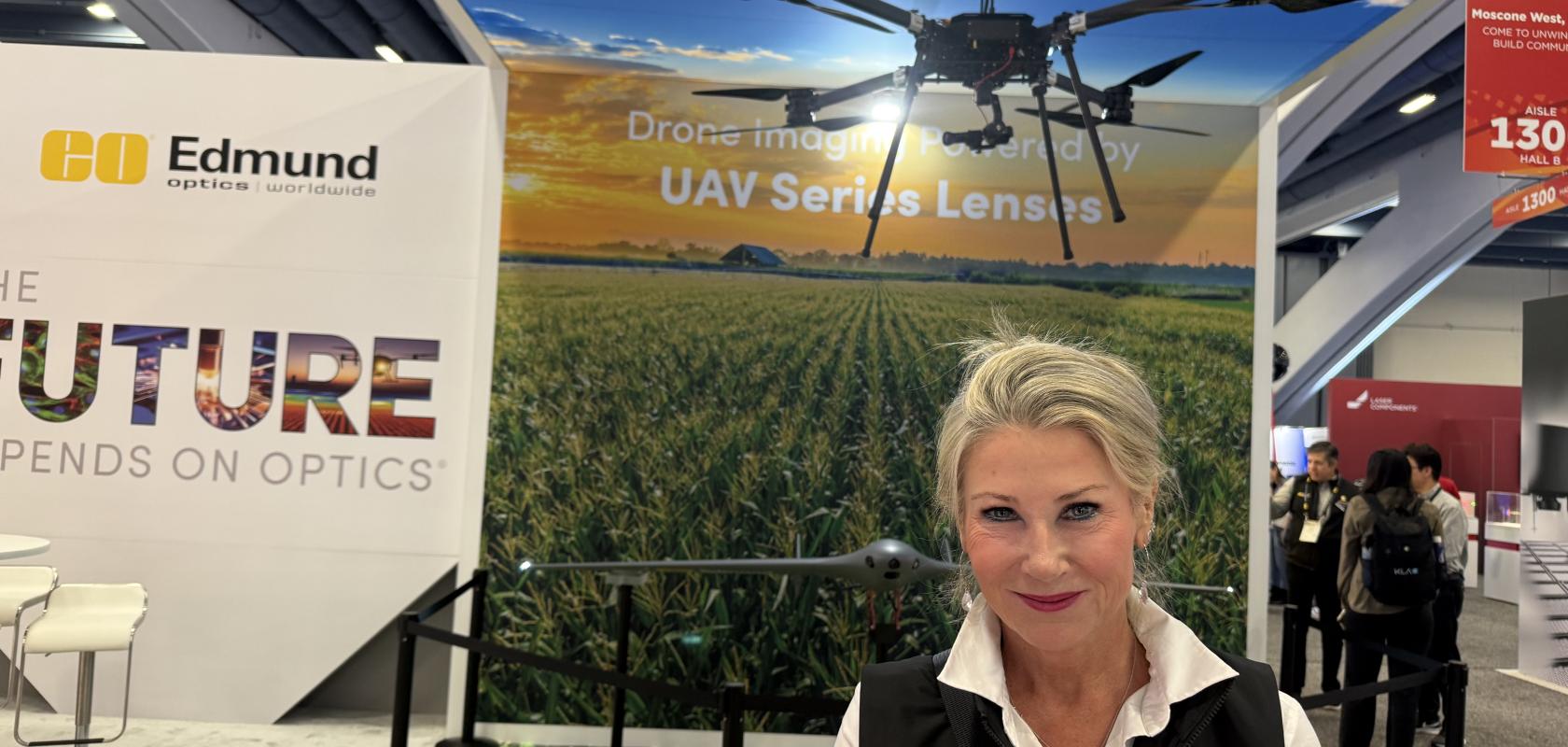
Photonics West has long served as a barometer for the health and direction of the global optics industry, and at 2026’s San Francisco event, it once again delivered a clear signal: manufacturing capability, proximity and partnership are rising to the top of strategic priorities. For Edmund Optics, the show was not about launching a single headline product, but about helping reshape how the company is understood.
“I still think this is one of the most important events of the industry,” said Agnes Huebscher, Senior Director Corporate Affairs, Communications & Industry Relations. “It’s good that it’s at the beginning of the year because it really sets the tone for the coming 12 months. You really get feedback on how the industry is ticking – and, of course, how customers are proceeding with their projects.”
That feedback, she explained, is increasingly shaped by customers’ need for speed, resilience and deeper collaboration. This year, Edmund Optics used the show to shine a spotlight on a part of its business that remains surprisingly unfamiliar: its precision optics manufacturing depth. While the company is, of course, widely known for its extensive catalogue and off-the-shelf inventory, Agnes is clear that this perception no longer reflects reality. “We were founded in 1942, and we were first known for the catalogue,” she said. “This is what people immediately connect with us. But we are so much more than that.”
Edmund continues its strong investments in precision optical fabrication and coatings, both organically with capex for areas such as aspheres, coatings relating to filter and laser technology, and assemblies, and also through strategic acquisitions. A key element of that message was the full integration of Edmund Optics Manufacturing Aachen into the main booth this year. Acquired in 2025, the former Fraunhofer spin-out, previously known as son-x, specialises in ultra-precision diamond turning, particularly for aluminium optics used in demanding applications such as aerospace. “This is their first time being fully integrated in our booth,” Agnes explained. “They are very good in diamond-turning aluminium, with very high accuracy, and specifically for space applications.
"We are also seeing an increase in crystalline material fabrication requests. This acquisition very much complements our precision assembly businesses in Tucson and Malaysia, where we have extensive engineering and metrology capabilities to optimise performance on an optical assembly. We have a growing customer base that sees Edmund Optics as a partner in their technology development and manufacturing. Fabricating optical elements is important, but even more critical is assembling and alignment those elements to maximise their performance and deliver consistent and trusted performance to our customers."
The integration of son-x is symbolic of a broader shift. Rather than presenting isolated components, Edmund Optics increasingly wants customers to understand how optics function within complete systems and assemblies. “Sometimes, optics can be very abstract,” Agnes said. “People need to be shown where optics go into applications and should understand how well Edmund Optics can support integrating them in final applications. That makes it more tangible – and it shows what we’re capable of doing. It’s not just the single component anymore.”
From components to assemblies
That shift extends beyond Europe. In Tucson, Arizona, Edmund Optics has made significant investments to build out mid-scale assembly capabilities. “We’re not doing entire systems,” Agnes clarified, “but we are doing mid-size assemblies and sub systems.”
This move reflects a wider industry trend towards localisation and vertically integrated manufacturing, driven by supply-chain concerns and geopolitical pressures. For Edmund Optics, global scale is both an advantage and a challenge. “We have manufacturing in China, Malaysia, Japan, Germany, and the US,” Agnes said. “That global footprint is a benefit – but also, perhaps, a risk, especially in today’s environment with tariffs and political uncertainty.”
Rather than retreating from global manufacturing, the company is balancing it with stronger regional capacity. Recent investments, such as a new European distribution hub in the Netherlands, are designed to bring products closer to customers. “To be quicker within Europe, to be with customers on-site, to have product within 24 hours – that has proven to be a very good investment,” she noted.
Despite decades of manufacturing experience, Agnes believes Edmund Optics still needs to do more to communicate this capability. “Our aim at the show this year is simple,” she said. “We want people to know we are a manufacturer. We can customise optics, and we partner with customers from the idea, through the design phase, all the way to the final product.”
Customisation now represents a significant portion of the business. While many customers still begin with off-the-shelf components, they increasingly return with tailored requirements. “People often take the standard optic to see if it works,” she explained. “Then, they come back and say, ‘This is it, but I need a tailor’. Different coating, different dimensions. About half of our business now involves customisation.”
That transition – from catalogue purchase to collaborative project – is supported by Edmund Optics’ digital platforms. The company continues to invest heavily in its online marketplace, while deliberately creating pathways into deeper technical engagement. “Once you find the product online, there’s always a button next to it saying, ‘Want to customise?’” Agnes said. “That’s how we bring customers from a standard product into a project.”
Building an ecosystem of capability
To extend its reach further, Edmund Optics has also launched the Trusted Optical Partnerships Program (TOPs), designed to connect customers with complementary expertise beyond Edmund’s in-house capabilities. “We bring companies into our ecosystem that have capabilities we currently do not have,” Agnes explained. “The vastness of photonics means no one can cover all aspects of mechanical and optical design specialties. TOPs partners support us and the customer in these areas, and we stay with the customer through the final project.”
This ecosystem approach reflects a more customer-driven development philosophy. Rather than pushing technology into the market, Edmund Optics increasingly responds to clearly articulated needs. “We are not engineering-driven – we are customer-driven,” Agnes said. “If there is no need, even the coolest technology has no value.”
One example is the development of ruggedised lenses, designed to withstand vibration, altitude and temperature extremes. Originally developed in response to customer demand, the technology has since been standardised and applied across multiple product lines. “It started as a specific request,” she said. “Now it’s a standard process we can apply to many products, and these specific products are supporting multiple applications.”
Applications, sustainability and responsibility
In terms of end markets, Edmund Optics is seeing strong demand from defence and security, alongside continued interest in life sciences, agriculture and environmental monitoring.
“There is definitely a big lift in defence,” Agnes acknowledged, “for sad reasons.” At the same time, applications for agriculture and optics used in stratospheric platforms for early forest-fire detection underline the broader societal impact of photonics. “We don’t just try to be green ourselves,” she said. “We do optics for green applications. That’s a nice way to support today’s challenges.”
As projects become more complex and timelines compress, engineering philosophies are also evolving. Agnes believes experience now plays a critical role. “You have a better base to work from,” she said. “It’s not just about speed – it’s about reliability; delivering what was asked for.”
Iteration remains central, even when projects do not end exactly where expected. “Sometimes you learn so much along the way that the product becomes something different,” she said. “It may not work for that one customer – but it might work for another.”
Despite its size and global reach, Agnes is also keen to emphasise Edmund Optics’ people-centric approach. “It’s all about relationships,” she said. “We stick with customers. There is always a person to talk to. That’s part of our advantage.”
In an industry dense with technology, she sees visibility and human connection as essential differentiators. “People perhaps don’t always know us,” she said. “That’s why being present at events such as this, telling stories, showing the people behind the optics – it really matters.” As Photonics West 2026 demonstrated, Edmund Optics’ message is clear: the catalogue may have built the brand, but manufacturing capability, partnership and trust are shaping its future.