Water analysis, thanks to techniques like UV-Vis Spectroscopy, plays an important role in environmental sustainability, public health, and industrial innovation. As we confront pressing issues such as climate change, population growth, public health and the depletion of natural resources, accurate, real-time monitoring of water quality becomes essential. This extends beyond scientific inquiry, it is crucial for businesses and governments striving to meet ESG objectives and regulatory standards. Maintaining an accurate picture of water quality not only aids in devising climate strategies but also offers a significant competitive advantage.
Water treatment technologies
Recent technological advancements have transformed traditional approaches. The latest modern tools such as AI-powered predictive analytics, digital twins (virtual models that accurately replicate real-world physical systems, facilities, or processes), and Industrial Internet of Things (IIoT) platforms now enable dynamic, digital optimisation of treatment processes, early detection of contaminants, and energy-efficient operations [1].
These innovations are reshaping the water sector, offering enhanced operational intelligence and resilience against extreme conditions.
A notable example is the ultra-filtration plant in Corleone, Sicily, which demonstrated the effectiveness of advanced membrane technologies in producing reclaimed water for agricultural and industrial utilisation. The facility achieved Class A water quality under EU Regulation 2020/741, adhering to strict standards for E. coli, turbidity, and total suspended solids [2].
These developments open new avenues for solutions that offer operational efficiency, sustainability, and competitive advantages. Water analysis instrumentation, from laboratory spectrometers to cloud-integrated, IoT-enabled sensors, is increasingly central to industrial decision-making. The global market for water analysis instruments is projected to grow from $4.1 billion in 2025 to $7.1 billion by 2035, driven by regulatory pressure and the need for automated, real-time monitoring [3].
Water analysis techniques
Effective water quality management relies on a suite of analytical techniques, each tailored to specific monitoring needs and operational contexts. The evolution from traditional laboratory methods to advanced digital solutions reflects the sector’s drive for greater accuracy, efficiency, and real-time insight [4].
Laboratory-based analysis
Laboratory-based methods remain foundational for establishing baseline water quality and ensuring regulatory compliance. These techniques are typically used for periodic, high-precision measurements, including:
- pH, turbidity, and conductivity: Measured using benchtop meters to assess general water quality.
- Heavy metals (e.g., lead, cadmium, mercury): Detected via Inductively Coupled Plasma Mass Spectrometry (ICP-MS).
- Organic pollutants: Analysed using Gas Chromatography-Mass Spectrometry (GC-MS).
- Microbial content: Assessed through membrane filtration and culture-based techniques.
While these methods provide robust and reliable data, they are often limited by the need for sample collection, transport, and processing time [5].
Sensor-based real-time monitoring
Recent advances have enabled the deployment of IoT-enabled, multi-parameter probes for continuous, on-site monitoring [6]. These sensors [7] are installed at critical sampling points and can measure:
- Dissolved oxygen (DO)
- Nitrate and phosphate concentrations
- Temperature and flow rate
Data from these sensors is transmitted to cloud-based dashboards, allowing for remote access, trend analysis, and immediate response to anomalies. This approach supports proactive water management and rapid decision-making.
Advanced digital techniques
To further enhance predictive capabilities and operational efficiency, digital technologies are increasingly integrated into water analysis workflows [1, 5] :
- Machine learning models are trained on historical and real-time data to forecast contamination events and optimise treatment processes.
- Digital twins, (virtual models of treatment plants), simulate process changes and support scenario planning.
- Edge computing reduces latency in sensor data processing, enabling faster detection and response to water quality issues.
By combining laboratory precision, real-time sensor data, and advanced analytics, organisations can achieve comprehensive water quality monitoring [6]. This integrated approach not only ensures compliance and operational excellence but also supports broader sustainability and public health goals.
Spectral analysis with optical technologies from Hamamatsu Photonics
In addition to biological and chemical analyses, which typically require laboratory testing and the use of reagents, recent optical technologies enable on-site, real-time analysis without altering or contaminating the sample.
By analysing light across different wavelengths, such as with UV-Vis spectroscopy techniques, it is possible to extract valuable information about both the presence of specific agents and the turbidity of the water. In this domain, Hamamatsu Photonics offers a comprehensive portfolio of mini-spectrometers and components tailored to diverse analytical needs:
- Mini-spectrometers for full-spectrum analysis (UV and visible)
- CCD and CMOS image sensors
- Photodiodes, covering the UV to infrared spectrum
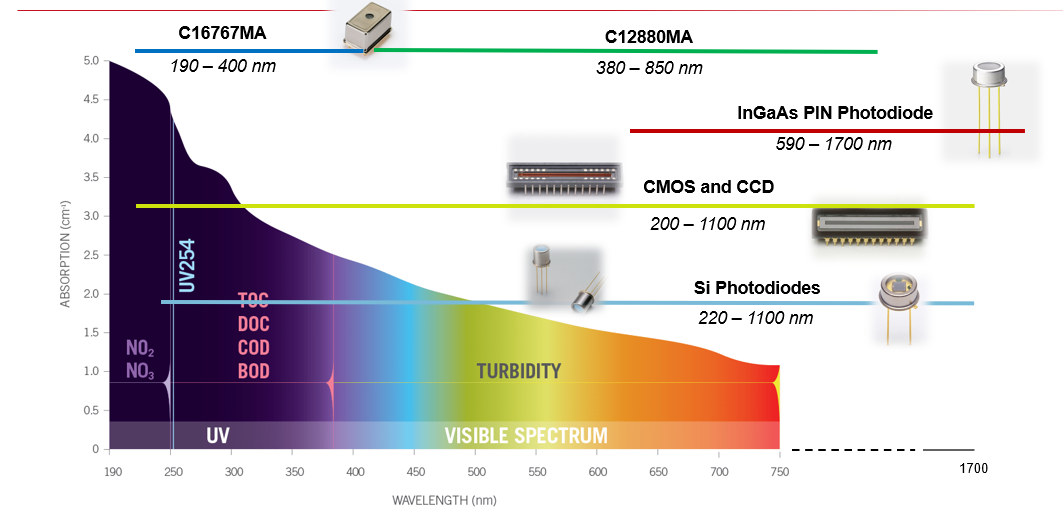
Figure 1: Hamamatsu detectors for water analysis, covering UV to VIS spectrum. Products depicted: Mini-spectrometers, InGaAs PIN photodiodes, CMOS and CCD sensors, silicon photodiodes
Particularly noteworthy in UV spectrum analysis are the S12742 and S16014 photodiode families, designed with specific filters targeting wavelengths at 220, 254, and 275nm, ideal for detecting pathogens and organic compounds. To complete the solution offering, these detectors can be paired with Xenon flash lamps, providing a stable and high-intensity light source for sophisticated analytical applications.
The integration of UV-Vis spectroscopy and digital techniques represent a transformative leap in water quality monitoring. As industries and public authorities prioritise sustainability and compliance, these technologies not only enhance operational efficiency but also lead to a more resilient and proactive approach to water management. By embracing these advancements, we can safeguard our vital water resources and support a healthier environment for future generations.