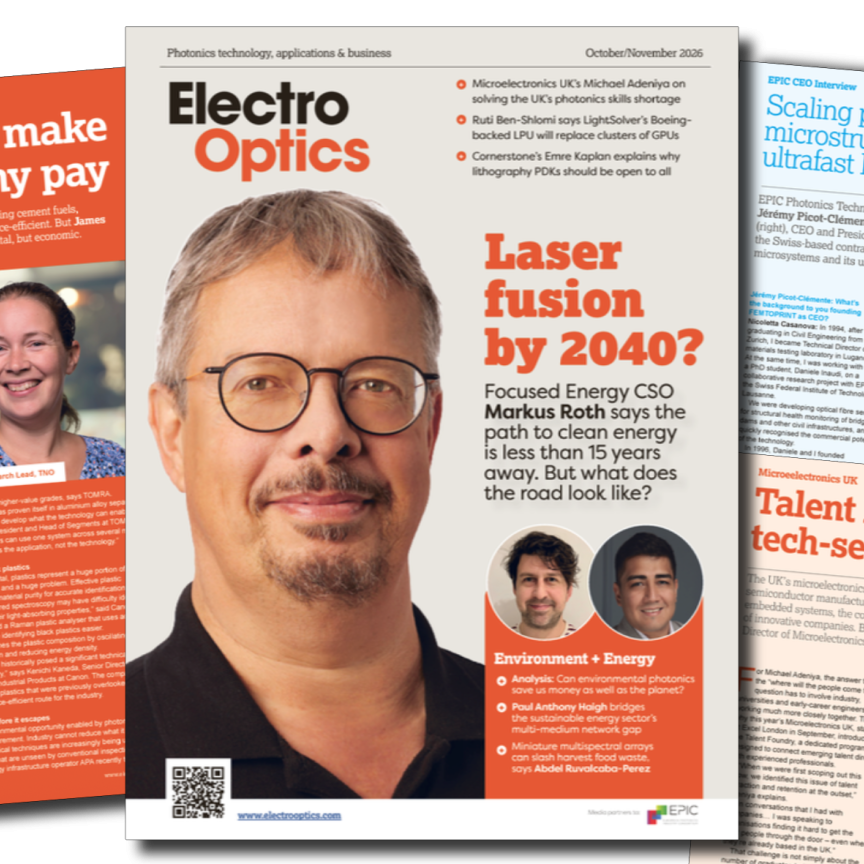
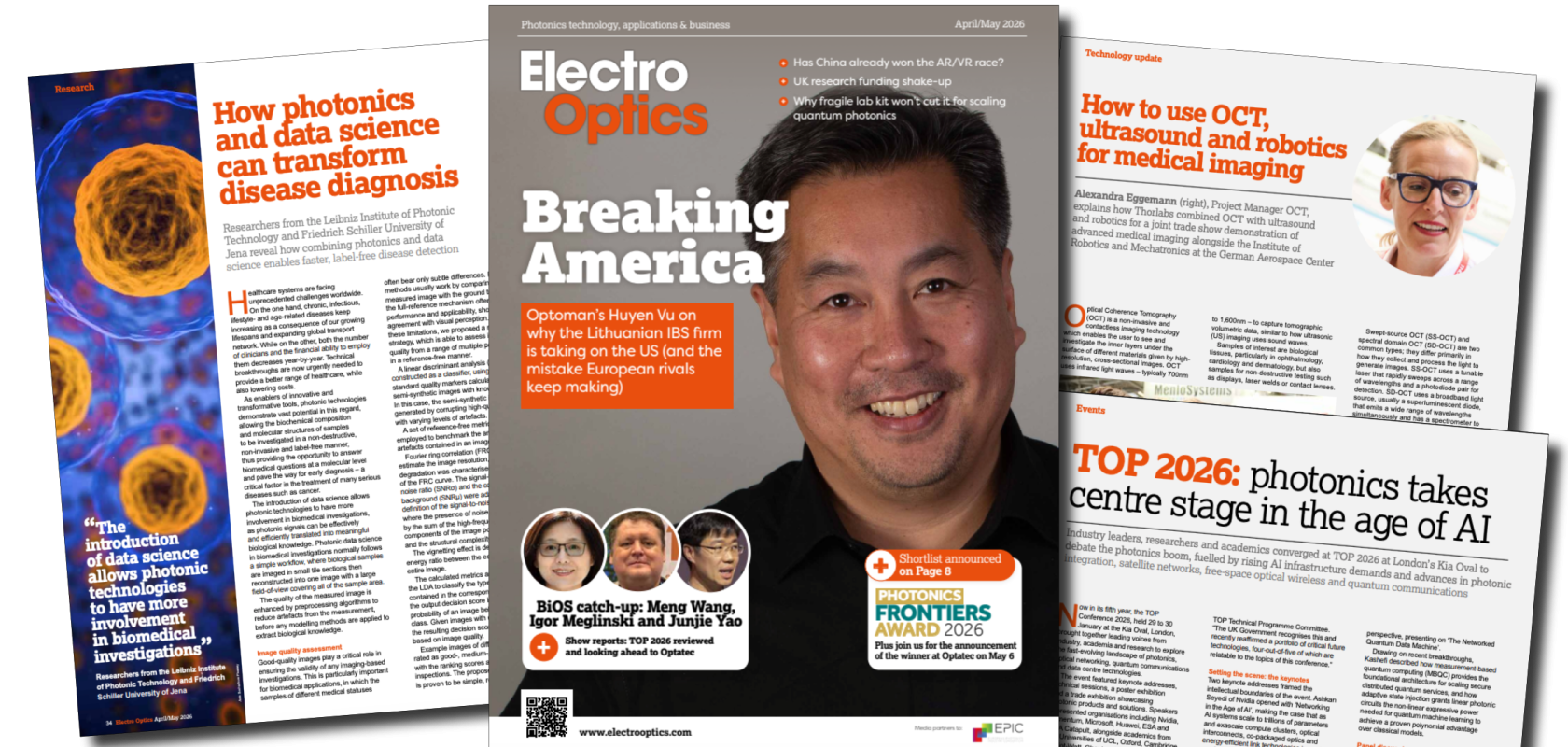
The latest issue of Electro Optics zooms in on a sector in flux. From UK funding shake-ups and AI-driven demand to quantum and biophotonics breakthroughs, this edition explores how light-based technologies are scaling out and stepping up with real-world results.
The April/May 2026 issue of Electro Optics has arrived, and it’s brimming with insight, debate and just enough laser-sharp wit to keep things in focus. This time, the spotlight falls on a field balancing big ambition with real-world pressures, from funding uncertainty to industrial-scale medical innovation.
Funding the future… or dimming the lights?
Leading the issue is a deep dive into the shifting landscape of the UK photonics funding landscape. With AI and quantum technologies commanding global attention, the question isn’t whether photonics matters, it’s whether it will get the coordinated backing it needs.
A recent restructuring of UK research funding has raised eyebrows across the scientific community. While the intention to align a national strategy is positive, many researchers are left wondering if the changes will sharpen the UK’s competitive edge or scatter resources at a critical moment.

UK Prime Minister Keir Starmer delivers speech at London Tech Week (Image: UK Prime Minister)
Conferences, collaborations and a photonics boom
At the TOP Conference 2026 in London, photonics took centre stage in discussions around AI infrastructure, satellite networks and photonic integration. If there was a single takeaway, it’s that demand for faster, more efficient data systems is pushing light-based technologies into the spotlight like never before.
Meanwhile, at BiOS 2026, biophotonics experts highlighted advances in medical research, with AI once again making an appearance, this time as a powerful partner in diagnostics and imaging. Collaboration across disciplines was also a recurring theme, even if the jury is still out on how seamless the collaboration really is.
Looking ahead, Optatec 2026 is gearing up to put miniaturisation front and centre. Smaller, smarter photonic components are the name of the game, and this year’s partnership with the Photonics Frontiers Award signals a focus on innovation that’s as compact as it is impactful.

(l-r): Igor Meglinski, P100 honouree and Professor of Quantum Biophotonics and Biomedical Engineering at Aston University; Meng Wang, Senior Group Leader at HHMI Janelia Research Campus; and Junjie Yao, Jeffrey N. Vinik Associate Professor of Biomedical Engineering at Duke University (Image: Aston University, Meng Wang, Junjie Yao)
A reality check for AR/VR
In this issue’s opinion piece, Faisal Kamran delivers a clear message to Europe’s AR/VR sector: catch up, or risk being left behind. China’s approach, running multiple technology paths in parallel and scaling what works, is proving hard to beat. It’s less about picking winners early and more about moving fast and iterating faster.
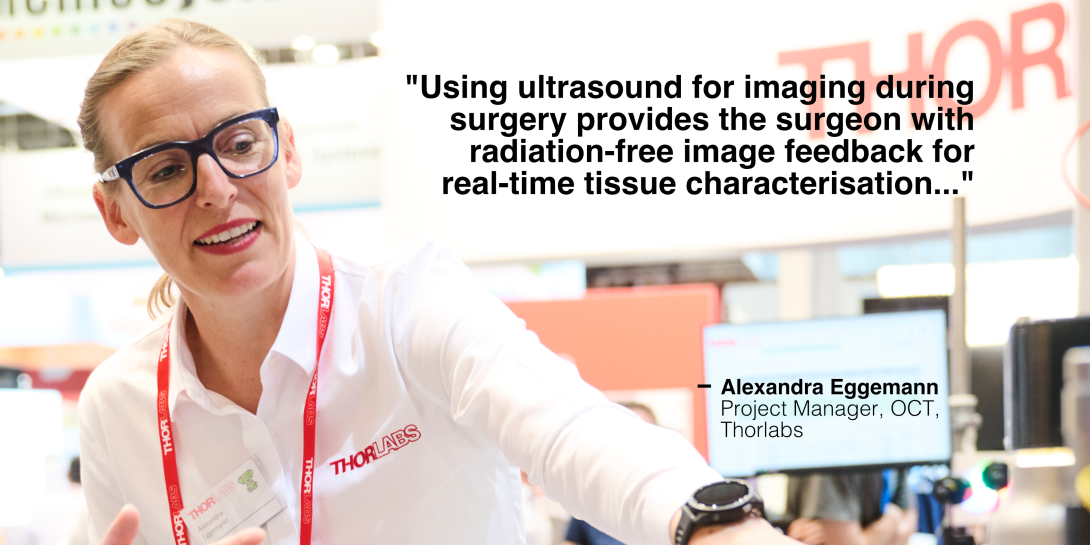
“Preoperative imaging helps identify cancerous tissue, but brain shift can cause drastic changes to tissue geometry and location,” says Thorlabs’ OCT Project Manager Alexandra Eggemann (Image: Thorlabs)
From lab bench to factory floor
This issue’s interviews include Monarch Quantum’s Timothy Day arguing that fragile, lab-built components simply won’t cut it in real-world quantum systems. Rugged, scalable alternatives are the only way forward if quantum technologies are to move beyond controlled environments. Similarly, OPTOMAN's expansion into the US highlights how global markets, time zones and supply chains are shaping business decisions just as much as technology itself. Meanwhile, at Scanlab, Holger Schlüter reflects on a career spent following laser technology across industries with one constant: the potential of photonics is far from exhausted.
(Image: Arek Socha from Pixabay)
Teamwork makes the dream work for medical research
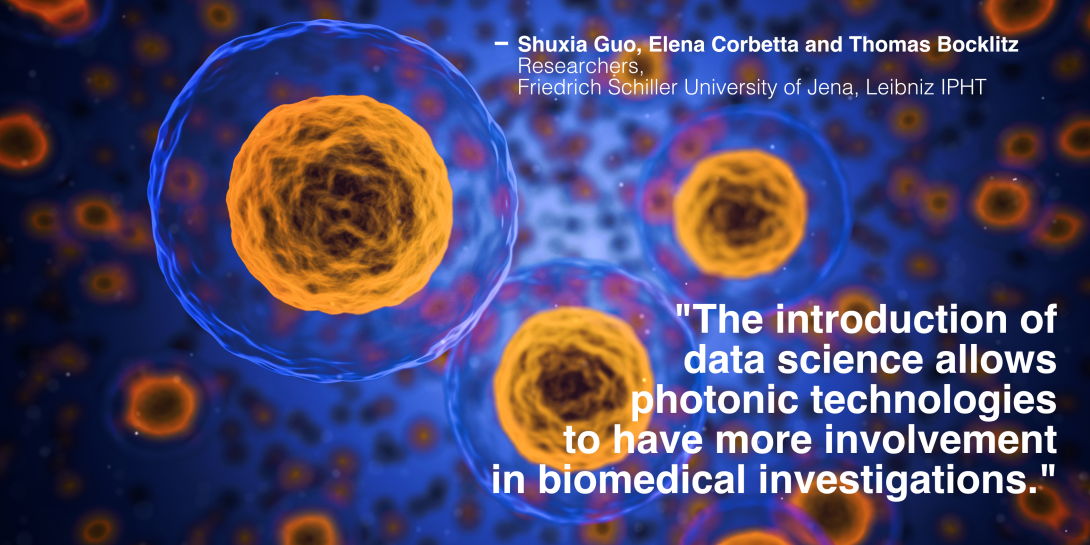
We top off the issue with two guest features. Thorlabs' OCT Project Manager Alexandra Eggemann describes a practical example that combines optical coherence tomography, ultrasound and robotics to push the boundaries of medical imaging. Elsewhere, researchers from the Friedrich Schiller University of Jena and Leibniz IPHT demonstrate how photonics and data science are teaming up to transform disease diagnosis. Faster, label-free detection methods could change how conditions are identified and monitored, bringing lab-grade precision closer to real-world healthcare.
Curious to see how it all comes together?
You’ll find these stories and more in the latest issue of Electro Optics. Whether you’re navigating funding shifts, building next-gen systems or simply trying to keep your finger on the pulse, there’s plenty here to keep your ideas light years ahead.
Register and subscribe here to receive the next issue of the magazine.